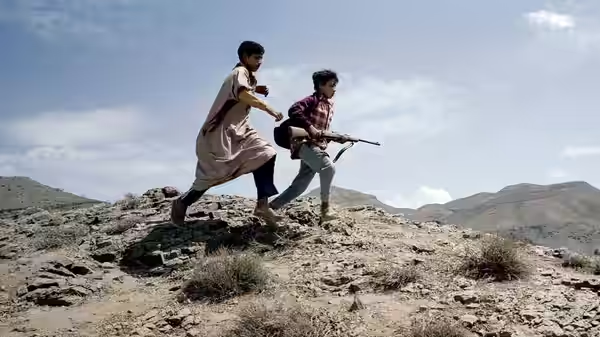
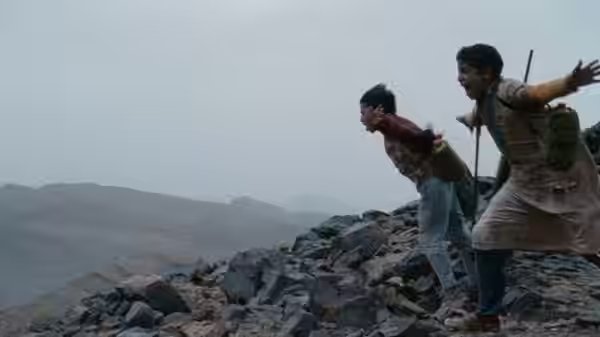
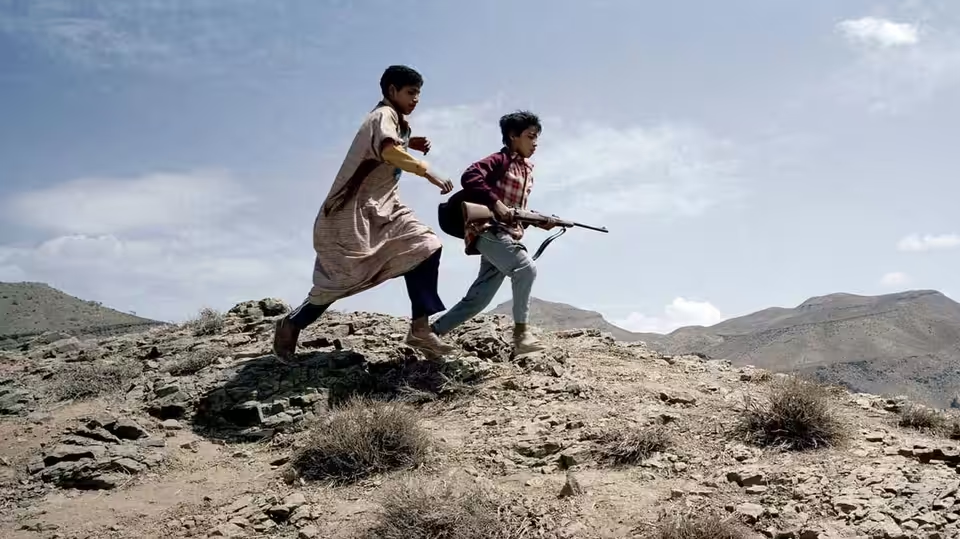
Two boys run across rocky hills carrying a rifle
Film review

Babel

2006 · Directed by Alejandro González Iñárritu · 2h 23m · MiC T

In a sentenceWe wanted someone to help these people, preferably before the screenplay found them again

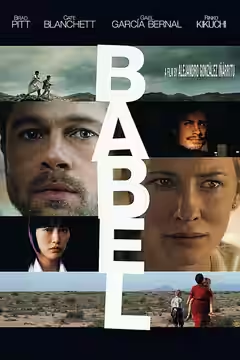
Babel follows several connected stories in which parents and children face the consequences of misunderstanding, fear and prejudice. Brad Pitt and Cate Blanchett play Richard and Susan Jones; Rinko Kikuchi plays Chieko, and Adriana Barraza plays Amelia. The ensemble also includes Said Tarchani as Ahmed, Boubker Ait El Caid as Yussef and Gael García Bernal as Santiago. As the film moves between countries, private troubles become entangled with differences of language and power. Alejandro G. Iñárritu directs from Guillermo Arriaga’s screenplay, following people whose ability to protect one another is tested by events they cannot fully understand.

Plays from YouTube when you press play; nothing loads from them until then.

Fi1m review

Babel is affecting when it stays with people and overbearing when it insists on connecting them. Alejandro G. Iñárritu draws strong performances from a crowded cast, but the mounting misfortune makes a serious drama feel needlessly managed.

Alejandro G. Iñárritu’s Babel asks us to care about people separated by language, nationality and circumstance, then gives us ample reason to worry about them. It is a worthwhile, sometimes moving drama whose screenplay keeps interrupting its own good work. Writer Guillermo Arriaga links the stories through misunderstandings and coincidences, with parents’ efforts to protect children providing a more convincing connection than some of the plotting. At 143 minutes, the film has time to make those relationships matter, but spends too much of it arranging further distress.

Cate Blanchett, as Susan Jones, and Adriana Barraza, as Amelia, give the film much of its emotional weight. We can believe in their distress even when we doubt the chain of events that has produced it. Brad Pitt’s Richard Jones and Rinko Kikuchi’s Chieko belong to an ensemble that generally makes the individual scenes more convincing than the whole. Iñárritu gets committed work from his cast, although the writing leaves too little room for these people to be anything other than troubled.

We were moved by the help offered in the Moroccan passages. Those moments allow kindness to take up space in a film that can seem determined to find another reason for everyone to be afraid. The criticism of American privilege is more persuasive here because Iñárritu makes room for the people doing the helping. We get a glimpse of how this drama might work with less insistence on everyone’s capacity to misunderstand.

Rodrigo Prieto’s cinematography gives the separate stories a physical immediacy that helps us accept the changes of setting. His images carry unease more effectively than some of the dialogue, and the passages without speech are among the film’s most involving. Brigitte Broch’s production design makes those settings feel inhabited, giving us something to notice beyond the central characters’ distress. Gustavo Santaolalla’s music is affecting, though it adds to a sadness that hardly needs reinforcing. With so much already being asked of our sympathy, the score can feel like one further instruction.

Editors Douglas Crise and Stephen Mirrione make the movement between stories tense, sometimes to an exhausting degree. Cutting away from one person’s trouble keeps us anxious about what we have left behind, even as another situation demands attention. The rhythm works well at first. Eventually, that repeated pressure becomes tiring, especially when the connections begin to look convenient. The second half gives Arriaga’s arrangements increasing prominence, and characters we had begun to care about get pulled towards the next required complication.

The familiar difficulty with this kind of ensemble drama is making each connection worth the interruption. Babel too often asks us to accept a coincidence because it serves a serious theme, then relies on its actors to make the resulting situation hurt. Their work, and the force of the quieter passages, make it worth considering if demanding, interwoven dramas are your preference. Go for the performances, and be prepared for a screenplay that has difficulty leaving them alone.

Critical consensus AI synthesised

53
Positive
3
Mixed
0
Negative
3

The reviews are sharply divided on Babel, though praise clusters around its visual force, emotional tension and performances. Admirers find the intersecting stories an affecting account of lives shaped by misunderstanding, prejudice and fear. They see the international scope as serving recognisable human concerns, especially family relationships and failures of communication. Screen Daily singles out Cate Blanchett and Adriana Barraza, while even some less convinced reviews acknowledge the impact of sequences that work without dialogue.

The disagreement is over whether those connections carry enough dramatic weight. Supporters find feeling and anger in the structure; detractors find contrivance, thin characters and suffering arranged to make an obvious point. Reservations also concern a second half that loses momentum as resolutions accumulate. Time Out regards the global connections as dramatically unproductive, while Film Comment challenges the performances themselves. The spread is wide: what moves one group strikes another as coercive and self-important.

Empire
2 January 2007 · Ian Freer
85*

Iñárritu’s ambitious, globe-spanning closure to his trilogy is terrific cinema with great performances, searing imagery and emotional tension that builds dread across intersecting stories. It explores big themes like globalisation and prejudice through humanist eyes without pat answers, though some may find the coincidences overwrought.

Read the full review →
The AV Club
27 October 2006 · B- · Noel Murray
70

The film starts promisingly but gradually deflates in its back half as resolutions pile on. It is gut-wrenching at times yet turns stilted, with the strongest element being its brilliantly cinematic sequences when no one is talking.

Read the full review →
Slant Magazine
9 October 2006 · Ed Gonzalez
40*

The director's one-note sensibility produces wafer-thin characters and jerry-rigged stories reliant on scare tactics. The film earns some credit for its critique of American privilege and the heart shown in the Moroccan support scenes, but overall sacrifices nuance for connect-the-dots plotting.

Read the full review →
Film Comment
1 July 2006 · festival review · Kent Jones
25*

The critic finds the film bloated with self-importance and immobilized by its sprawling global narrative. He singles out the inexplicable nasty behaviors and lack of genuine performances for complaint.

Read the full review →
Time Out
15 January 2007 · Dave Calhoun
25*

The review calls the film an energetic but thoroughly depressing and shallow exercise in flashy suffering, criticizing its contrived global connections and banal message as offering no real dramatic benefit beyond misery.

Read the full review →
Screen Daily
28 May 2006 · festival review

The critic sees the film maturing into a melancholy meditation on humanity divided by misunderstanding, prejudice and fear, with strong performances from Cate Blanchett and Adriana Barraza standing out amid the multi-stranded narrative.

Read the full review →

Straight answers AI written, from our review

Is Babel worth watching?
Babel is worth watching for people who like demanding, interwoven dramas and can forgive a screenplay that keeps arranging fresh misfortune, and we scored it 64. Cate Blanchett and Adriana Barraza carry much of the emotional weight, and the Moroccan passages are the most moving. Go for the performances rather than the plotting.
How long is Babel, and what is it rated?
Babel runs 2h 23m and is rated T by the MiC in Italy. It is a drama film.
Where can I watch Babel in Italy?
Babel is not on any streaming or rental service in Italy at the moment. It is available in 27 other countries; change your country at the top of the page to see where. Availability is checked daily.
How violent or frightening is Babel, and is it suitable for children?
Babel carries a UK 15 certificate, so it is not for children, and it is a sombre, distressing drama rather than a frightening one. Its stories place parents and children in danger and the film returns to fear and misfortune repeatedly, which makes it hard going. Teenagers who can take sustained sadness will manage; the squeamish need not worry about gore.
How does Babel compare to Amores Perros?
Babel is the more polished and far-reaching of the two, moving between countries, while Amores Perros stays in Mexico City with rougher, more difficult people and more graphic cruelty. We think the earlier film is the stronger one, because its contrivances feel earned by its performances. Babel suits those who want the wider canvas and can tolerate its managed distress.
What should I watch after Babel?
After Babel, try Amores perros (2000, Fi1m 85): Iñárritu follows connected lives with more room for unruly, difficult people. Then A Separation (2011, Fi1m 93): A family dispute widens through small decisions, with nobody conveniently innocent; and Secrets & Lies (1996, Fi1m 88): Mike Leigh gives family misunderstandings time to hurt without neglecting the humour.

Cast

Awards

Academy Awards, 2007

Nominated
Best Director
Nominated
Best Film Editing
Nominated
Best Picture
Nominated
Best Supporting Actress
Nominated
Best Writing, Original Screenplay
Won
Best Original Score

If you liked this, try…

  1. Amores perros (2000, Fi1m 85)Iñárritu follows connected lives with more room for unruly, difficult people.

  2. A Separation (2011, Fi1m 93)A family dispute widens through small decisions, with nobody conveniently innocent.

  3. The Edge of Heaven (2007) · not reviewed yetCrossing borders brings parents and children into painful, carefully drawn relationships.

  4. Secrets & Lies (1996, Fi1m 88)Mike Leigh gives family misunderstandings time to hurt without neglecting the humour.

  5. Yi Yi (2000, Fi1m 92)Edward Yang gives several generations room to be funny, frightened and uncertain.

Free account

Know what to watch tonight

Two lists that know where things are streaming, collections you can share, your own score beside ours, and Discover that remembers what you have seen.

  • Want to see, sorted by what is streaming now
  • Seen, with your score out of ten
  • No adverts, ever