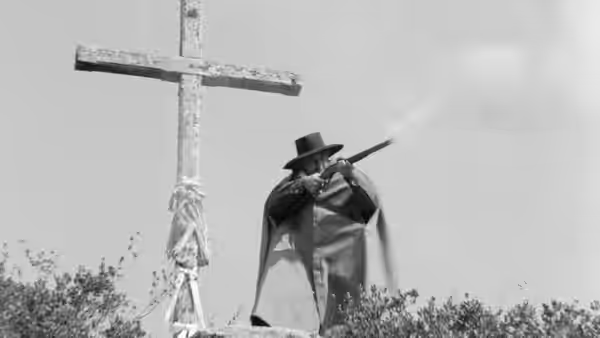
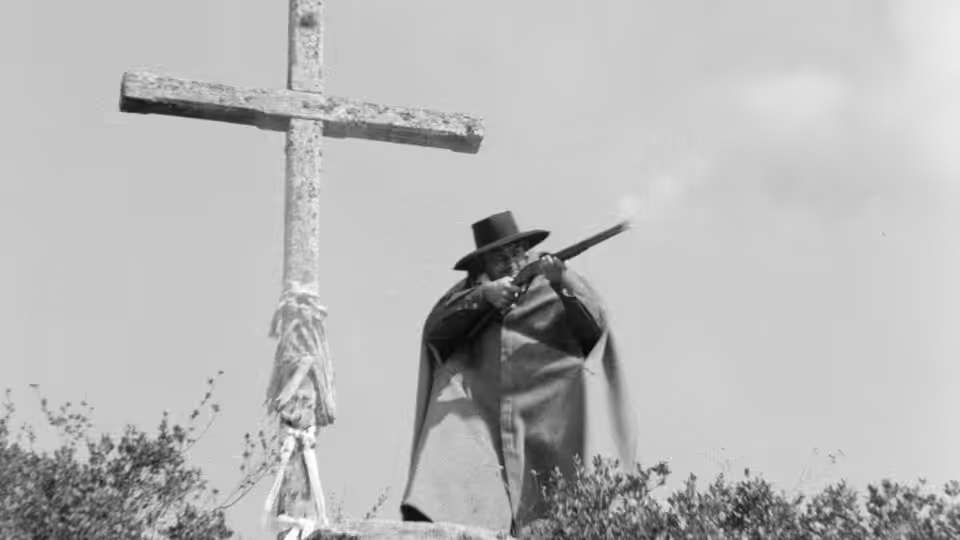
A gunman in a broad hat stands beside a wooden cross above the scrub
Film review

Black God, White Devil

1964 · Directed by Glauber Rocha · 2h 00m

In a sentenceA cowherd trades a swindling boss for a prophet and then a bandit, and gets shouted at by all three

In the sertão of Bahia, in Brazil’s dry north-east, Manoel (Geraldo del Rey) herds cattle for a Colonel (Antônio Pinto) and lives in a mud hut with his wife Rosa (Yoná Magalhães). When four cows die on a drive, the Colonel rules that the dead ones are Manoel’s share and strikes him for arguing. Manoel kills him with a machete. The Colonel’s men come for his family, and he and Rosa flee across the scrub to Monte Santo, where a black preacher, Sebastião (Lídio Silva), has gathered hundreds of the starving with a promise that the land will become sea and the sea land. Manoel kneels. Rosa does not. Below the hill, a priest (João Gama) and the landowners are talking to a hired gun, Antônio das Mortes (Maurício do Valle).

Plays from YouTube when you press play; nothing loads from them until then.

Fi1m review

Glauber Rocha’s film about a Bahian cowherd who kills his boss and follows first a prophet and then a bandit is fierce, strange and often thrilling to look at. It is also loud for two hours, and louder in the second.

Manoel (Geraldo del Rey) counts a landowner’s cattle across the dry scrub of Bahia, and when the Colonel (Antônio Pinto) rules that the four cows that died on the drive are Manoel’s share of the herd, then hits him for objecting, Manoel kills him with a machete. That is the first ten minutes. Glauber Rocha’s film, written with Paulo Gil Soares and Walter Lima Jr., sends Manoel and his wife Rosa (Yoná Magalhães) running, first to a preacher and then to a bandit, and does not let them or us sit down for two hours. It is fierce, odd and often thrilling to look at. It is also loud, and it gets louder.

Waldemar Lima shoots the sertão at noon, the sky burned to white and the thorn bushes gone black, so that people stand in a country with no shade and squint. There is a cow’s skull in the first shot and a dead cow in the second. When Manoel kills the Colonel the camera is handheld and swings round the two men so fast that for a moment we could not tell who had struck whom. Manoel does not decide to kill; it happens. Rafael Justo Valverde cuts against the grain throughout, repeating a movement, jumping ahead a beat, holding a wide shot after the people have left it.

The sound is stranger. Sérgio Ricardo’s ballads, sung on the soundtrack by a voice we never see, tell us what Manoel and Rosa are about to do before they do it, in the manner of the region’s street ballads, and then Villa-Lobos and Bach come in over the wide shots. The first time we saw the pilgrims climb Monte Santo, hundreds of them in white against that white sky, with Lima in among them and the chanting laid over the strings, we felt dizzy and a little frightened, and we could not tell whether the film wanted us to join in or to run.

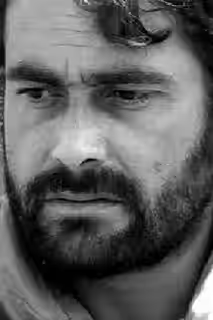
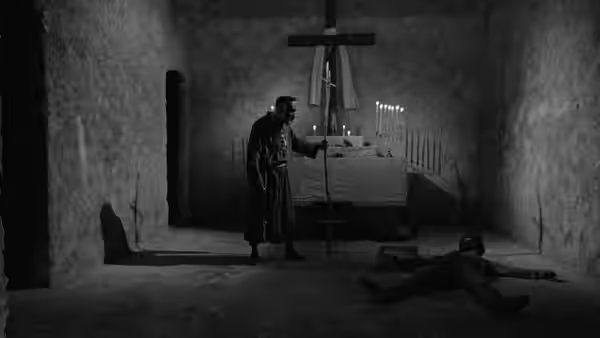
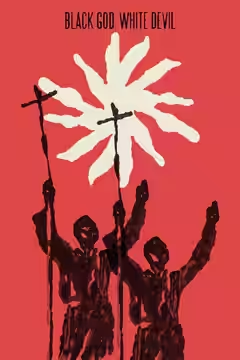
The preacher is Sebastião (Lídio Silva), the black God of the title, who stands on the hill in a black robe with a staff and tells the starving that the sertão will become sea and the sea sertão. Silva plays him without a flicker of doubt. Rosa is the only person who doubts him, and Magalhães gives the best performance in the film: she watches her husband kneel and kiss the hem of a stranger’s robe, and her face does the arguing the script leaves to the men. Below the hill a priest (João Gama) and the landowners hire Antônio das Mortes (Maurício do Valle), a killer of bandits and holy men, to deal with the sect. What he does we will leave to the film.

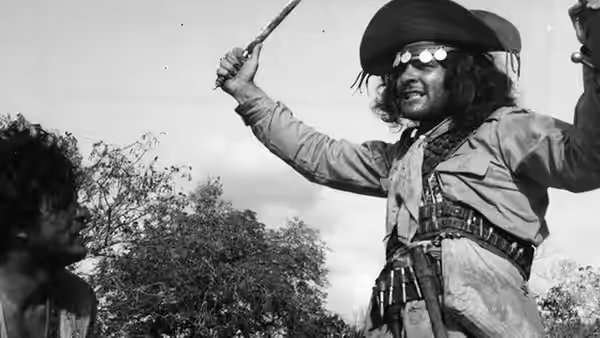
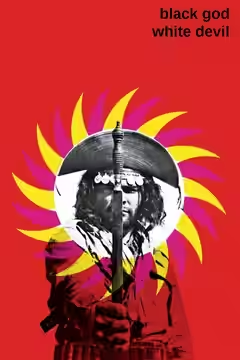
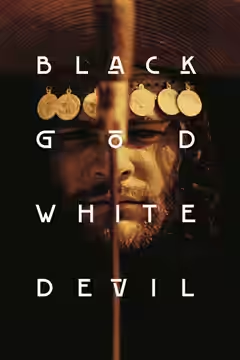
The second half belongs to Corisco (Othon Bastos), the white devil: blond, in leather, a hat sewn with stars and coins, calling himself the last of Lampião’s band. Soares’s costumes do a lot of work here; you can tell what a man believes from his hat. Bastos plays Corisco straight to the camera at a shout, in speeches about justice and the gun, and for twenty minutes it is exciting. Then it goes on, and we found ourselves checking how long was left. Manoel’s grievance against one man has become a set of positions declaimed at the audience, and Sonia dos Humildes’s Dadá, Corisco’s companion, is handed a knife and little else.

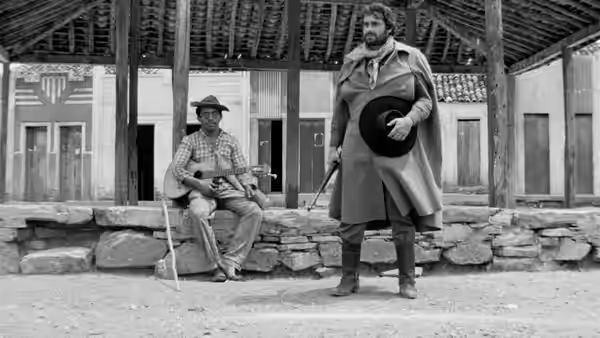
Rocha was arguing about Brazil, its landlords, its Church and its poor, and about what the poor are offered instead of land: a prophet or a bandit. The film has been claimed as the centre of Cinema Novo, and we can see why; nobody had put the north-east on screen with this much anger. It also takes the shape of a Western, a hired gun crossing flat country after a fugitive, and then refuses the Western’s rewards. Do Valle’s Antônio das Mortes, in a long coat and wide hat, is the only man in the film who speaks quietly, and he is the one Rocha brought back for a film of his own five years later.

Watch it in one sitting, in a dark room, with the sound up. In daylight, on a sofa, with tea, the second half becomes a lecture with singing, and the first half is too good to have that done to it.
Critical consensus AI synthesised

78
Positive
4
Mixed
2
Negative
0

Most critics regard Glauber Rocha’s film as a major work of political cinema, and the reviews lean clearly positive with none against. The praise clusters on method: long takes set against hard montage, raw and urgent images, and a soundtrack that several single out, with Villa-Lobos and Bach named alongside the incantatory folk material. Its place in Brazilian cinema nôvo comes up repeatedly, as does the sense that it lays down methods, themes and characters Rocha returns to later.

The reservations are mild and concern tone rather than craft. The New Yorker calls its vision bleak and notes a bitterness and sense of entrapment. Philip French in the Guardian is respectful rather than enthusiastic, treating it as a complex object to be unpicked. Slant Magazine, the warmest, is partly praising the 4K restoration and its extras. The spread is narrow; one older New York Times notice is unavailable in full, so its verdict cannot be read with confidence.

Slant Magazine
17 July 2024 · ★★★★★ · William Repass
100

The critic presents Rocha’s film as a forceful, critically minded work of revolutionary mythmaking. They praise the sharp, detailed 4K restoration and the release’s rich contextual extras.

Read the full review →
Time Out
· TR
85*

The available description presents Rocha’s film as a major work that introduced methods and themes developed later. It singles out those methods, themes and recurring characters as its notable contribution.

Read the full review →
Radio Times
★★★★ · David Parkinson
80

The review is positive about Rocha’s politically engaged portrait of peasant life. It praises the film’s use of long takes and montage, as well as its place in Brazilian cinema nôvo.

Read the full review →
The New Yorker
festival review
75*

The critic presents Rocha’s film as a forceful, politically charged work that ultimately offers a bleak vision. They praise its raw, urgent images and incantatory soundtrack, while noting its bitterness and sense of entrapment.

Read the full review →
The Guardian
9 November 2008 · Philip French
65*

French presents the film as a complex, politically charged work, tracing its influence from revolutionary cinema and myth. He singles out its blend of cinematic influences and the music of Villa-Lobos and Bach.

Read the full review →
The New York Times
25 September 1971
64*

The article text is unavailable, so the critic’s verdict cannot be established. No specific praise or complaint is visible.

Read the full review →

Straight answers AI written, from our review

Is Black God, White Devil worth watching?
Black God, White Devil is worth watching for anyone with a taste for fierce, strange political cinema, and we scored it 82. Glauber Rocha's story of a Bahian cowherd who kills his boss and follows a prophet and then a bandit is often thrilling to look at, though the second half turns into shouted speeches. Watch it in one sitting, in a dark room, with the sound up.
How long is Black God, White Devil, and what is it rated?
Black God, White Devil runs 2h 00m. It is an adventure and western film.
Where can I watch Black God, White Devil in Chile?
Black God, White Devil is not on any streaming or rental service in Chile at the moment. It is available in 2 other countries; change your country at the top of the page to see where. Availability is checked daily.
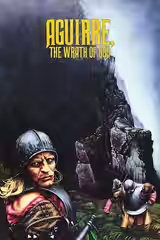
How does Black God, White Devil compare to Aguirre, the Wrath of God?
Black God, White Devil and Aguirre, the Wrath of God are both journeys across hostile country toward madness, one through Brazil's dry sertão, the other down a Peruvian river. Herzog's film is the more controlled and the easier to recommend outright, held together by Kinski's frightening performance; Rocha's is angrier and stranger, with a first half we admire more and a second half that lectures. Choose Herzog for dread, Rocha for fury.

Cast

Awards

International Submission to the Academy Awards, 1965

Nominated
International Submission to the Academy Awards

If you liked this, try…

  1. Barren Lives (1963) · not on Fi1m yetNelson Pereira dos Santos’s drought family in the same sertão, filmed quietly and without speeches.

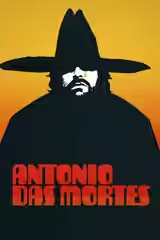
  2. Antonio das Mortes (1969) · not on Fi1m yetRocha’s hired killer gets his own film, in colour, and it is even louder.

  3. Aguirre, the Wrath of God (1972, Fi1m 91)Herzog’s conquistadors go mad on a river; the jungle answers the sertão.

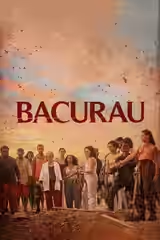
  4. Bacurau (2019) · not on Fi1m yetA north-eastern village fights back; Rocha’s landscape with a modern grudge.

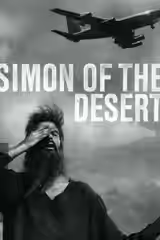
  5. Simon of the Desert (1965) · not on Fi1m yetBuñuel’s saint on a pillar; the same argument about faith in forty-five minutes, made funny.

Black God, White Devil (1964) review: fierce, strange and often too lo (Chile) | Fi1m