Hal Ashby’s film of Woody Guthrie’s Dust Bowl years is beautifully photographed by Haskell Wexler and quietly played by David Carradine. It is also half an hour too long and treats a scrappy, funny man with a reverence he would have laughed at.
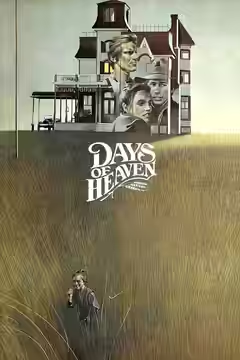
Hal Ashby made Bound for Glory between Shampoo (1975) and Coming Home (1978), and it is the most stately film of that run. Robert Getchell’s screenplay takes Woody Guthrie’s autobiography and stops before the fame: Texas in the dust years, the freight trains west, the fruit camps of California, a radio job in Los Angeles that comes with conditions. It is a handsome, serious, slow film, 148 minutes long, and about a hundred and twenty of them are worth your evening. The rest are the film admiring itself.
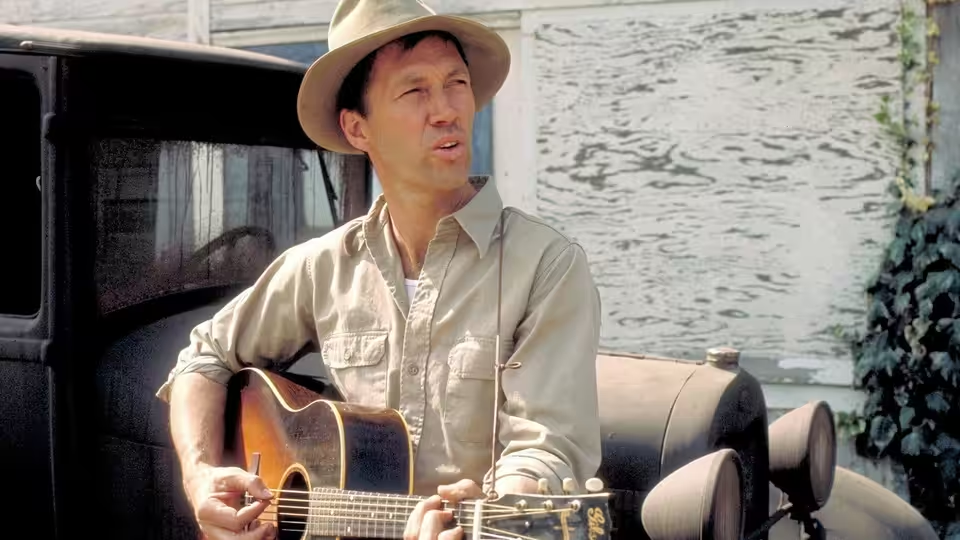
Start with what is on screen, because that is where the film earns its reputation. Haskell Wexler shoots the opening dust storm as a brown wall rolling over a flat town, and afterwards keeps the dust in the air, so that light comes through it in shafts and everyone looks lit through gauze. The migrant camps are shot at dusk, tents and cardboard and cars loaded to the roof, and in one long take the camera comes down from a crane and walks in among the pickers as though it had got off the truck with them. The film is generally credited as the first to use the Steadicam, and that shot is why. Michael D. Haller’s camps look built from what people could carry, and William Ware Theiss puts the whole cast in the same washed-out browns and blues, so that Guthrie is never better dressed than anyone he sings to.
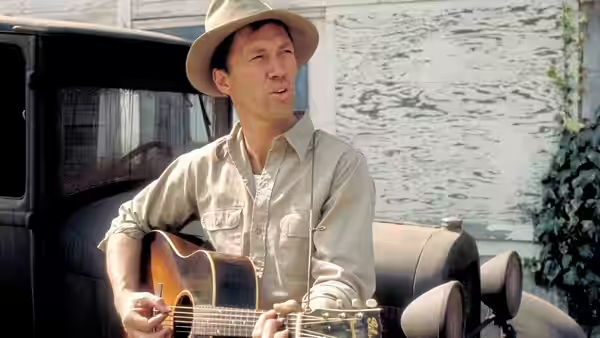
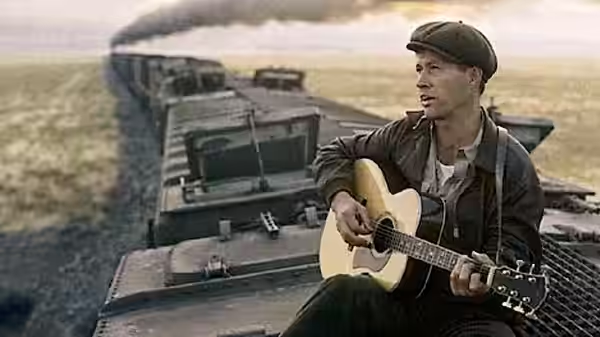
David Carradine underplays, and it is the right choice. He sings in his own voice, thin and flat and unbothered about it, and he plays Guthrie as a man who cannot be made to hurry. He is not asking to be liked. This Woody leaves a wife and two small daughters in Texas and is a long time writing, takes up with a rich woman, Pauline (Gail Strickland), because she is there, and drifts into politics because somebody handed him a guitar at the right moment. The film does not excuse any of it and Carradine does not plead, and that is the most honest thing in the film.
Ronny Cox is the warmth. His Ozark Bule sings for the union in the camps, gets Woody in front of a microphone, and is the only person in the film who seems to enjoy being alive. Melinda Dillon plays both Mary, the wife left behind, and Memphis Sue, the singer Woody is paired with on air, a piece of doubling the film sets up and never explains; you can make of it what you like. Randy Quaid, as the picker Luther Johnson, gets one scene of anger the film badly needs. John Lehne’s Locke, the station manager, wants the songs cheerful and the politics out, and says so pleasantly.
Now the trouble. Robert C. Jones and Pembroke J. Herring cut the film at a walking pace, which suits the trains and the camps and does not suit Los Angeles. The radio stretch makes one point, that money will pay Woody to sing so long as he sings about nothing, and then makes it again, and again. Somewhere in the third repetition we were bored, and then annoyed, because the film had already shown us it could do better. There is also the halo. The Guthrie of the records and the books was funny, rude and unreliable, and the film has smoothed most of that away in favour of a quiet man who is right about everything. We missed the rudeness.
And yet. When Woody finally sings to a camp at night, with faces coming up out of the dark one at a time, we were moved more than we expected to be, and it was not the song that did it but the listening: Wexler holds on the people, not the singer. The same is true of the roadblock at the state line, where police turn back families with everything they own on the running boards. Nobody makes a speech, and none is needed.
Against The Grapes of Wrath (1940) it is the gentler film, and the lesser one; Ford was angry and Ashby is mostly sad. Against Ashby’s own The Last Detail (1973) and Harold and Maude (1971) it is missing the looseness that let those films breathe. Watch it at home, on a grey afternoon, when its pace will feel like company rather than a test. It is worth that afternoon. Do not expect the Guthrie of the records; the film has given him a wash and a good coat, and he stands a little stiffly in them.