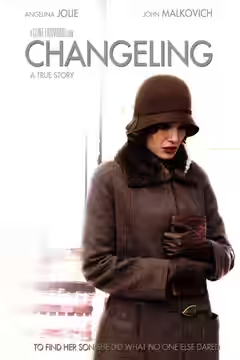
Clint Eastwood’s account of a mother handed the wrong child by the Los Angeles police is handsome, serious and properly angry, and Angelina Jolie is better in it than she is credited with. It is also half an hour too long, with three endings.
Clint Eastwood has taken a true case from Los Angeles in 1928 and made a film about being told by every man with a badge or a title that you do not know your own child. J. Michael Straczynski’s script follows Christine Collins from the afternoon her son goes missing through the months in which the police hand her a stranger and then set about proving she is mad for saying so. It is serious, well made and properly angry, and Angelina Jolie is better in it than its reputation allows. It is also half an hour too long, with three endings where one would have done.
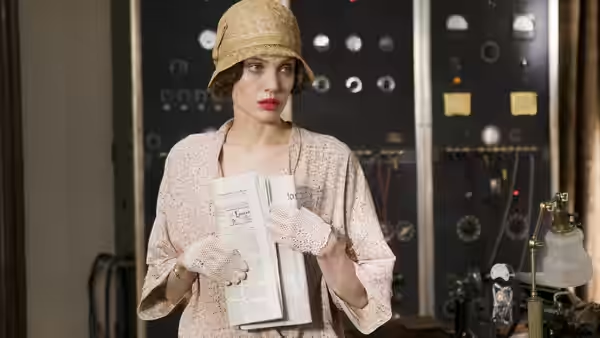
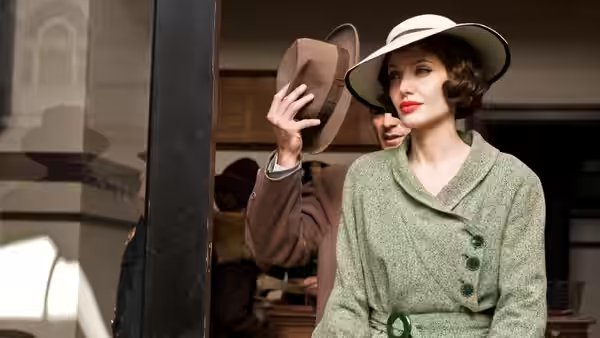
Tom Stern shoots the city with most of the colour drained out, so the browns and greys sit flat and skin looks like paper, and the one warm thing in most frames is Jolie’s lipstick. James J. Murakami rebuilds the telephone exchange where Collins works, long rows of women at switchboards under a high ceiling, and it is the best set in the film. Deborah Hopper’s cloche hats and narrow coats make Collins look smaller each time she walks into a room full of men. Eastwood wrote the music himself, a slow piano theme with strings, and it arrives on cue whenever somebody is about to cry. Jolie has usually done the work by then.
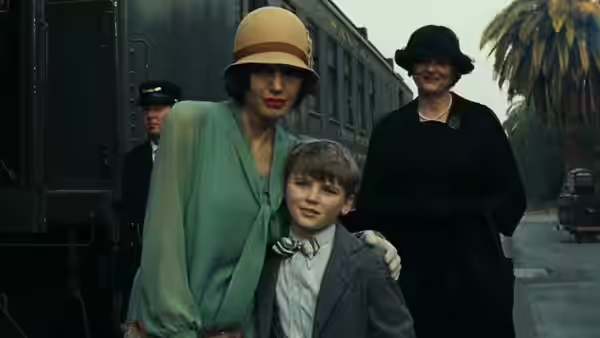
For the first hour she is quietly good. She plays Collins as a woman who has spent her working life being polite to men and stays polite while they lie to her, and the politeness is what hurts. The scene at the railway station, where Captain J.J. Jones (Jeffrey Donovan) brings a boy off a train in front of the photographers, made us angrier than we expected, and it was Donovan who did it. He never raises his voice. He tells her she is tired, that the boy has changed, that she should take him home on a trial basis, in the tone of a man helping a customer with a form. We wanted to hit him.
Later the script sends Collins into room after room to say a version of the same sentence, and by the third room it is the same scene again. John Malkovich, as the radio preacher Gustav Briegleb, is restrained by his own standards, a man who likes the sound of his own broadcasts and happens to be right. Colm Feore’s Chief Davis and Donovan’s Jones are smug rather than frightening, and the film’s idea of a corrupt police department never gets more complicated than hair oil and a moustache.
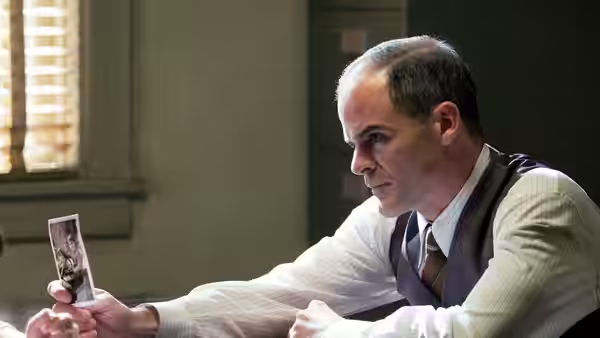
Michael Kelly, as Detective Lester Ybarra, gives the film’s best performance: a policeman doing a dull job properly, sent on an unrelated errand, who finds something that changes the film’s shape. We will not describe it. Amy Ryan has two scenes later on and makes both count. Jason Butler Harner appears in the second half, and his scenes are the ones we would not want to watch alone.
And it keeps changing. It is a mother’s story, then something close to a horror film, then a courtroom drama, then another courtroom drama, and Joel Cox and Gary D. Roach cut each competently and let none of them go. There is a natural ending at about the two-hour mark, and we felt the film reach it; then it carried on, twice. Each addition is there because the real case had one. The film did not need them.
Mystic River (2003) was about grief and a crime and told them as one story; Million Dollar Baby (2004) knew when to stop. Changeling has two stories and cuts between them, and the one with the mother in it is the one we cared about. Eastwood’s best quality, the patience to sit in a room while nothing seems to happen, is here for the first hour and gone by the last.
Most critics have been a little kinder, and we see why: the anger is real and the craft is sound. Watch it at home, where the length is easier to forgive. It runs 142 minutes and carries a 15, which the second half earns.