Film review

Crash

2005 · Directed by Paul Haggis · 1h 52m · MPA R

In a sentenceLos Angeles has millions of people and the script keeps introducing the same dozen to each other

Drama

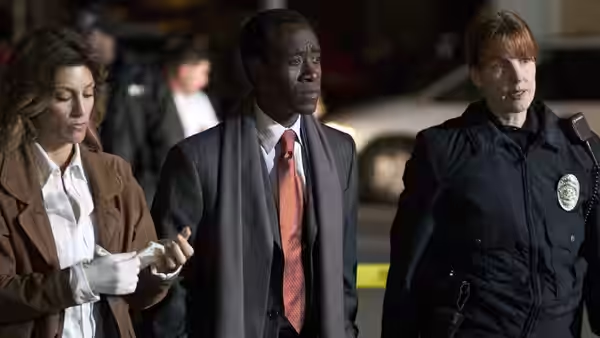
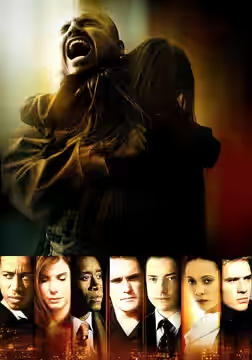
Los Angeles, over a day and a half. Det. Graham Waters (Don Cheadle) and his partner Ria (Jennifer Esposito) are rear-ended on the way to a crime scene, where a body lies in the brush beside the road. The film goes back a day. Anthony (Ludacris) and Peter (Larenz Tate) carjack the district attorney Rick Cabot (Brendan Fraser) and his wife Jean (Sandra Bullock); at home, Jean has the locks changed and does not trust the locksmith, Daniel Ruiz (Michael Peña). Officer John Ryan (Matt Dillon) pulls over the television director Cameron Thayer (Terrence Howard) and his wife Christine (Thandiwe Newton) and humiliates them while his partner Tom Hansen (Ryan Phillippe) looks on. Farhad (Shaun Toub), a Persian shopkeeper, buys a gun. Their paths will cross again.

Plays from YouTube when you press play; nothing loads from them until then.

Fi1m review

Paul Haggis’s first film as director has a fine cast and one traffic stop we will not forget. It also has a script that keeps steering everyone in Los Angeles into everyone else so that each collision can teach a lesson.

Paul Haggis wrote Million Dollar Baby (2004) and then, for his first film as director, wrote himself a city. Crash takes a dozen people in Los Angeles over a day and a half and runs them into each other: a detective, a district attorney and his wife, two patrolmen, two carjackers, a locksmith, a television director and his wife, a shopkeeper with a new gun. Everyone is a bigot to somebody and wronged by somebody else. The cast is first-rate, and the script keeps stopping them to explain what they have just shown us.

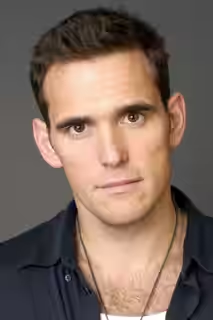
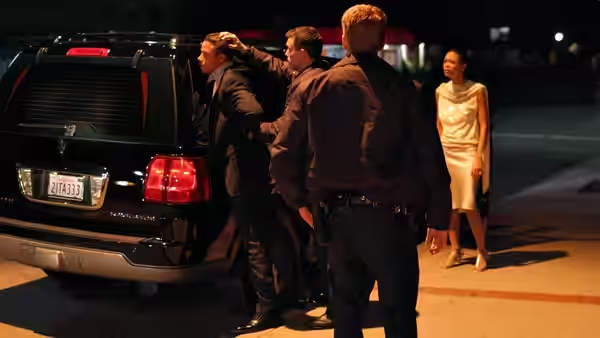
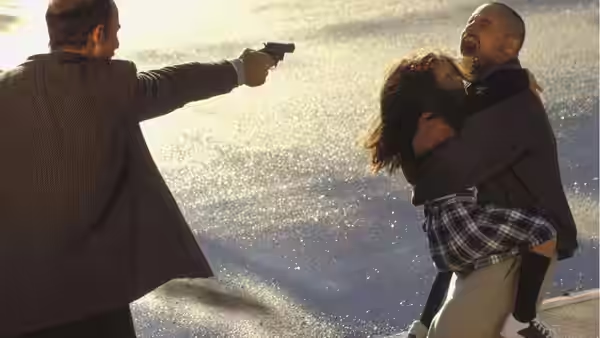
Matt Dillon plays Officer John Ryan, whose father is ill and whose insurer will not help, and who takes it out on a black couple in an expensive car. The stop is the film’s centre and we watched it in real distress. Dillon does not raise his voice. He searches Christine Thayer (Thandiwe Newton) while her husband Cameron (Terrence Howard) stands a yard away with a torch in his face, and Howard plays the decision to say nothing in the jaw and nowhere else. Newton, humiliated in front of the man she wants to protect her and then furious at him for being protected, is remarkable. Ryan Phillippe’s rookie, Tom Hansen, watches and does nothing, which the film knows is the worst thing in the scene.

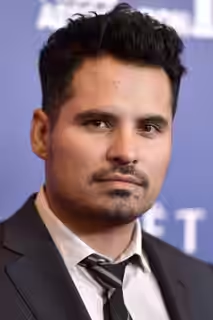
The acting stays that good. Michael Peña’s locksmith, Daniel Ruiz, has a scene with his small daughter and a story about an invisible cloak, and plays it plainly. Don Cheadle gives Det. Graham Waters a tiredness that reads as intelligence. Sandra Bullock’s Jean Cabot, rude to everyone after the carjacking, later admits she is angry all the time and cannot say why, the most honest writing Haggis manages. Ludacris, as Anthony, gets the jokes, lecturing Peter (Larenz Tate) on why two black men should be the frightened ones on a white street, and Shaun Toub plays Farhad as a man who has been robbed before and expects it again.

J. Michael Muro shoots the city hand-held and close, mostly at night, street-lamp orange against headlight blue, and when he pulls back Los Angeles looks emptied, as though these dozen people were the only ones in it. Laurence Bennett gives the Cabots a large pale house full of things nobody touches and Daniel a small one where everything has been. Linda Bass puts Cameron in suits that cost more than Ryan’s car. Mark Isham’s score, a low electronic wash with wordless voices, is on nearly all the time, pushing every scene towards sorrow before the actors have got there. Hughes Winborne cuts between the strands so cleanly that we never lost our place.

The trouble is the plot, and the plot is the coincidences. Haggis and Robert Moresco have written a city in which the locksmith who fixes Jean’s locks is accused of cheating by the shopkeeper across town whose door he fixes next, and the same twelve people keep finding each other within thirty-six hours. By the second half we were counting, and once we were counting we had stopped believing. Every character has a prejudice and every prejudice gets a reversal, until the film feels like a diagram of a city rather than a city. And the people talk in paragraphs, telling strangers what they think about race in full sentences and at volume, so the script never has to dramatise its point.

Robert Altman’s Short Cuts (1993) and Paul Thomas Anderson’s Magnolia (1999) also collided strangers across Los Angeles. Altman let the collisions mean what they meant and Anderson admitted his were absurd. Haggis wants each of his to prove the same thing: that everyone is worse than they look and then better. Most critics liked it more than we do, praising the cast and the nerve and forgiving the contrivance. We agree about the cast.

It is worth an evening for Dillon, Newton and Howard on the roadside and for Peña with his daughter, and there is plenty to argue about afterwards, most of it about whether the film argued fairly. It runs 112 minutes and carries a 15 certificate, which the traffic stop earns on its own.
Critical consensus AI synthesised

67
Positive
10
Mixed
2
Negative
3

Most critics like it, and the praise lands in the same two places: the ensemble cast and Haggis’s script. The reviews repeatedly single out the actors for making schematic characters feel lived-in, and several credit the writing for putting blunt talk about race and class in Los Angeles at the centre of a mainstream drama. Screen Daily also picks out Mark Isham’s score. The New Yorker rates it among the strongest American films of its moment.

The reservations are as consistent as the praise. Even admirers concede the coincidences are convenient, the melodrama heavy and the redemption tidy. The spread is wide, from raves to outright dismissals. The Los Angeles Times finds the script airless and the message noxious, with only the actors rising above it; Time Out says a promising start collapses into melodrama and a stale redemption story. The Ringer, looking back years later, calls it influential but built on contrivance.

The New Yorker
25 April 2005 · David Denby
90*

The movie packs every conceivable ill-tempered remark about race and intolerance in Los Angeles into a hyper-articulate, intelligent story of colliding lives that is brazenly alive and the strongest American film since Mystic River. It produces exhilaration through its frankness and emotional release.

Read the full review →
Slant Magazine
4 May 2005 · ★★★½/4 · Nick Schager
88

The critic finds the film a blistering and incisive portrait of urban alienation and intolerance that confronts prejudice with unvarnished nastiness. While it occasionally goes overboard with irony and tidy catharsis, the caustic script and superb cast ground the story in believable emotional terrain, highlighted by moments of transcendent grace.

Read the full review →
Radio Times
★★★★ · Karen Krizanovich
80

Praises the finely tuned ensemble drama about interconnected lives in Los Angeles brought together by collisions and encounters amid racial tensions. Highlights the fully developed characters and events that surprise and shock even seasoned viewers.

Read the full review →
Screen Daily
30 September 2004 · festival review
80*

Calls it a superb addition to multi-storylined ensemble pieces about dysfunctional life in southern California, with a nuanced script and riveting acting that reveals complex, contradictory characters beyond initial stereotypes. Singles out intensely acted powerful moments and Mark Isham's score.

Read the full review →
Empire
12 August 2005 · Simon Braund
70*

Haggis's ambitious directorial debut dissects race relations in LA through intersecting lives over a short period. It is a haunting, perceptive and uncompromising examination saved by an outstanding cast, even when stretching credibility or ladling on pathos.

Read the full review →
Evening Standard
10 April 2012 · Derek Malcolm
70*

Haggis's debut proposes that almost everyone has racial hang-ups and connects disparate characters in the multicultural mix of LA. Despite heavy-handed moments, obvious melodrama and convenient coincidences, it is worth watching for its humour, details and strong performances.

Read the full review →

Cast

Awards

Academy Awards, 2006

Nominated
Best Director
Nominated
Best Supporting Actor
Won
Best Film Editing
Won
Best Picture
Won
Best Writing, Original Screenplay

European Film Award for Best Non-European Film, 2005

Nominated
European Film Award for Best Non-European Film

Grand prix du Festival de Deauville, 2005

Won
Grand prix du Festival de Deauville

If you liked this, try…