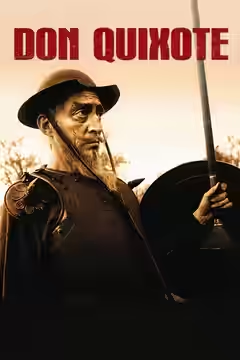
Orson Welles filmed his Don Quixote across decades and never finished it. Jesús Franco’s 1992 assembly of the footage is muddy, badly dubbed and often a slog, and twice, among sheep and beneath windmills, it comes close to greatness.
Orson Welles spent a large part of his working life filming Cervantes and died in 1985 without finishing it. What appeared in 1992 is an assembly of his footage put together by Jesús Franco, who is one of nine credited editors, alongside Welles himself. It runs 116 minutes. It is not Welles’s film, because Welles’s film does not exist; it is a guess at one, made by people who admired him and did not have the material to be right. That is the verdict. The rest is detail, and some of the detail is remarkable.
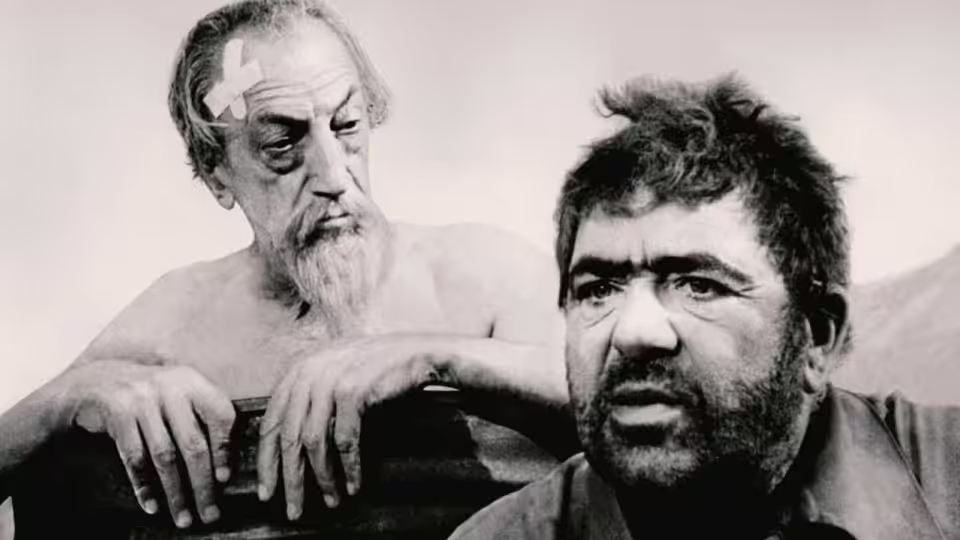
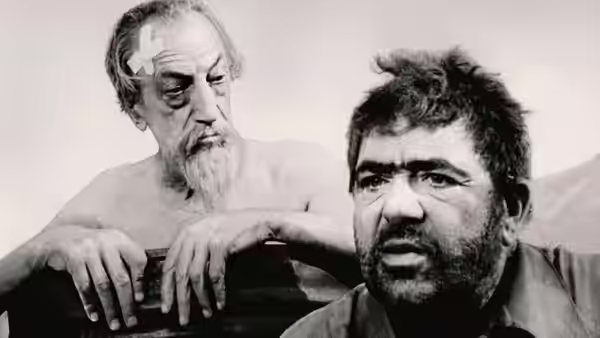
The two men at the centre are the reason to sit through it. Francisco Reiguera plays Don Quijote as a face first and a body second: hollow cheeks, a beard like frayed rope, eyes that have already decided what they are looking at before they look. Akim Tamiroff’s Sancho is round, damp and put-upon, and he does more with a shrug at a passing lorry than most actors manage with a speech. They ride through a Spain of tarmac and scooters, and the joke of the anachronism is never pushed. The knight simply does not see the century he is in.
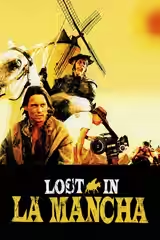
Two sequences show what Welles was after. In one, the Don charges a flock of sheep, and the camera is down among the animals, low and fast, dust everywhere, so that for a few seconds we believe in the army too. In the other he rides at a windmill, and Welles cuts between the blades turning and the old man’s face until the blades start to look like they mean it. We were moved, more than we expected, by Reiguera in that second sequence, because he plays the defeat as if it were a victory and the camera agrees with him. Those minutes are the film’s argument for existing.
The rest is what it looks like when a film is built from fragments. Seven cinematographers are credited, among them Jack Draper and Edmond Richard, and the footage carries the marks of different cameras, different stock and different light. Some shots are crisp black and white with a hard Spanish sky. Others are grey soup, the contrast gone, faces bleeding into walls. The joins are not hidden. A scene will change grain between one cut and the next, and once you have noticed it you cannot stop.
Then there is the sound. Reiguera and Tamiroff are dubbed by Pepe Mediavilla and Juan Carlos Ordóñez, and the voices are laid over mouths that were filmed years earlier and often do not match them. Constantino Romero’s narration arrives whenever the picture cannot explain itself, which is frequently, and it explains in the tone of a schools broadcast. Daniel White’s music fills the silences with guitar and strings and does not seem to have been written for any particular scene. Welles’s own appearances, behind a camera or talking about Spain, are meant to hold it together and instead announce how much is missing.
We were bored for long stretches, and then annoyed at being bored, because the boredom is not Welles’s. It belongs to the assembly, which repeats shots, lingers on nothing, and treats every surviving foot of film as though it must be used. Franco had a hopeless job and did it without ruthlessness. A shorter, harder cut, with fewer voices and more silence, might have let the two great sequences breathe. This one buries them.
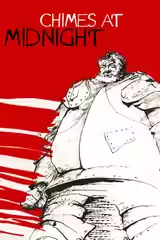
Against Welles’s own finished work the comparison is unfair and unavoidable. Chimes at Midnight (1965) is another old fool in a cold country, and it is one of the most complete things he made. F for Fake (1973) proved he could build a film out of scraps and make the scraps the point. The reviews of this one are split three ways, from warm to dismissive, and the mean sits close to ours; we come down a shade below it because the trying passages outnumber the good ones by some distance.
Watch it as a ruin, not as a film. Go in knowing that the picture will be poor, the voices will be wrong and the story will stall, and wait for the sheep and the windmill. For anyone with an interest in Welles they are worth the evening. For anyone else they are not, and the Don would have understood that.