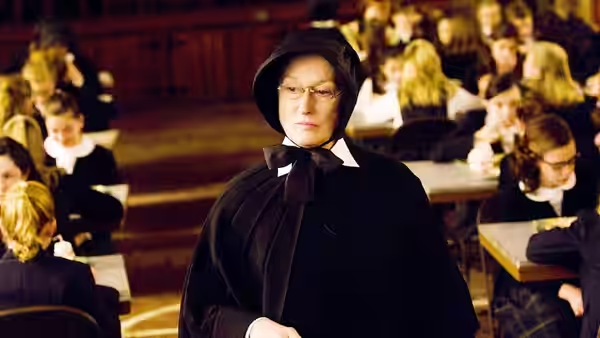
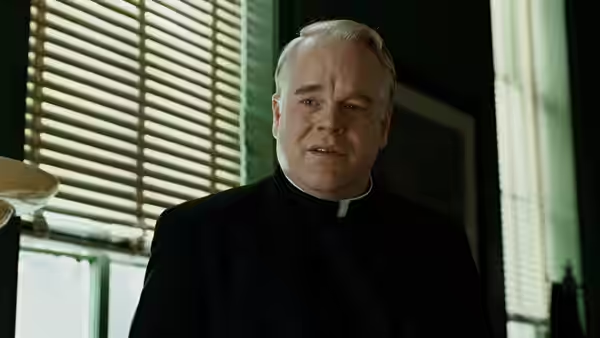
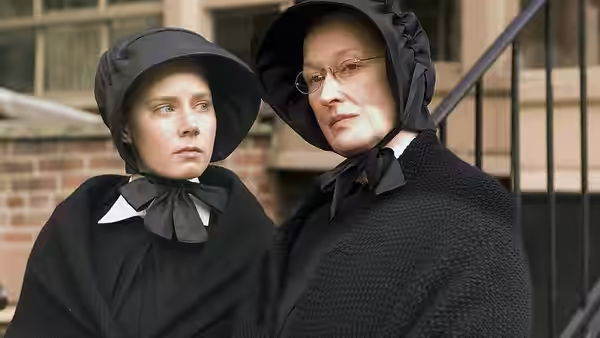
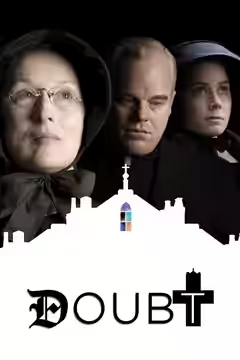
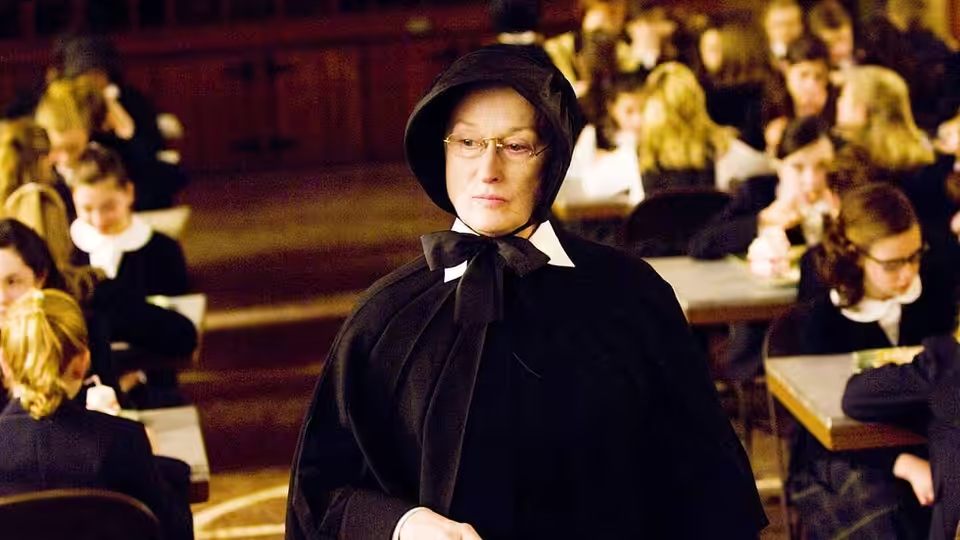
Sister Aloysius (Meryl Streep) watches students studying in the school classroom
Film review

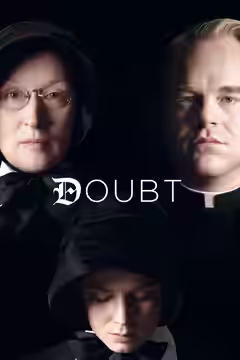
Doubt

2008 · Directed by John Patrick Shanley · 1h 44m · MPA PG-13

In a sentenceTwo nuns, one priest, no evidence, and a wind that keeps slamming the windows for emphasis

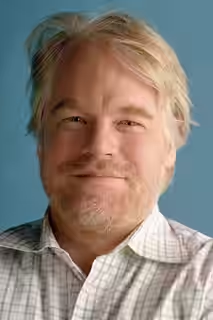
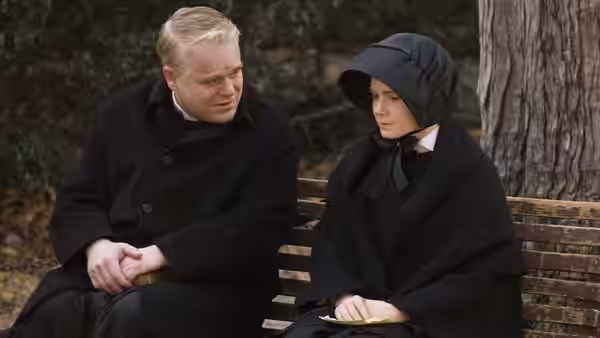
A Catholic parish school in winter. Father Brendan Flynn (Philip Seymour Hoffman) preaches a sermon on doubt, and the principal, Sister Aloysius Beauvier (Meryl Streep), wants to know what prompted it. Aloysius runs the school on fear: she bans ballpoint pens, patrols the pews during Mass and regards Frosty the Snowman as heretical. Flynn coaches basketball, tells jokes at dinner and wants the church to feel like a family. Sister James (Amy Adams), a young teacher, is told to keep her eyes open. She learns that Flynn has called Donald Miller (Joseph Foster), the school’s first black pupil, to the rectory alone, and the boy comes back to class upset, with alcohol on his breath. She reports it. Aloysius has no proof, and she has already decided.

Plays from YouTube when you press play; nothing loads from them until then.

Fi1m review

John Patrick Shanley films his own play with four actors who need no help and a camera that keeps offering it. Streep, Hoffman and Adams argue magnificently, Viola Davis walks off with one scene, and the tilted angles and howling wind add nothing.

John Patrick Shanley has filmed his own play himself, keeping the four characters, the single accusation and the total absence of evidence. A priest may or may not have done something to a boy. A nun is sure he has. Nobody saw anything. For 104 minutes the film does what the play did, which is decline to tell us, and it does so with four performances as good as any you will see in one room. It is let down by its director, who does not trust them, and it is still worth your evening.

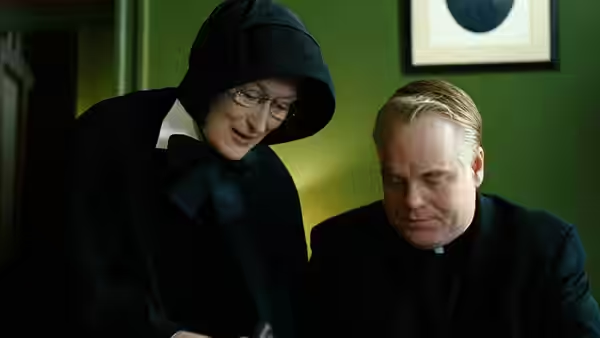
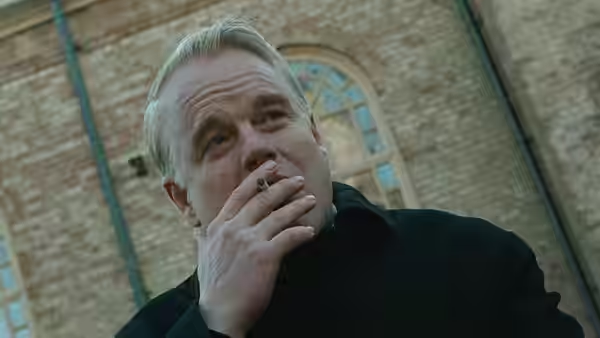
Meryl Streep plays Sister Aloysius Beauvier, principal of a parish school, with a squint and a stride, and she is funnier than we expected. Aloysius bans ballpoint pens, treats a boy’s nosebleed as probable fraud and has views on Frosty the Snowman. Philip Seymour Hoffman’s Father Brendan Flynn is her opposite: fleshy, friendly, reasonable, a man who wants the church to feel like a family and keeps his fingernails a little long. When the two are finally alone in her office with the desk between them, the film is as tense as anything with guns in it. Streep lets Aloysius enjoy the fight. Hoffman lets Flynn be wounded by it, and never tells us whether the wound is innocence or something else.

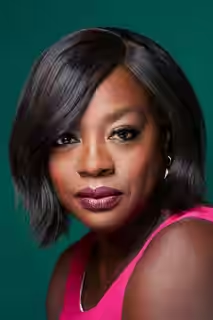
Amy Adams’s Sister James is the one we are meant to stand beside, a young teacher who wants to believe people, and Adams plays her without the simper the part invites. Then there is Viola Davis, who has one scene and perhaps ten minutes as Mrs. Miller, Donald’s mother. She walks down a street beside Aloysius and says things about her son and her husband that we did not expect a mother to say, in a flat, practical voice, with a running nose she does not wipe. It winded us. The film has spent an hour on whether Flynn is guilty, and Davis arrives and makes that question sound like a luxury only a nun could afford.

Roger Deakins shoots the parish in winter, brown brick, bare trees and grey light, and keeps the camera low in the corridors so the nuns’ black bonnets fill the frame. David Gropman gives Aloysius an office that is mostly dark wood and a window, and a convent dining room where the Sisters eat in silence; Dylan Tichenor cuts from that to the priests’ table, red meat, cigarettes and laughter, and the point about who holds the power is made without a word. Ann Roth’s bonnets leave Streep only her eyes and mouth to act with, and she needs no more. Howard Shore’s score stays mostly out of the way, a few low strings under the walks between buildings, and the film is better for it.

What is not better is Shanley’s camera. Every time certainty wavers he tilts it. When Aloysius has a worry, the wind gets up, leaves blow across the yard and a window slams. A light bulb blows in her office at a moment we are plainly meant to find significant. Shanley wrote the lines, so he knows what they can carry; here he does not seem to believe it. The actors have already told us the ground is moving, and the camera leaning over to confirm it is a prompter reading the line twice. These flourishes do not wreck the film. They make it look nervous, which is the wrong look for a film about certainty.

Around the hour mark we noticed we had stopped weighing Flynn’s guilt and started weighing Aloysius’s, which is the play’s trick, and the film keeps it intact. Shanley has written the two sides so that whichever way you lean, the other gets the better line in the next scene. Flynn’s sermons, delivered from a wooden pulpit, are the best writing in it: a story about gossip, a pillow and a knife, told so well that we wanted the man telling it to be innocent, and then distrusted the wanting.

It runs 104 minutes and carries a 15. Watch it with someone, because you will not agree afterwards about what happened, and the film has been built so that you cannot. Leaving annoyed with the person beside you is, for once, the intended effect.

Critical consensus AI synthesised

64
Positive
5
Mixed
6
Negative
2

Most critics find Doubt compelling and provocative, and nearly all of them put the praise on the acting. Meryl Streep’s Sister Aloysius is the reason several reviewers say the film is worth seeing at all, with Philip Seymour Hoffman and Amy Adams drawing steady approval alongside her. The name that recurs most, though, is Viola Davis, whose single scene opposite Streep is called the film’s high point by more than one critic and its standout by others.

The reservations cluster on the adaptation. Shanley’s film is described as stagebound, clunky and inert, telling where it might show, and some think his visual flourishes get in the way of a drama that could stand alone. Slant Magazine judges it weaker than the play. The spread is wide: a cluster of four-star notices sits against two outright dismissals, with IndieWire calling it handsome but forgettable and the Los Angeles Times faulting the direction for overplaying its hand. Most settle in the middle, admiring the performances and doubting the film around them.

The Guardian
8 February 2009 · Philip French
80*

French finds the film provocative and compelling, praising its outstanding performances. He especially singles out Viola Davis for making an indelible impression in her brief scene.

Read the full review →
Time Out
3 February 2009 · ★★★★ · Dave Calhoun
80

The standfirst suggests a serious but thought-provoking film about judgment, self-belief and certainty. It singles out the ideas prompted by the characters’ convictions, while the full review text is unavailable.

Read the full review →
Total Film
3 February 2009 · ★★★★ · Neil Smith
80

The review finds the film riveting, though its stagebound approach may not suit viewers who prefer films to show rather than tell. It praises the performances, singling out Viola Davis as the standout in her brief scene.

Read the full review →
Slant Magazine
6 April 2009 · ★★★½ · Dan Callahan
70

Callahan finds the film less effective than the play, though he considers it worth seeing for Meryl Streep’s performance. He especially praises her subtle, unexpected acting choices, including her reaction when recalling her late husband.

Read the full review →
Screen Daily
7 November 2008 · Brent Simon
64*

The accessible page identifies this as a review, but its critical assessment is not visible. No specific praise or complaint can be verified from the available text.

Read the full review →
The New York Times
31 December 2008
64*

The page content is inaccessible, so the critic’s verdict and specific praise or complaint cannot be verified. The URL identifies it as a film review, but provides no basis for summarizing its opinion.

Read the full review →

Straight answers AI written, from our review

Is Doubt worth watching?
Doubt is worth watching for anyone who wants four actors arguing in rooms, and we scored it 71. Streep, Hoffman and Adams are as good as any you will see together, and Viola Davis has one scene that winded us. The letdown is John Patrick Shanley's direction, which tilts the camera and slams windows the performances never needed.
How long is Doubt, and what is it rated?
Doubt runs 1h 44m and is rated PG-13 by the MPA in the US. It is a drama film.
Where can I watch Doubt in the US?
Doubt is available to rent from Apple TV and Amazon Prime Video from $4.99. Availability is checked daily; the links above go straight to each service.
How violent or frightening is Doubt, and is it suitable for children?
Doubt carries a UK 15 and contains no violence on screen; the subject is an accusation that a priest has abused a boy, and nothing is shown. The film is tense rather than frightening, built on arguments in offices and a sermon or two. It is a talking drama for adults and older teenagers, not for children, and the squeamish have nothing to fear.
How does Doubt compare to The Hunt?
Doubt and The Hunt ask the same question, whether a man accused of abusing a child did it, and answer it differently. Shanley's film declines to tell us and keeps both sides alive to the end; Vinterberg's is plainly about a false accusation, and is the more frightening and absorbing of the two. Choose Doubt for the acting and the argument, The Hunt for Mikkelsen and dread.
What should I watch after Doubt?
After Doubt, try The Hunt (2012, Fi1m 82): Mads Mikkelsen as a nursery teacher accused on a child’s word; Denmark, same question, colder. Then Spotlight (2015, Fi1m 85): The same church examined with documents and shoe leather instead of a nun’s intuition; and Calvary (2014, Fi1m 81): Brendan Gleeson’s good Irish priest is told in confession he has a week to live.

Cast

Awards

Academy Awards, 2009

Nominated
Best Actress
Nominated
Best Supporting Actor
Nominated
Best Supporting Actress
Nominated
Best Writing, Adapted Screenplay

If you liked this, try…

  1. The Children's Hour (1961) · not on Fi1m yetA pupil’s lie about two teachers; Hepburn and MacLaine watch it do its work.

  2. The Hunt (2012, Fi1m 82)Mads Mikkelsen as a nursery teacher accused on a child’s word; Denmark, same question, colder.

  3. Spotlight (2015, Fi1m 85)The same church examined with documents and shoe leather instead of a nun’s intuition.

  4. Calvary (2014, Fi1m 81)Brendan Gleeson’s good Irish priest is told in confession he has a week to live.

  5. 12 Angry Men (1957, Fi1m 91)One room, one verdict, and a slow lesson in what reasonable doubt costs.