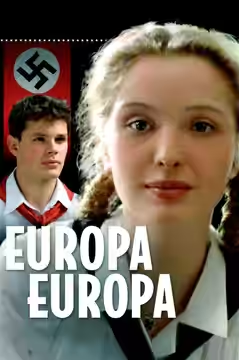
Agnieszka Holland tells the true story of a Jewish teenager who survived the war inside the Hitler Youth, and tells it as a dry comedy of survival. The filmmaking is rougher than the story deserves; the story is astonishing.
Agnieszka Holland’s film tells a true story so unlikely that a novelist would have been asked to tone it down. Salomon Perel, a German-Jewish boy from Peine, spends the war first in a Soviet orphanage as a model Komsomol member and then, having talked his way past a German patrol, as an interpreter for the Wehrmacht and a pupil at a Hitler Youth school. Holland, who wrote the screenplay with Paul Hengge, plays most of it as comedy: a boy swept along by history, saying yes to whichever uniform is held out to him. That is the right decision, and the film is better than its rough edges. It is worth your evening, provided you know the story is doing much of the work.
The first ten minutes are the best. Sally (Marco Hofschneider) is in the bath on his thirteenth birthday when the windows come in; he runs naked into the street, hides in a barrel, and comes home to find his sister dead. Holland shoots it fast and without music, and we were shaken, more by the boy’s bare feet on the cobbles than by anything shown directly. Then the family moves to Łódź, the Germans arrive, and Sally and his brother Isaak (René Hofschneider) are sent east and lose each other at a river. From there Sally is on his own.
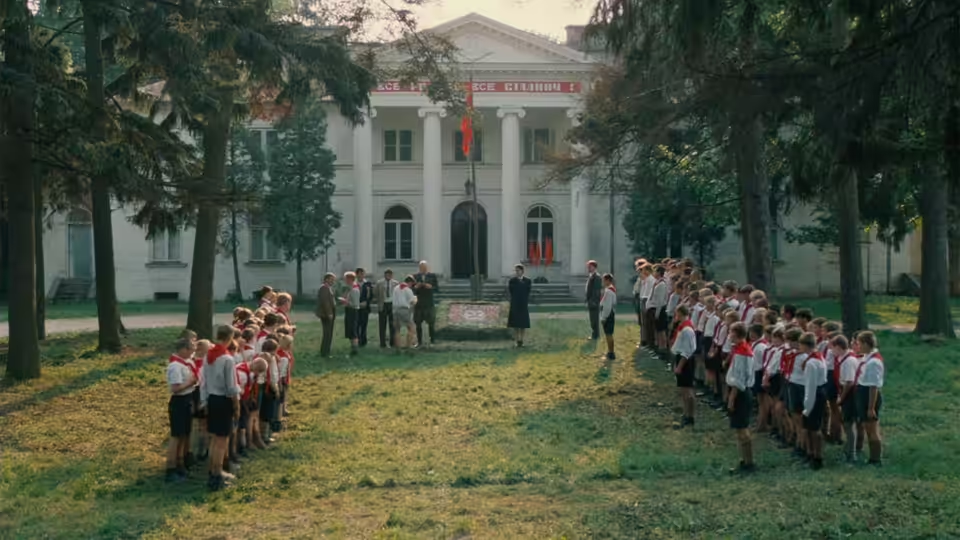
Jacek Petrycki shoots the orphanage in Grodno in flat winter light and the German barracks in warmer browns, and neither look is remarkable. There are stretches in the middle where the film has the plainness of television, actors standing in rows, trucks arriving on cue. Allan Starski’s sets are more precise than the camera that records them: the orphanage under its portrait of Stalin, the Hitler Youth school in Braunschweig with its polished floors and tidy bunks, a place built to make a lie easy to live in. Zbigniew Preisner’s score is sparing, a few mournful strings and a folk tune, and he stays out of the comedy. Isabelle Lorente and Ewa Smal cut the years briskly, sometimes too briskly: whole winters vanish in a caption.
Holland’s best joke is that the two ideologies are interchangeable to a boy who wants only to eat and be liked. Inna (Delphine Forest) drills Sally in Marxism and he takes to it as readily as he later takes to racial science, where a lecturer measures his skull and declares him a Baltic Aryan. There is a dream in which Hitler and Stalin waltz together; it is broad and it works. Sally’s real problem is not doctrine but his body. He is circumcised, and every changing room, every swimming lesson, every kindly German girl is a trap. Holland gets more suspense from a boy declining a shower than most war films get from a battle.
One scene we have not been able to shake. Alone in a lavatory, Sally tries with a length of thread to undo the one fact about himself that would kill him. Holland does not cut away and does not score it, and Hofschneider plays it not as tragedy but as a chore, which is worse. We watched it through our hands. It is over in a minute.
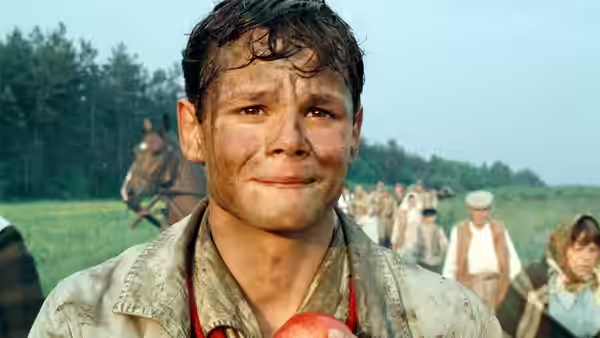
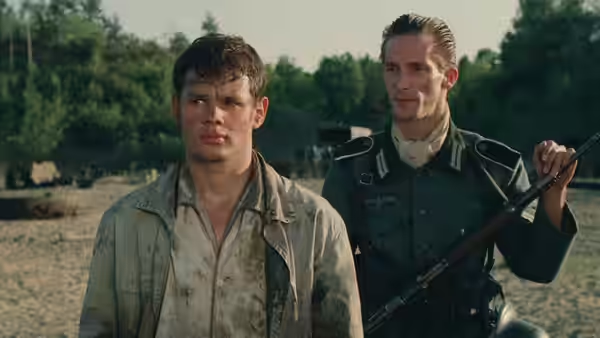
Hofschneider is a watchful, open-faced boy, and he can look as though he believes whatever he has just said. What he has not been asked to do is show us what Sally thinks when nobody is watching, and over 112 minutes the character stays slightly out of reach; we know what he does and seldom what it costs him until the film says so. André Wilms is warm and sad as Robert, the soldier who takes him under his wing. Hanns Zischler’s Captain von Lerenau is a decent man who has never asked what his uniform means, played without a wink. Julie Delpy’s Leni, the Hitler Youth girl who likes him, gets one good scene and then a function. The last half hour leans hard on coincidence, and knowing it happened does not stop it feeling written.
Holland had already made Angry Harvest (1985), about a Polish farmer and the Jewish woman he hides, and that was the tighter film, one house and two people. Europa Europa covers seven years and half a continent on what looks like a modest budget, and it shows. The story survives the treatment. Watch it with someone who will want to argue afterwards about whether Sally is a hero, a coward or simply a boy who was cold, because the film, to its credit, declines to say.