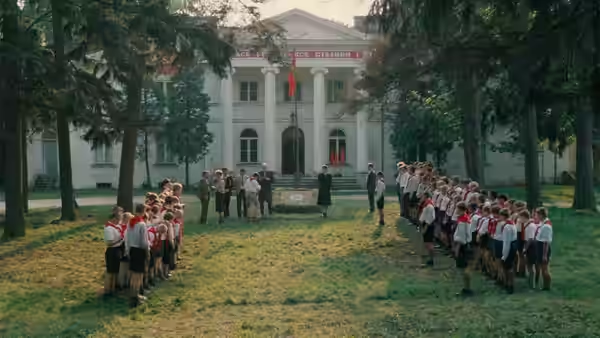
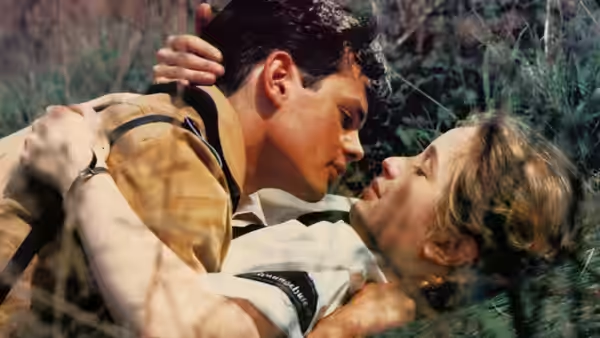
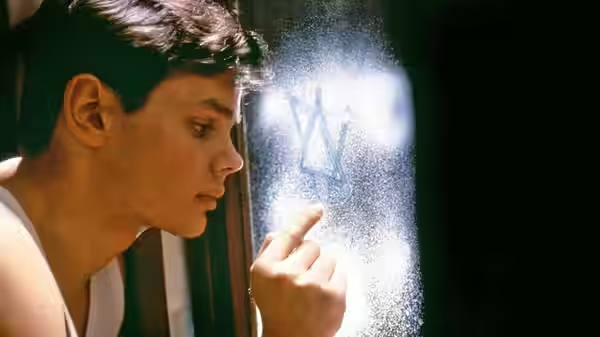
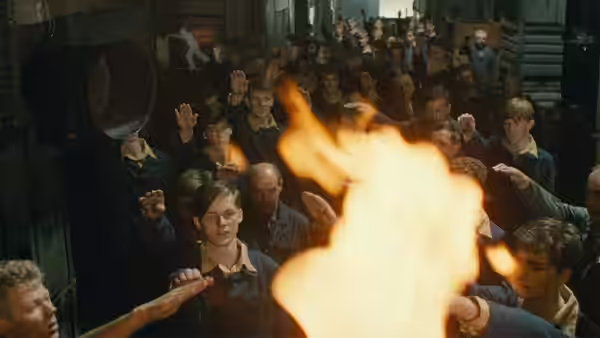
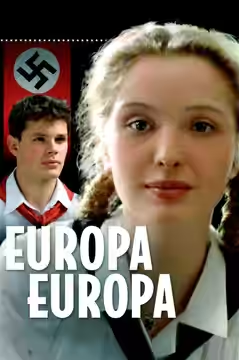
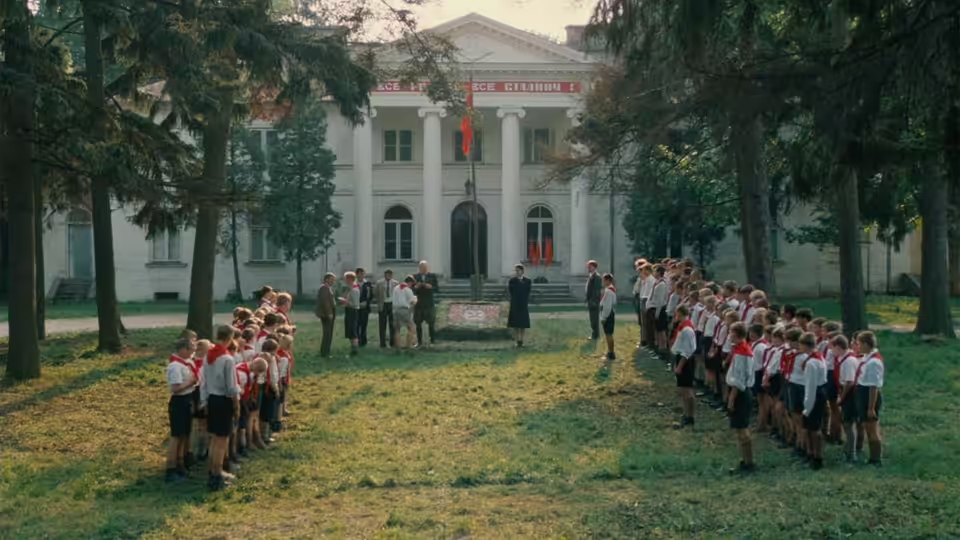
Children stand in uniformed lines outside a large building as adults gather between them
Film review

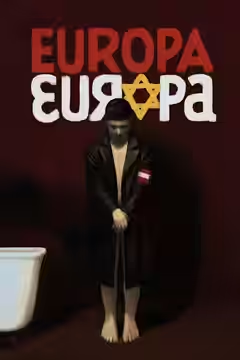
Europa Europa

1990 · Directed by Agnieszka Holland · 1h 52m

In a sentenceOne boy, two totalitarian uniforms and a lifelong dread of the showers

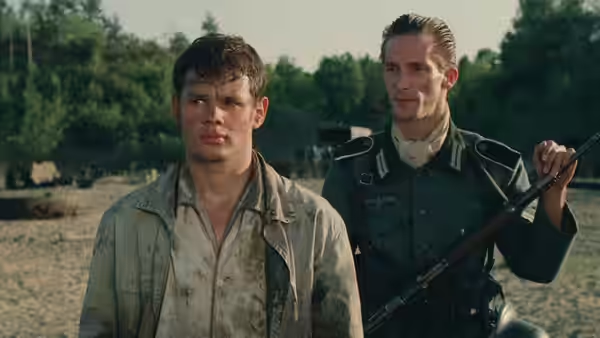
It is November 1938 in Peine, Germany, and Salomon ‘Sally’ Perel (Marco Hofschneider) is in the bath on his thirteenth birthday when the windows are smashed. His sister is killed; the family moves to Łódź in Poland. When the Germans invade in 1939, Sally’s father (Klaus Abramowsky) sends him and his brother Isaak (René Hofschneider) east, and the two are separated crossing a river. Sally ends up in a Soviet orphanage in Grodno, where the teacher Inna (Delphine Forest) turns him into a model Komsomol member. In June 1941 the Germans invade the Soviet Union, and Sally, caught in the open, tells a patrol he is an ethnic German called Josef Peters. They take him on as an interpreter, and a soldier named Robert (André Wilms) takes a liking to him.

Fi1m review

Agnieszka Holland tells the true story of a Jewish teenager who survived the war inside the Hitler Youth, and tells it as a dry comedy of survival. The filmmaking is rougher than the story deserves; the story is astonishing.

Agnieszka Holland’s film tells a true story so unlikely that a novelist would have been asked to tone it down. Salomon Perel, a German-Jewish boy from Peine, spends the war first in a Soviet orphanage as a model Komsomol member and then, having talked his way past a German patrol, as an interpreter for the Wehrmacht and a pupil at a Hitler Youth school. Holland, who wrote the screenplay with Paul Hengge, plays most of it as comedy: a boy swept along by history, saying yes to whichever uniform is held out to him. That is the right decision, and the film is better than its rough edges. It is worth your evening, provided you know the story is doing much of the work.

The first ten minutes are the best. Sally (Marco Hofschneider) is in the bath on his thirteenth birthday when the windows come in; he runs naked into the street, hides in a barrel, and comes home to find his sister dead. Holland shoots it fast and without music, and we were shaken, more by the boy’s bare feet on the cobbles than by anything shown directly. Then the family moves to Łódź, the Germans arrive, and Sally and his brother Isaak (René Hofschneider) are sent east and lose each other at a river. From there Sally is on his own.

Jacek Petrycki shoots the orphanage in Grodno in flat winter light and the German barracks in warmer browns, and neither look is remarkable. There are stretches in the middle where the film has the plainness of television, actors standing in rows, trucks arriving on cue. Allan Starski’s sets are more precise than the camera that records them: the orphanage under its portrait of Stalin, the Hitler Youth school in Braunschweig with its polished floors and tidy bunks, a place built to make a lie easy to live in. Zbigniew Preisner’s score is sparing, a few mournful strings and a folk tune, and he stays out of the comedy. Isabelle Lorente and Ewa Smal cut the years briskly, sometimes too briskly: whole winters vanish in a caption.

Holland’s best joke is that the two ideologies are interchangeable to a boy who wants only to eat and be liked. Inna (Delphine Forest) drills Sally in Marxism and he takes to it as readily as he later takes to racial science, where a lecturer measures his skull and declares him a Baltic Aryan. There is a dream in which Hitler and Stalin waltz together; it is broad and it works. Sally’s real problem is not doctrine but his body. He is circumcised, and every changing room, every swimming lesson, every kindly German girl is a trap. Holland gets more suspense from a boy declining a shower than most war films get from a battle.

One scene we have not been able to shake. Alone in a lavatory, Sally tries with a length of thread to undo the one fact about himself that would kill him. Holland does not cut away and does not score it, and Hofschneider plays it not as tragedy but as a chore, which is worse. We watched it through our hands. It is over in a minute.

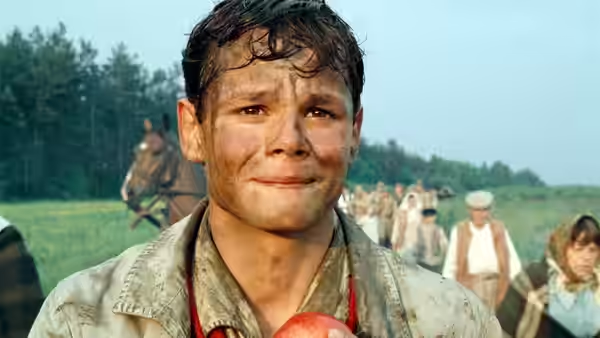
Hofschneider is a watchful, open-faced boy, and he can look as though he believes whatever he has just said. What he has not been asked to do is show us what Sally thinks when nobody is watching, and over 112 minutes the character stays slightly out of reach; we know what he does and seldom what it costs him until the film says so. André Wilms is warm and sad as Robert, the soldier who takes him under his wing. Hanns Zischler’s Captain von Lerenau is a decent man who has never asked what his uniform means, played without a wink. Julie Delpy’s Leni, the Hitler Youth girl who likes him, gets one good scene and then a function. The last half hour leans hard on coincidence, and knowing it happened does not stop it feeling written.

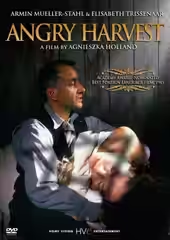
Holland had already made Angry Harvest (1985), about a Polish farmer and the Jewish woman he hides, and that was the tighter film, one house and two people. Europa Europa covers seven years and half a continent on what looks like a modest budget, and it shows. The story survives the treatment. Watch it with someone who will want to argue afterwards about whether Sally is a hero, a coward or simply a boy who was cold, because the film, to its credit, declines to say.
Critical consensus AI synthesised

72
Positive
4
Mixed
2
Negative
0

Most critics lean positive on Europa Europa, and the praise gathers around two things: the true story of Salomon Perel, which several reviews say carries the film almost on its own, and Agnieszka Holland’s restraint in handling material that could easily have tipped into either melodrama or farce. The comic edge is generally taken as working, with the film’s mockery of Nazi and communist ideologies alike counted a strength. Marco Hofschneider’s performance as Perel is singled out where the acting is discussed at all.

The reservations are mild and fairly consistent. Empire finds the filmmaking itself imperfect and says the story’s momentum does the heavy lifting. Slant, reviewing much later, considers the protagonist emotionally underdeveloped until the second half. Nobody dismisses the film, and the spread of scores is narrow: the difference between the warmest and the coolest notices is one of enthusiasm rather than of verdict.

Los Angeles Times
26 July 1991 · PETER RAINER
80*

Rainer finds the film’s account of survival compelling and its comic elements effective. He praises Holland’s restrained, judicious approach to the difficult material.

Read the full review →
Radio Times
★★★★ · David Parkinson
80

The critic calls the story extraordinary and praises Agnieszka Holland’s understated direction. Marco Hofschneider is singled out for an impressive performance as Salomon Perel.

Read the full review →
Slant Magazine
18 July 2019 · ★★★½ · Derek Smith
70

Smith finds the film largely successful as a tragicomic satire, though its protagonist can feel emotionally underdeveloped. He praises Holland’s playful, cutting exposure of Nazi and communist ideologies, while noting the film gains emotional depth in its second half.

Read the full review →
Time Out
· JRo
70*

The review presents Holland’s war story as unsettling despite familiar material. It singles out the fact that the story is true as a source of its impact.

Read the full review →
Empire
1 January 2000 · David Parkinson
65*

The critic finds the film’s execution imperfect but says its remarkable true story carries the wartime tale. He praises the story’s sheer momentum, while noting that the filmmaking could be improved.

Read the full review →
The New York Times
28 June 1991
64*

The page is inaccessible, so the critic’s verdict cannot be determined. The URL headline identifies a review but does not establish what it praised or criticized.

Read the full review →

Straight answers AI written, from our review

Is Europa Europa worth watching?
Europa Europa is worth watching for its story alone, a true account of a Jewish boy who survived the war inside the Hitler Youth, and we scored it 74. Agnieszka Holland plays it as a dry comedy of survival, which is the right choice, but the filmmaking is plain in the middle stretches and the last half hour leans on coincidence. Watch it with someone who will want to argue afterwards about what Sally is.
How long is Europa Europa, and what is it rated?
Europa Europa runs 1h 52m. It is a history and drama film.
Where can I watch Europa Europa in Panama?
Europa Europa is not on any streaming or rental service in Panama at the moment. It is available in 5 other countries; change your country at the top of the page to see where. Availability is checked daily.
How violent or frightening is Europa Europa, and is it suitable for children?
Europa Europa has no UK certificate and is rated R in the US, and it is not a film for children. In the opening pogrom the hero comes home to find his sister dead, and one later scene shows the teenage Sally alone in a lavatory trying with a thread to undo his circumcision, held without a cut or music. Little is graphic, but the dread runs throughout; it suits older teenagers and adults.
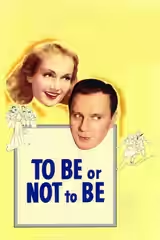
How does Europa Europa compare to To Be or Not to Be?
Europa Europa and To Be or Not to Be both find comedy in Nazi occupation, but Lubitsch's film is the more polished, a theatrical farce made while Warsaw was still occupied, where Holland's is a rough-edged true story. Lubitsch is the surer filmmaker once his slow early stretches pass; Holland has the more astonishing material. Choose the earlier film for wit and assurance, the later for a story you will struggle to believe happened.
What should I watch after Europa Europa?
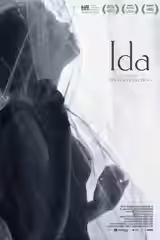
After Europa Europa, try To Be or Not to Be (1942, Fi1m 87): Lubitsch found the farce in occupied Warsaw while it was still occupied. Then Ida (2013, Fi1m 85): Poland after the war, a novice nun and a buried family secret, in black and white.

Cast

Awards

Academy Awards, 1992

Nominated
Best Writing, Adapted Screenplay

If you liked this, try…

  1. To Be or Not to Be (1942, Fi1m 87)Lubitsch found the farce in occupied Warsaw while it was still occupied.

  2. Angry Harvest (1985) · not on Fi1m yetHolland’s earlier hiding story, tighter and crueller, with one house and two people.

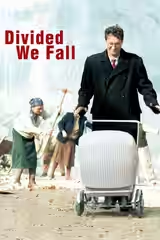
  3. Divided We Fall (2000) · not on Fi1m yetA Czech couple hide a Jewish neighbour; the comedy is nervous and earned.

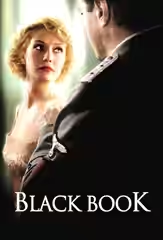
  4. Black Book (2006) · not on Fi1m yetVerhoeven’s Jewish singer passes among the Germans and nobody comes out clean.

  5. Ida (2013, Fi1m 85)Poland after the war, a novice nun and a buried family secret, in black and white.