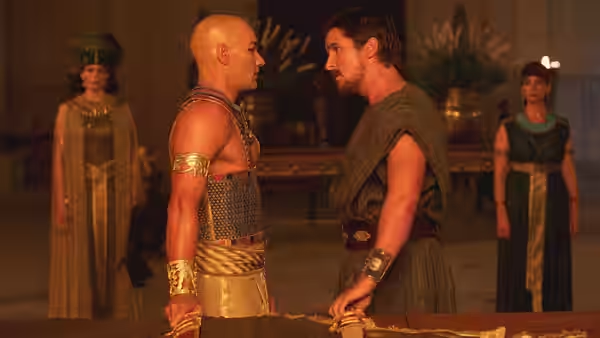
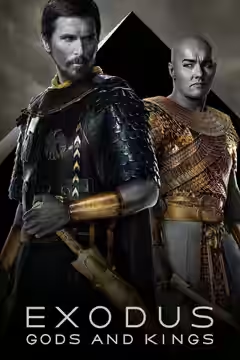
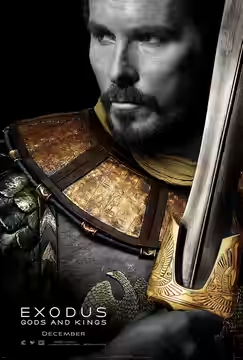
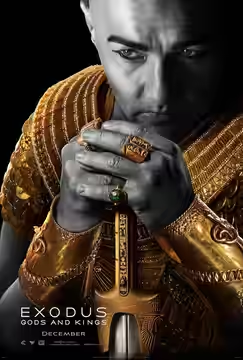
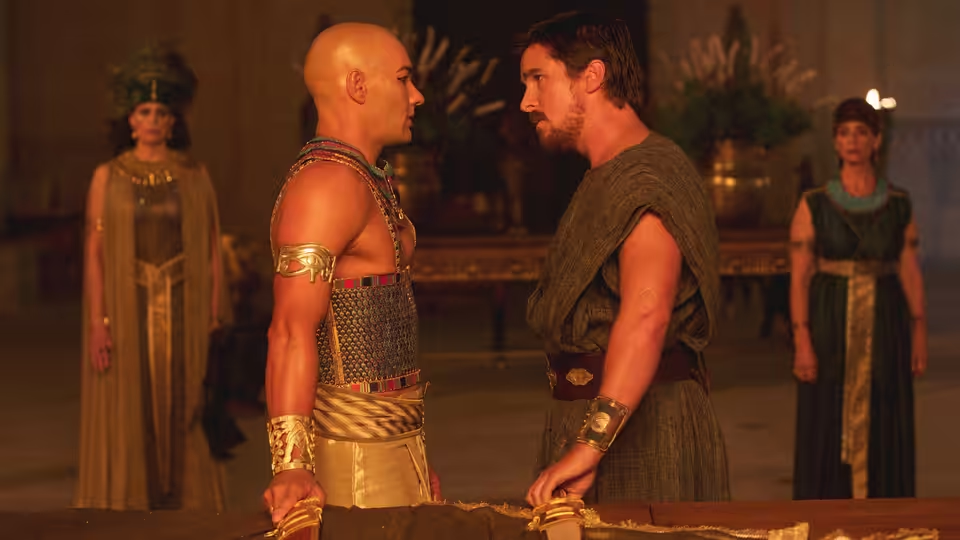
Moses (Christian Bale) and Ramses (Joel Edgerton) face each other across a table in the palace
Film review

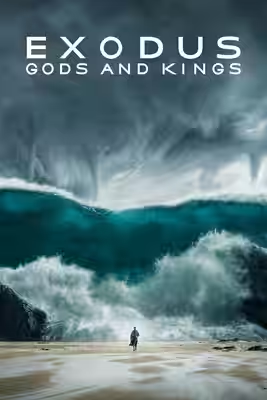
Exodus: Gods and Kings

2014 · Directed by Ridley Scott · 2h 30m

In a sentenceTen plagues, four screenwriters, two and a half hours, and the clearest point of view in the film belongs to the crocodiles

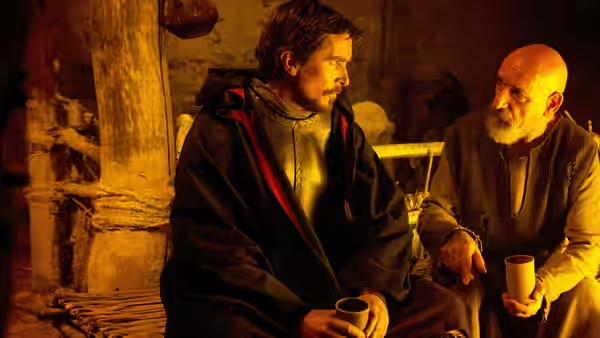
Egypt, 1300 BCE. Moses (Christian Bale) and Ramses (Joel Edgerton) have been raised as brothers in Memphis under Pharaoh Sethos I (John Turturro), Moses the better general and Ramses the heir. Before a battle against the Hittites at Kadesh, the High Priestess (Indira Varma) reads a prophecy: one of the two will save the other and become a leader. Moses saves Ramses. Sent to the city of Pithom to inspect the corrupt Viceroy Hegep (Ben Mendelsohn), Moses meets Nun (Ben Kingsley), an elder among the Hebrew slaves, who tells him he was born one of them and smuggled into the palace as a baby by Bithia (Hiam Abbass). Hegep reports what he overheard. When Sethos dies, the new Pharaoh has a decision to make about his brother.

Plays from YouTube when you press play; nothing loads from them until then.

Fi1m review

Ridley Scott films the plagues as the best half-hour of large-scale horror he has staged in years, and surrounds them with a 150-minute war film in which nobody is allowed a personality, least of all Moses. For the frogs and the water; not for the man.

Ridley Scott’s Moses runs 150 minutes, opens on a caption reading 1300 BCE and has four credited screenwriters: Adam Cooper, Bill Collage, Jeffrey Caine and Steven Zaillian. It wants to do the Exodus the way Gladiator did Rome, two men raised as brothers who end up commanding opposite armies, and to be sceptical about the miracles while showing every one. For about forty minutes in the middle, when the plagues come, it is as frightening as anything Scott has made in years. The rest of the time it is a handsome film in which nobody says anything a person would say.

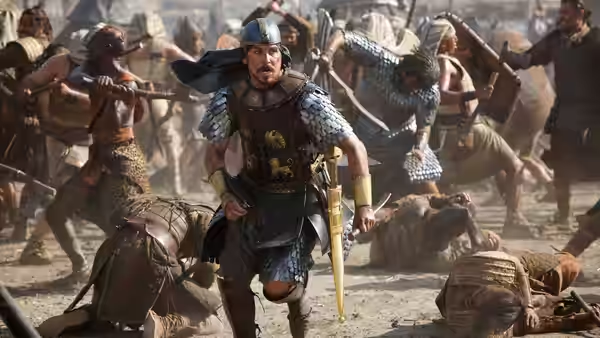
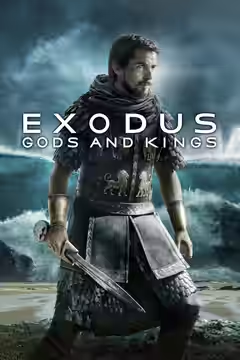
Christian Bale plays Moses as a general first and a prophet under protest. He is good at the soldiering: at Kadesh he rides into the Hittite chariots with the flat irritation of a man doing a job, and when the High Priestess (Indira Varma) reads a prophecy out of a bird’s insides he looks at her as if she had quoted for a repair. The film gives him that scepticism and then nothing to do with it. When God appears, as a boy credited as Malak (Isaac Andrews), Moses argues with him, loses, and does as he is told, and the arguments are the same argument several times over. Bale is never bad. He is never handed a scene in which Moses decides something.

Joel Edgerton has more fun. His Ramses is shaved, kohl-eyed and gold-plated, keeps cobras as pets, and seems permanently puzzled that running Egypt involves so many decisions. It is a camp performance in a solemn film, and we were relieved every time he came back, because he is the only person on screen who behaves as if the stakes are his.

The rest of the cast turn up and are not used. María Valverde’s Séfora gets the film’s one quiet stretch, in Midian, and the script is through it in minutes.

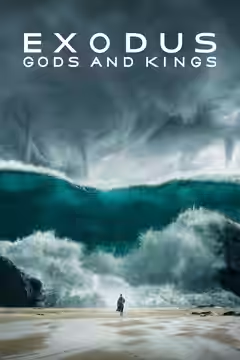
Then the plagues, and the film we were promised. The Nile does not turn red because a staff is dipped in it; it turns red because the crocodiles come in from the banks and start on the fishermen, and the water clouds from the bottom up. Frogs follow the blood and get into the beds. Flies follow the frogs, boils follow the flies, and Dariusz Wolski and Mark Patten shoot it all in a bleached, dusty light that turns the palace gold to brass and leaves the courtiers’ sores looking wet. Billy Rich cuts the locusts as weather, a brown bank rolling over a field, and the dark comes down on Memphis as a smear. We were horrified, properly horrified, and glad of it. Scott has filmed the plagues as a public health disaster that happens to have an author, and we had not seen them done that way before.

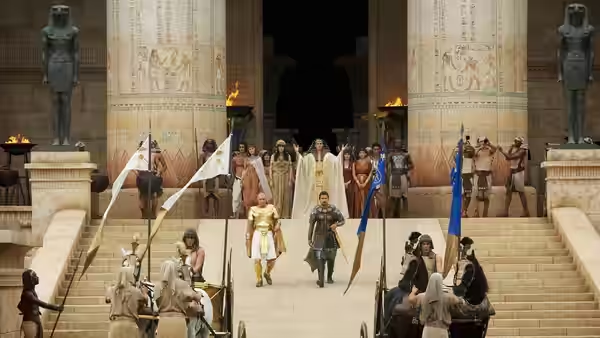
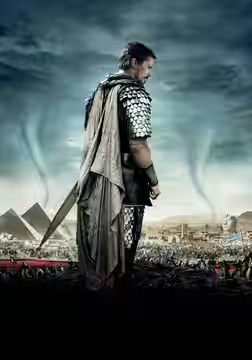
Arthur Max builds Memphis as a building site, scaffolding up the flank of a half-finished colossus, and the film is at its most intelligent when it treats Egypt as a place that runs on labour and is beginning to notice. Janty Yates puts the court in pleated linen and gold and the Hebrews in undyed brown, which tells you who to root for before anyone speaks.

The casting was argued over before the film opened, and we will add only that a film which hands its Egyptian court to white actors has made a choice, and the choice shows whenever the camera pulls back on a crowd. The larger failure is dramatic. Scott cannot decide whether God is real or a blow to the head, so Moses can be neither believer, madman nor politician, and the end of a story everybody knows arrives without anyone on screen having seemed to want it.

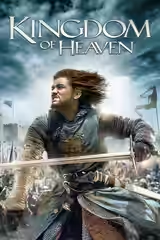
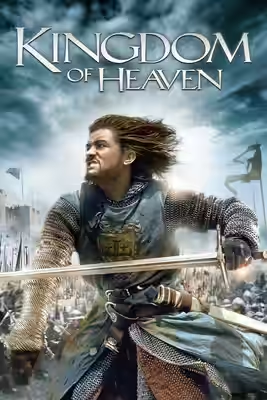
Kingdom of Heaven, from 2005, had the same shape, and in its longer cut it knew what it thought. This one has four writers and the opinion of none of them. See it in a cinema if one is showing it, for the frogs and the water, which shrink on a television to a weather report. The 15 certificate is for the crocodiles, who earn it. The rest you may find yourself admiring from a distance, which is roughly how Moses treats God.

Critical consensus AI synthesised

49
Positive
5
Mixed
10
Negative
9

Most critics come away unconvinced; the reviews lean mixed to negative. Where they do agree is on the spectacle. The plagues are praised almost everywhere, with the locusts, the frogs and the approaching chariots singled out, and the Red Sea sequence is frequently named as the film’s strongest stretch. Ridley Scott’s ancient Egypt is found elaborate and sumptuous, and several reviews praise Christian Bale’s tense, conflicted Moses as the human centre the film otherwise lacks.

The reservations cluster on the script. Critics complain of thin characterisation, rushed relationships, a weak opening and a long, flat middle, and several find the film’s attempts to rationalise the miracles muddled. Joel Edgerton divides them: Radio Times finds his Ramses camp, the Evening Standard finds him sympathetic. Slant Magazine and The Wrap object to the casting of predominantly white actors in the ancient setting. The spread is wide, from four stars at Total Film and Den of Geek to one at Time Out.

Total Film
1 December 2014 · ★★★★ · Jamie Graham
80

Graham sees the film as a bold, entertaining adventure whose scale and uncompromising action make it a striking Biblical epic. He praises the vast battle and plague sequences, while noting that some supporting roles are camp or underdeveloped.

Read the full review →
Variety
29 November 2014 · Justin Chang
80*

Chang finds the film an imperfect but transporting biblical epic, praising its visual spectacle while appreciating its skeptical, morally searching take on faith. He especially singles out the vividly staged plagues and the suspenseful Red Sea sequence.

Read the full review →
Empire
27 November 2013 · Nev Pierce
70*

Pierce finds the film a thoughtful, modern biblical epic, though its spiritual uncertainty weakens the cathartic payoff. He especially praises Christian Bale’s tense, conflicted performance as Moses.

Read the full review →
Vulture
12 December 2014 · Bilge Ebiri
70*

Ebiri finds the film clumsy and tedious at first, but ultimately an enjoyable biblical epic. He praises the visceral spectacle of the plagues and the exodus, while criticizing the early storytelling and character work.

Read the full review →
The New York Times
11 December 2014 · A. O. Scott
64*

The article appears to be a review, but its verdict and specific praise or criticism cannot be verified from the inaccessible page. The available text contains no review content.

Read the full review →
Radio Times
★★★ · Alan Jones
60

The review finds the biblical epic a slog that lacks the awe of earlier religious epics. It praises Christian Bale’s performance, while faulting the script and Joel Edgerton’s camp portrayal of Ramses.

Read the full review →

Straight answers AI written, from our review

Is Exodus: Gods and Kings worth watching?
Exodus: Gods and Kings is worth watching only for its plagues, which Ridley Scott films as forty minutes of large-scale horror, and we scored it 52. The surrounding 150-minute war film gives Christian Bale's Moses soldiering to do but no decisions to make, and only Joel Edgerton's camp Ramses behaves as if the stakes are his. See it for the frogs and the water, not for the man.
How long is Exodus: Gods and Kings, and what is it rated?
Exodus: Gods and Kings runs 2h 30m. It is an adventure and drama film.
Where can I watch Exodus: Gods and Kings in Ukraine?
Exodus: Gods and Kings is available to rent from Apple TV from ₴3.99. Availability is checked daily; the links above go straight to each service.
How violent or frightening is Exodus: Gods and Kings, and is it suitable for children?
Exodus: Gods and Kings carries a UK 15 certificate, and the plagues earn it: crocodiles take fishermen in the Nile, frogs get into beds, flies bring boils, and the courtiers' sores are shot to look wet. There are large chariot battles besides. It is too frightening for younger children and will unsettle the squeamish; older teenagers who can take the plagues will be fine.
How does Exodus: Gods and Kings compare to The Ten Commandments?
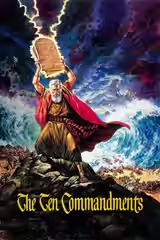
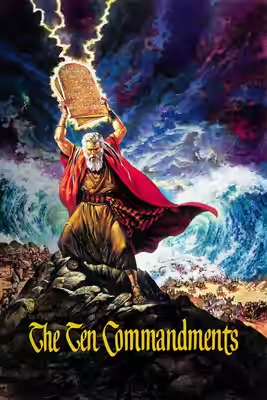
Exodus: Gods and Kings has the better spectacle and The Ten Commandments has the belief, and the belief is what the older film is made of. DeMille takes every word as true and is sincere, enormous and stiff; Scott cannot decide whether God is real or a blow to the head, so nobody on screen seems to want the story. Choose Scott for the plagues, DeMille for the conviction and Yul Brynner.
What should I watch after Exodus: Gods and Kings?
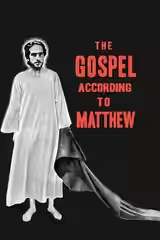
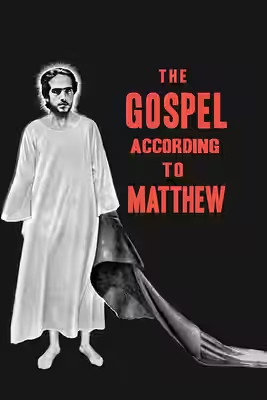
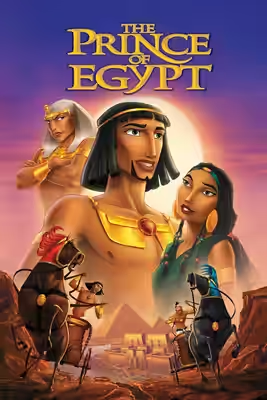
After Exodus: Gods and Kings, try The Ten Commandments (1956, Fi1m 67): DeMille believes every word, and the belief is the spectacle; Scott only has the spectacle. Then The Gospel According to St. Matthew (1964, Fi1m 88): Pasolini shoots scripture with non-actors and no money and finds more awe than this; and The Prince of Egypt (1998, Fi1m 74): The same story in a third of the time, with songs and a Ramses you feel for.

Cast

If you liked this, try…

  1. The Ten Commandments (1956, Fi1m 67)DeMille believes every word, and the belief is the spectacle; Scott only has the spectacle.

  2. The Gospel According to St. Matthew (1964, Fi1m 88)Pasolini shoots scripture with non-actors and no money and finds more awe than this.

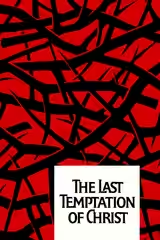
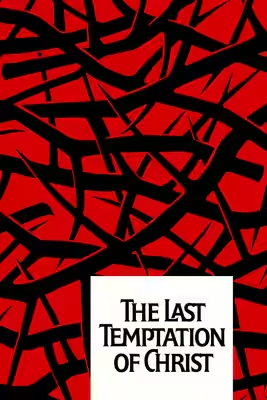
  3. The Last Temptation of Christ (1988) · not reviewed yetScorsese makes doubt the subject rather than a mood, and the film is braver for it.

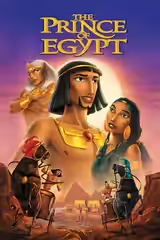
  4. The Prince of Egypt (1998, Fi1m 74)The same story in a third of the time, with songs and a Ramses you feel for.

  5. Kingdom of Heaven (2005) · not reviewed yetScott’s earlier holy war; find the longer cut, which knows what it thinks.

Free account

Know what to watch tonight

Two lists that know where things are streaming, collections you can share, your own score beside ours, and Discover that remembers what you have seen.

  • Want to see, sorted by what is streaming now
  • Seen, with your score out of ten
  • No adverts, ever