Film review

Extremely Loud & Incredibly Close

2011 · Directed by Stephen Daldry · 2h 09m · MPA PG-13

In a sentenceA small boy tries every lock in New York and the film cries before he does

Drama

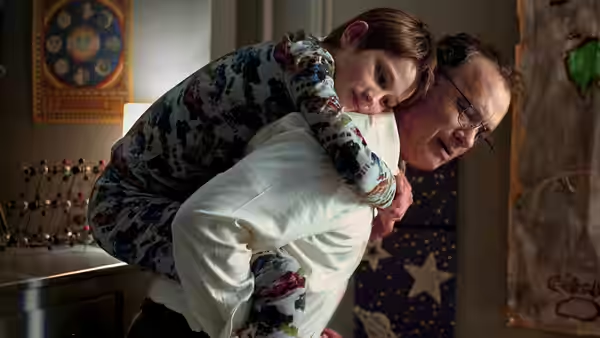
New York, a year after 11 September 2001. Oskar Schell (Thomas Horn) is a small, exacting boy whose father Thomas (Tom Hanks) died in the World Trade Center, on what Oskar calls the worst day. His mother Linda (Sandra Bullock) cannot get near him. In his father’s wardrobe, Oskar knocks a blue vase to the floor and finds inside it an envelope marked Black, and in the envelope a key. Convinced it is a last puzzle his father set him, he decides to visit every person named Black in the five boroughs and try the key in their locks, beginning with Abby Black (Viola Davis). He carries a tambourine to steady his nerves and keeps hidden the answering-machine messages his father left that morning.

Fi1m review

Stephen Daldry has made a handsome, carefully acted film about a boy’s grief that never stops telling you what to feel, and the more it pushes the less we felt. Thomas Horn and Max von Sydow are good; the film around them is not.

Stephen Daldry’s film of Jonathan Safran Foer’s novel arrived with a promise on its poster: that it was not a story about 11 September but a story about every day after. That describes Eric Roth’s screenplay better than the finished film, which puts the towers on screen early and returns to them whenever it needs help. Oskar Schell (Thomas Horn) finds a key in his dead father’s wardrobe and decides that somewhere in New York there is a lock that will explain everything. It is a good idea for a children’s book, and the film runs 129 minutes.

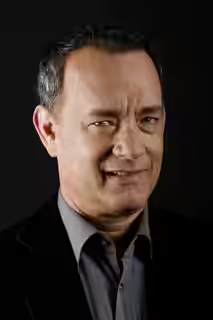
Horn is the reason to keep watching. He plays Oskar as a small, brisk, literal boy who lists what frightens him, bridges, the subway, loud noises, and rattles a tambourine at his hip to keep the panic down. The trouble is that Roth gives him a voiceover explaining each thing he does as he does it, the key, the search, the lie he tells his mother each morning, so a character built on not saying things spends two hours saying them. Tom Hanks, in flashback, is easy and warm as the father who sets him expeditions in Central Park, and the film is at its best when the two of them are talking.

We were got at once. Oskar has kept the answering machine from the morning his father died, with the messages Thomas left from the tower, and he plays them alone. Hanks’s voice on the tape is level and ordinary, saying he is fine. Horn’s face does nothing at all. Alexandre Desplat’s score, for once, stays out. It moved us more than we expected, and then we noticed the film had built its whole plot around that machine and around what it is holding back from us, and the feeling soured into resentment. It is the only scene in the film that trusts the tape to do the work.

Everywhere else it pushes. Desplat’s piano and strings sit under nearly every scene and swell a bar before anyone says anything sad, so we are ready. Chris Menges lights New York in a soft, clean, even glow, and every door Oskar knocks on across the five boroughs opens onto a stranger who is kind to him. Claire Simpson cuts the visits into montages of thresholds and faces until the Blacks of New York become a slideshow of good people. K.K. Barrett gives the Schells a flat full of books and warm wood, with the father’s wardrobe kept like a shrine. It is all handsome.

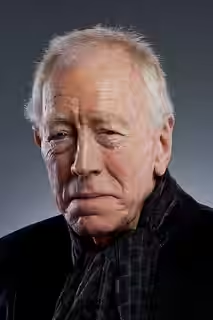
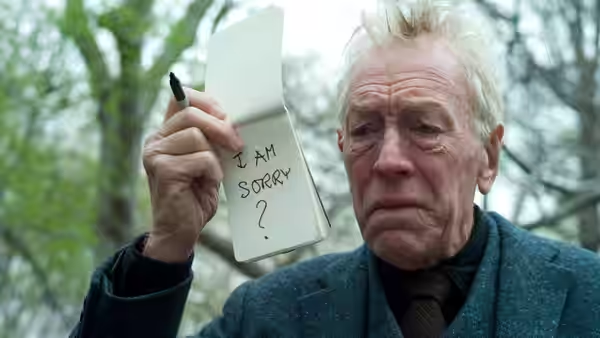
The supporting cast is better than its parts. Viola Davis, as Abby Black, cries in a doorway while a marriage ends in the next room, a minute of adult mess the film hurries past. Max von Sydow plays a lodger in Oskar’s grandmother’s flat who does not speak, answers with a notepad and with Yes and No inked on his palms, and joins the search; it is the one device the film leaves alone, and he is dry and sad and funny in it. Jeffrey Wright arrives late and is good in a scene we will not describe. Sandra Bullock spends most of the film at the edge of the frame as a mother who cannot reach her son, then is handed its best scene, which we also will not describe. She plays it small.

Daldry made Billy Elliot in 2000, and it is the fair comparison: a boy in a house where a parent has gone. There the loss was a fact the boy lived around while he did something else. Here it is a project, with a map, a list and a rule for every borough, and every clue Oskar finds is another scene of him being clever rather than sad. Most critics were as unpersuaded as we were; those who were moved were moved by Horn, and we see why.

It is long for a search with one answer. The 12A is right: there is nothing here a twelve-year-old cannot watch, and a fair amount one might see through. If you want to be made to cry on a wet Sunday afternoon it will do that, because it has been built for nothing else. We can see who it was made for, and they were owed something less tidy.

Critical consensus AI synthesised

44
Positive
5
Mixed
2
Negative
10

Most critics do not like this film, and many dislike it a good deal. Ten of seventeen reviews are negative, and the complaint is much the same each time: Daldry’s adaptation treats grief after the 9/11 attacks as an occasion for sentiment rather than reflection, and the boy’s quest across New York with a key strikes them as contrived and cute. Where there is praise, it lands on the cast. Thomas Horn’s performance as Oskar is singled out by several reviews as natural and matter-of-fact, and Max von Sydow and Sandra Bullock are credited with steadying the supporting scenes.

The spread is wide. The Los Angeles Times and The Wrap find the film moving and its handling of loss humane; The AV Club and The Guardian consider it preposterous and mawkish, and the former gives it a failing grade. Even admirers concede Daldry lays the sentiment on thick, and Horn divides opinion, with some finding his idiosyncrasies grating rather than endearing.

Los Angeles Times
23 December 2011 · Betsy Sharkey
80*

Daldry sensitively adapts the story through a precocious boy's eyes, balancing sentiment and substance while exploring grief and healing on a human level.

Read the full review →
Film Comment
1 January 2012 · Nicolas Rapold
70*

The film is a surprisingly engaging adaptation of the novel about a precocious boy dealing with his father's death in the 9/11 attacks. Its chief strength is the passionate portrayal by newcomer Thomas Horn as the boy Oskar.

Read the full review →
The Hollywood Reporter
18 December 2011 · Todd McCarthy
70*

The film is an affecting, well-acted tale of 9/11 trauma centered on a boy's quest to process his father's death. The standout element is the exceptional natural performance by young lead Thomas Horn.

Read the full review →
The New York Times
22 December 2011 · Manohla Dargis
40*

The movie treats 9/11 as kitsch rather than occasion for mourning or reflection, turning the boy's quest into a sentimental journey through New York aided by its people.

Read the full review →
RogerEbert.com
18 January 2012 · Roger Ebert
30*

The film is contrivance and folderol built around a boy's improbable quest across New York with a key and tambourine. It fails to provide plausible or meaningful catharsis for 9/11.

Read the full review →
Screen Daily
19 December 2011
30*

The film is seen as a preening and contrived exercise in manipulative poignancy, overly mannered despite skilled craft and strong supporting performances, existing mainly to elicit feelings rather than tell a story.

Read the full review →

Cast

Awards

Academy Awards, 2012

Nominated
Best Picture
Nominated
Best Supporting Actor

If you liked this, try…

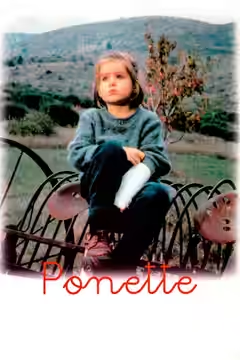
Ponette poster

Ponette

1996 · A four-year-old grieves her mother, in French, with no quest and no score pushing you

Billy Elliot poster81

Billy Elliot

2000 · Daldry’s earlier boy with a dead parent, who dances instead of making lists

United 93 poster88

United 93

2006 · The same day, told flat and in real time, and far harder to shake

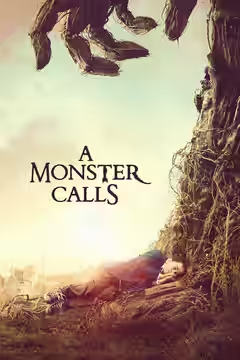
A Monster Calls poster

A Monster Calls

2016 · Another boy, another dying parent, and a fantasy device that earns its tears

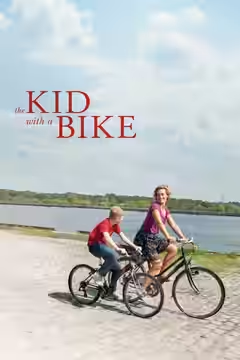
The Kid with a Bike poster

The Kid with a Bike

2011 · A Belgian boy hunts for his father across a town; the Dardennes never raise their voices