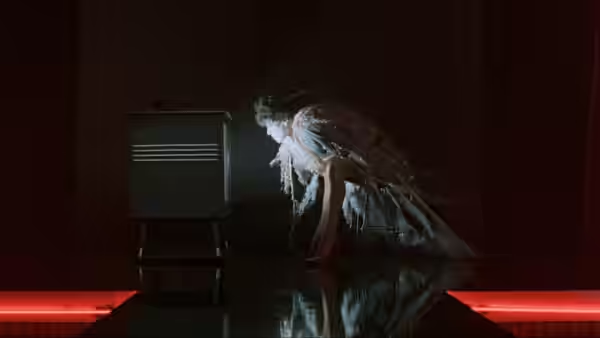
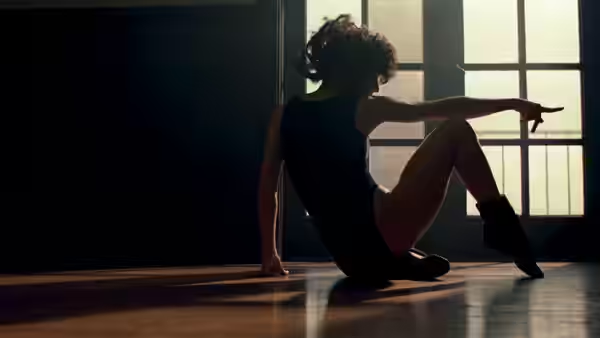
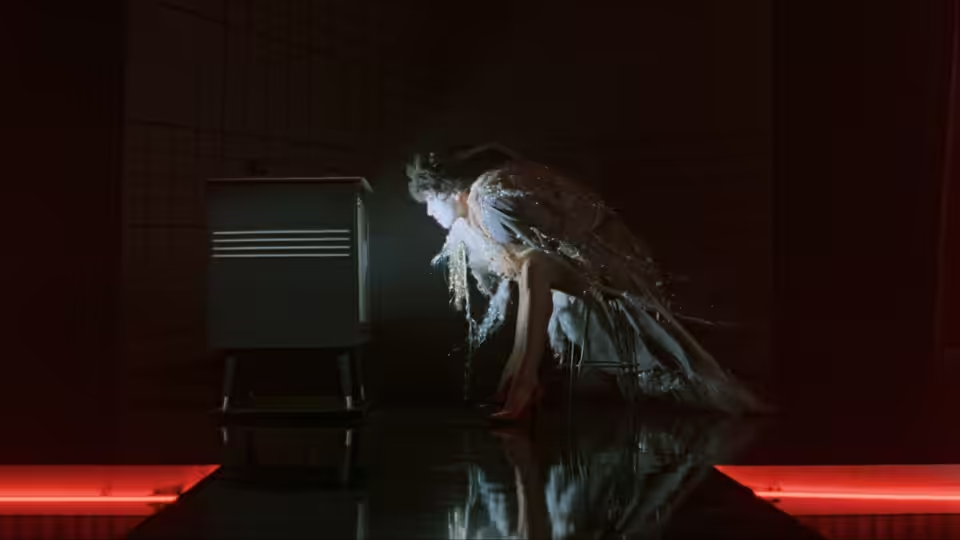
A dancer crouches beside a television on a dark stage lit by red floor lights
Film review

Flashdance

1983 · Directed by Adrian Lyne · 1h 35m

In a sentenceThe dancing makes a persuasive case for dispensing with most of the conversations

Alex Owens (Jennifer Beals) is at the centre of Flashdance, a drama and romance directed by Adrian Lyne. Nick Hurley (Michael Nouri) and Jeanie Szabo (Sunny Johnson) are among the principal characters, alongside Richie (Kyle T. Heffner), Tina Tech (Cynthia Rhodes) and Hanna Long (Lilia Skala). Dance performances feature in a story written for the screen by Thomas Hedley Jr. and Joe Eszterhas. Keith Forsey and Giorgio Moroder provide the music. The film dates from 1983, runs for 95 minutes and carries a 15 certificate.

Plays from YouTube when you press play; nothing loads from them until then.

Fi1m review

Adrian Lyne’s dance drama is enjoyable whenever it gets moving and disappointingly thin when it settles into its romance. The numbers have enough energy to sustain attention, but the characters need more than enthusiasm and a soundtrack.

Flashdance is a mixed pleasure, with dance numbers that deserve a better story around them. Adrian Lyne treats movement, lighting and music as the main attraction, which is a sensible judgement about the material. At 95 minutes, the film ought to be brisk entertainment, but its romance makes it feel longer than it is. There are stretches when the dancing justifies the wait, though we would have welcomed another pass at the screenplay before anyone started rehearsing.

The screenplay by Thomas Hedley Jr. and Joe Eszterhas is too slight to support the emotion being asked of it. Familiarity is not the trouble on its own; a familiar romance can work if we believe in the particular people. Here the characters remain insufficiently developed, and the film asks its music to supply feelings that the writing has not earned. The simplicity might have been welcome if the dialogue and relationships had been sharper.

Jennifer Beals gives Alex Owens enough presence to hold our attention even when the writing is doing little for her. The performance has an eagerness that suits the film, although we wanted more opportunities to understand the person beneath it. Michael Nouri, playing Nick Hurley, makes less of an impression, and the romance needs more help than he can give it. Neither performer can quite make these people interesting enough to sustain the passages between dances.

The dance sequences explain why the film remains watchable. Donald Peterman’s lighting makes the movement emphatic, while Bud S. Smith and Walt Mulconery cut the numbers with a force that the dramatic passages lack. We felt a lift when the dancing took over, because the light, the cuts and the beat finally seemed to be working together. These passages have the confidence missing from the conversations, and Adrian Lyne is right to give them such attention.

Giorgio Moroder and Keith Forsey provide music that makes the film’s feelings seem stronger than the writing warrants. During the dance numbers, that is part of the pleasure, and resisting it would be a rather joyless way to watch. The difficulty comes when the surrounding drama needs to sustain that excitement without the same musical help. The film has taught us to expect another number, which leaves its already ordinary romance at a further disadvantage.

Charles Rosen’s production design contributes to the dance sequences’ showmanship, helping them command attention without making the surrounding story more convincing. The visual polish is purposeful, and it would be unfair to dismiss the work simply because the screenplay is weak. A dance drama can survive an unlikely plot if its characters seem to have lives beyond their performances. Here Adrian Lyne gives us too little to care about between numbers, so the implausibility becomes harder to overlook.

There is enough skill in the dancing, lighting and editing to make a blanket dismissal seem ungenerous. There is also too much underwritten drama to recommend the whole film without a substantial warning. Its pleasures depend on accepting characters who rarely become more interesting than they first appear. Choose it only if the dancing is enough; for a romance, we would look elsewhere.

Critical consensus AI synthesised

42
Positive
0
Mixed
3
Negative
3

The reviews lean negative on Flashdance, with praise concentrated on the dance sequences rather than the story or characters. Even several detractors acknowledge the appeal of the numbers, while the more sympathetic accounts find enough visual energy and feeling to make the thin plotting bearable. Radio Times praises Adrian Lyne’s handling of the post-disco mood, and Eye for Film points to the lighting, editing, music and staging as reasons the dances work.

The division is over how much those pleasures compensate for the weaknesses elsewhere. Reservations centre on derivative romance, implausibility, weak characterisation and a commercial approach that leaves little substance. The available verdicts range from dismissal to qualified affection, rather than forming a close consensus. Radio Times finds the film winning despite its familiar story; Eye for Film responds to its emotional force but remains troubled by its ideological contradictions.
RogerEbert.com
64*

The page could not be accessed, so the critic’s verdict is unavailable. No specific praise or complaint can be verified from the supplied text.

Read the full review →
Radio Times
★★★ · Alan Jones
60

Jones finds the story and romance derivative, but says the film wins viewers over. He praises Adrian Lyne’s capture of the post-disco visual mood.

Read the full review →
The New York Times
15 April 1983 · Janet Maslin
30*

The review is negative about the film’s commercialized approach. It singles out the dance sequences as its main appeal.

Read the full review →
Variety
31 December 1982 · Variety Staff
30*

The review finds the film thin, implausible, and vulgar, despite its flashy dance numbers. It singles out those dances as the film’s main appeal, while criticizing the weak plot and characterization.

Read the full review →
Time Out
· TJ
10*

The review dismisses the film as lacking substance. It singles out Jennifer Beals’s dancing as the only thing beyond the hit song.

Read the full review →
Eye for Film
18 April 2009 · Chris
65*

The critic finds Flashdance a slick, emotionally potent experience whose ideological contradictions and thin plot keep it from being straightforwardly admirable. The dance sequences are singled out as electrifying, especially for their lighting, editing, music and staging.

Read the full review →

Straight answers AI written, from our review

Is Flashdance worth watching?
Flashdance is worth considering for its energetic dance numbers, but we score it 54 because the thin romance makes the gaps between them drag. The lighting, editing and music work together when the dancing starts; we would look elsewhere for characters and relationships worth caring about.
How long is Flashdance, and what is it rated?
Flashdance runs 1h 35m. It is a drama and romance film.
Where can I watch Flashdance in South Africa?
Flashdance is not on any streaming or rental service in South Africa at the moment. It is available in 38 other countries; change your country at the top of the page to see where. Availability is checked daily.
How violent or frightening is Flashdance, and is it suitable for children?
Flashdance carries a UK 15 certificate, so it is not suitable for children under 15. That classification indicates material intended for older teenagers and adults, but we cannot give a specific warning about violence or frightening scenes from the information available; the certificate is the clearest guide here.
How does Flashdance compare to Saturday Night Fever?
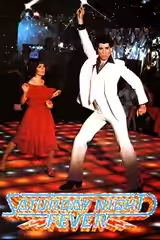
Flashdance is the weaker drama beside Saturday Night Fever, which we recommend for dancing supported by a more involving account of the dancers’ frustrations. Both have writing problems, but John Travolta’s uneasy charm gives the latter more to hold our attention between numbers; Flashdance suits those content to wait for the next dance.
What should I watch after Flashdance?
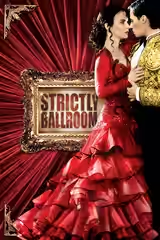
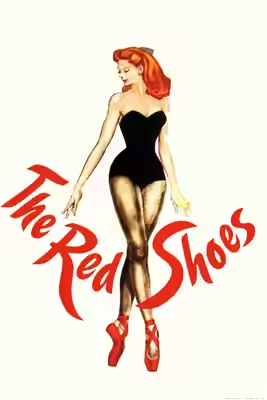
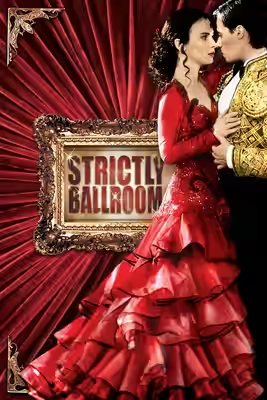
After Flashdance, try Saturday Night Fever (1977, Fi1m 78): For dancing that cannot quite conceal how unhappy the dancers are. Then Strictly Ballroom (1992, Fi1m 83): Another dance-floor fantasy, with sharper jokes and more affection for its eccentrics; and The Red Shoes (1948, Fi1m 92): For a dance film that takes the cost of ambition seriously.

Cast

Awards

Academy Awards, 1984

Nominated
Best Cinematography
Nominated
Best Film Editing

Golden Raspberry Award for Worst Screenplay, 1984

Nominated
Golden Raspberry Award for Worst Screenplay

If you liked this, try…

  1. Saturday Night Fever (1977, Fi1m 78)For dancing that cannot quite conceal how unhappy the dancers are.

  2. Strictly Ballroom (1992, Fi1m 83)Another dance-floor fantasy, with sharper jokes and more affection for its eccentrics.

  3. The Red Shoes (1948, Fi1m 92)For a dance film that takes the cost of ambition seriously.

  4. Girlhood (2014) · not reviewed yetMusic, movement and female friendship, with more curiosity about the lives between songs.

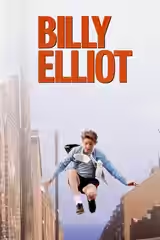
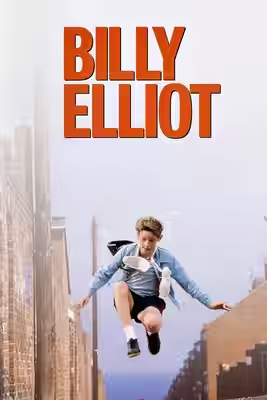
  5. Billy Elliot (2000, Fi1m 81)Another would-be dancer facing obstacles, with a more convincing life outside rehearsals.

Free account

Know what to watch tonight

Two lists that know where things are streaming, collections you can share, your own score beside ours, and Discover that remembers what you have seen.

  • Want to see, sorted by what is streaming now
  • Seen, with your score out of ten
  • No adverts, ever