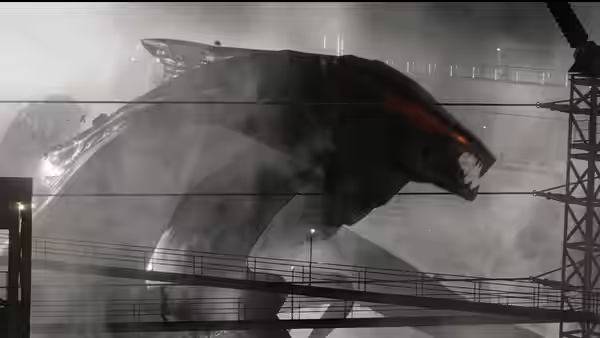
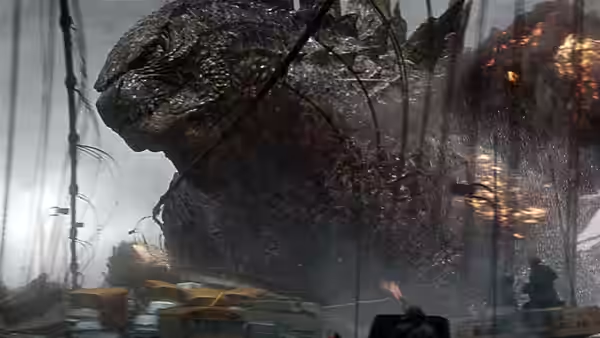
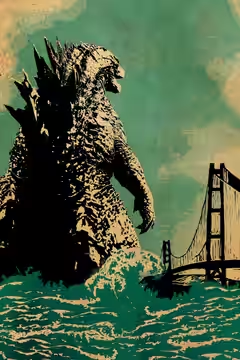
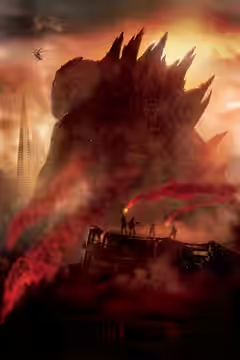
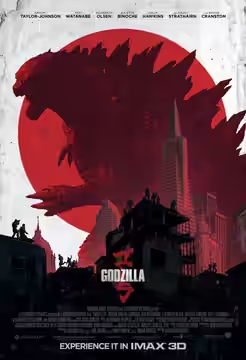
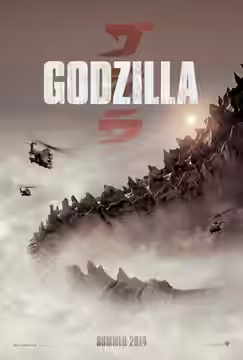
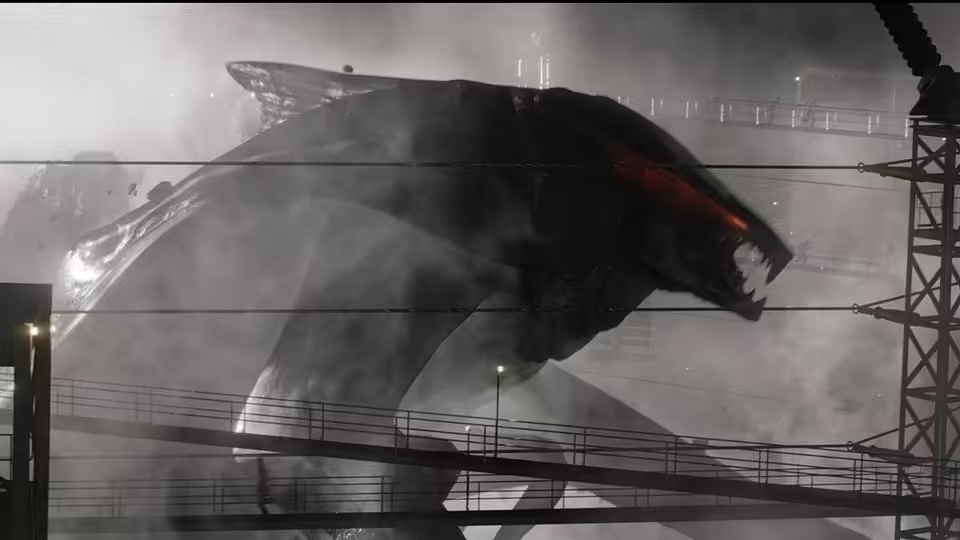
A giant winged creature looms over an elevated walkway amid smoke and industrial structures
Film review

Godzilla

2014 · Directed by Gareth Edwards · 2h 03m · BBFC 12A

In a sentenceTwo hours of a film cutting away from its own monster, and a last half hour explaining why it was right to

In 1999, Joe Brody (Bryan Cranston) runs a nuclear plant on the Japanese coast with his wife Sandra (Juliette Binoche). Tremors arrive that nobody can explain, the plant collapses and the town is sealed off. Fifteen years later their son Ford (Aaron Taylor-Johnson), a Navy bomb-disposal officer, has come home to his wife Elle (Elizabeth Olsen) in San Francisco when he is called to Japan to bail his father out of jail. Joe was arrested inside the quarantine zone, certain the collapse was no accident. Father and son go back in, find a town frozen in 1999, and are taken to the ruined plant, where Dr Serizawa (Ken Watanabe) and Dr Vivienne Graham (Sally Hawkins) have been watching something the size of a building grow inside a cocoon.

Plays from YouTube when you press play; nothing loads from them until then.

Fi1m review

Gareth Edwards keeps his monster in the fog for most of two hours, and a night-time battle over San Francisco repays the wait. The people in the foreground are another matter: Cranston is used too briefly, Taylor-Johnson barely at all.

Gareth Edwards made Monsters (2010) by keeping his creatures at the edge of the frame and pointing the camera at the people looking at them. He does the same thing here with the most famous creature in cinema, on a scale his first film could only gesture at. Godzilla is a patient film, close to a slow one, and it holds its title character back for most of its 123 minutes. When it lets go, in the last half hour, it is as good as this sort of thing gets. Getting there means spending a lot of time with people that Max Borenstein’s screenplay has not bothered to write.

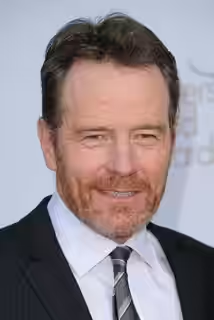
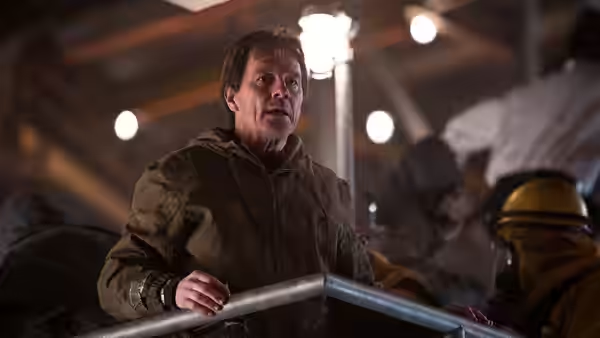
The opening is the strongest stretch of story the film has. Joe Brody (Bryan Cranston) runs a nuclear plant on the Japanese coast in 1999, tremors arrive that should not be there, and the plant comes down around him. Cranston plays the fifteen years that follow as a man who has not slept properly since, jabbing at charts in a flat papered with cuttings, and he is the only actor here given something to want. The wig he does it under has been much remarked on and deserves to be. Juliette Binoche, as his wife Sandra, has perhaps three scenes and makes them count.

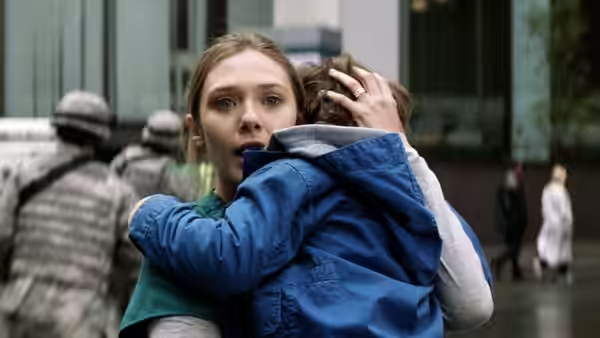
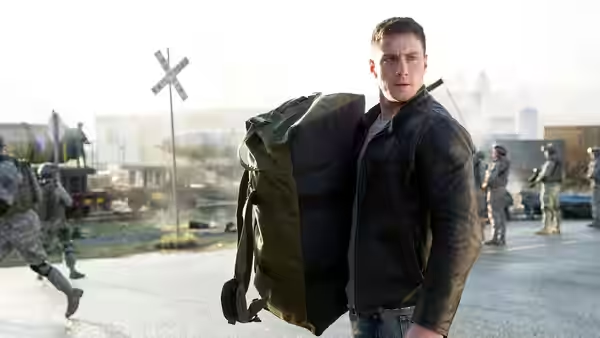
The trouble is who the film hands the story to afterwards. Aaron Taylor-Johnson’s Ford is a Navy bomb-disposal officer, which is a useful thing to be in a film that ends up needing one, and that is the whole of his character. The script moves him from Japan to Hawaii to San Francisco because it needs a face at each stop, and Taylor-Johnson supplies a face. Elizabeth Olsen, as his wife Elle, spends the film in a hospital waiting for a phone to ring. Ken Watanabe’s Serizawa stares at things with his mouth slightly open while Sally Hawkins’s Dr Graham explains them to him, and David Strathairn’s Admiral Stenz gives orders that nobody in the audience believes will work.

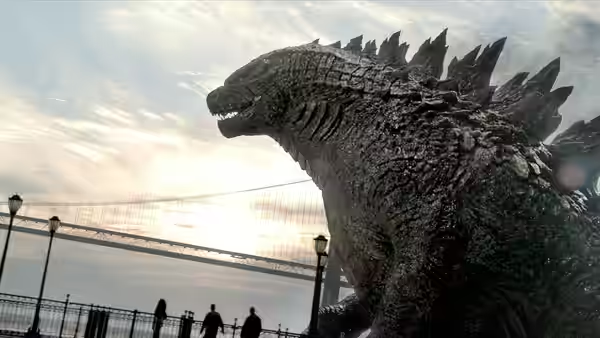
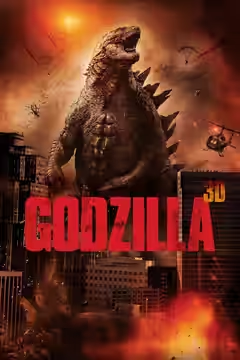
The craft is another story. Seamus McGarvey shoots almost everything through something: smoke, rain, the window of a train, the visor of a gas mask, a television screen in a departure lounge. The monsters are lit by flares and lightning and the fires they have started, so we see a flank, a tail, a jaw, and are left to put the rest together. Owen Paterson’s quarantine zone is a town with the 1999 calendars still on the walls and the plant behind it gutted to its ribs. Alexandre Desplat’s score keeps to low brass and drums and leaves the roar to the sound department, which is the right decision.

Bob Ducsay’s editing is the film’s most argued-over choice, and we argued with it ourselves. The first monster fight, at Honolulu airport, is glimpsed on a news report as a hospital door swings shut. We laughed, and then we were annoyed, and then we saw the point: Edwards wants us hungry. It works for two withholdings. By the third we had stopped admiring the restraint and started checking our watch.

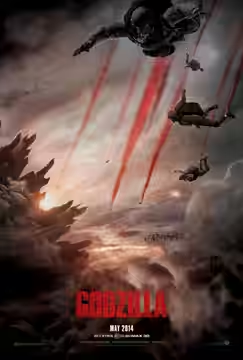
Then the soldiers jump. A team drops from an aircraft into black cloud over San Francisco with red flares trailing from their ankles, a Ligeti requiem on the soundtrack, and the city below lit only by what is burning, and we sat forward and did not sit back until the credits. The fight that follows is staged at night in dust and fog, with Godzilla a shape more often than a body, and it earns every one of the shots the film refused us earlier. There is a moment in it that fans of the older films have waited a long time for, and Edwards makes them wait until the last possible second.

Ishirō Honda’s original, in 1954, was about the bomb. This one says the word Hiroshima once and moves on. Edwards’s Monsters was a film about two people with a creature behind them; this is a film about a creature with people left in front of it by accident. Most critics have split roughly down the middle, and for once that seems about right.

See it on the largest screen you can find with the sound turned up, because at home the fog is only fog and the man in the foreground is only a man. It carries a 12A, and the certificate is earned by dread rather than blood.
Critical consensus AI synthesised

64
Positive
11
Mixed
10
Negative
4

Most critics come out in favour, though not by much: eleven positive reviews, ten mixed and four negative. The praise gathers around Gareth Edwards’s patience. Reviewers admire the slow build to the monster’s first full appearance, the way people are dwarfed by the creatures and the wreckage, and the scale of the final battle, which several call the film’s best stretch. The creature effects are widely approved of, and Bryan Cranston is picked out more than once.

The reservations are nearly unanimous on one point: the human characters are thin and the story cannot carry the weight put on it. Several critics also feel Godzilla is kept off screen too long and the tone is too solemn. The spread is wide. Little White Lies and The Skinny give full marks; The New Yorker tells readers to skip it. The harshest notices come mostly from the American press, Variety and the Los Angeles Times among them, while British critics are warmer.

Little White Lies
16 May 2014 · 5/5/5 · Adam Lee Davies
100

The critic delivers an emphatic rave, calling the film glorious and astonishing. They praise its patient build and awe-inspiring spectacle, while noting Bryan Cranston’s wig as its only flaw.

Read the full review →
Evening Standard
23 July 2014 · David Sexton
85*

Sexton calls it a thumpingly good monster movie and recommends seeing it. He praises its fidelity to the original and Edwards’s effective use of partial, fleeting views.

Read the full review →
The Guardian
18 May 2014 · Mark Kermode
85*

Kermode finds the reboot impressive and respectful of Honda’s original, though not as deep. He praises Edwards’s ambition and the film’s tender creature relationships, while noting that supporting characters fade during the destructive third act.

Read the full review →
Film Comment
· Jonathan Romney
75*

Romney finds the film to be powerful fun. The standfirst singles out its star-studded take on Godzilla’s story.

Read the full review →
Slant Magazine
17 March 2021 · ★★★½ · Chris Cabin
70

The review praises the film’s bold visual sense of scale and compelling action. It finds the 4K image markedly improved, though the disc’s extras are cursory and largely unneeded.

Read the full review →
Sight and Sound
16 May 2014 · Kim Newman
65*

Newman finds the film successfully restores Godzilla as the true King of the Monsters, despite its weak human story. He praises the awe-inspiring scenes that dwarf people against the monsters and destruction.

Read the full review →

Straight answers AI written, from our review

Is Godzilla worth watching?
Godzilla is worth watching if you can sit through two patient hours for a last half hour that is as good as monster cinema gets, and we scored it 68. The people in the foreground are the problem: Bryan Cranston is used too briefly and Aaron Taylor-Johnson barely at all. See it on the largest screen you can, because at home the fog is only fog.
How long is Godzilla, and what is it rated?
Godzilla runs 2h 03m and is rated 12A by the BBFC in the UK. It is an action and drama film.
Where can I watch Godzilla in the UK?
Godzilla is streaming on HBO Max, Apple TV and Amazon Prime Video in the UK, and it is also available to rent from Amazon Prime Video and Apple TV from £3.49. Availability is checked daily; the links above go straight to each service.
How violent or frightening is Godzilla, and is it suitable for children?
Godzilla carries a 12A, and the certificate is earned by dread rather than blood. The monsters are kept in smoke, rain and darkness, a nuclear plant collapses in the opening scenes, and the film builds tension for a long time before it lets go. Older children and teenagers should be fine; younger or more nervous viewers will find the waiting harder than anything it shows.

How does Godzilla compare to Godzilla: King of the Monsters?
Godzilla is the tighter and better made of the two, holding its monster back for most of the running time and then paying off the wait in a night battle over San Francisco. Godzilla: King of the Monsters gives its creatures grander entrances, Mothra's especially, but fills the gaps with people in bunkers reading the plot to each other. Choose the earlier film for patience, the later one for spectacle.
Do you need to have seen the other Godzilla films before Godzilla?
Godzilla stands alone, and nothing else needs to be seen before it. The story begins in 1999 with a nuclear plant on the Japanese coast and explains itself as it goes, with the later films in the series following on from it rather than leading into it. Fans of the older films will spot a moment saved for them near the end, but newcomers lose nothing by missing it.
What should I watch after Godzilla?
After Godzilla, try Godzilla (1954, Fi1m 88): Honda’s original, where the monster is grief for a bombed country and it shows. Then Shin Godzilla (2016, Fi1m 74): Japan’s own reboot, half creature feature and half committee meeting, oddly gripping; and Jaws (1975, Fi1m 93): The lesson in withholding that Edwards learned from, with better people in the boat.
What order should I watch the Godzilla films in?
Release order is the safe choice for Godzilla, and it is the order our collection page lists them in. Godzilla is the first of the 4 Godzilla titles on Fi1m; after it Godzilla: King of the Monsters. The full order.

Cast

If you liked this, try…

  1. Godzilla (1954, Fi1m 88)Honda’s original, where the monster is grief for a bombed country and it shows.

  2. Monsters (2010) · not on Fi1m yetEdwards’s first film, two people and a border, creatures kept politely out of frame.

  3. The Host (2006) · not on Fi1m yetBong Joon-ho’s river monster, a family who bicker through it, and real feeling.

  4. Shin Godzilla (2016, Fi1m 74)Japan’s own reboot, half creature feature and half committee meeting, oddly gripping.

  5. Jaws (1975, Fi1m 93)The lesson in withholding that Edwards learned from, with better people in the boat.