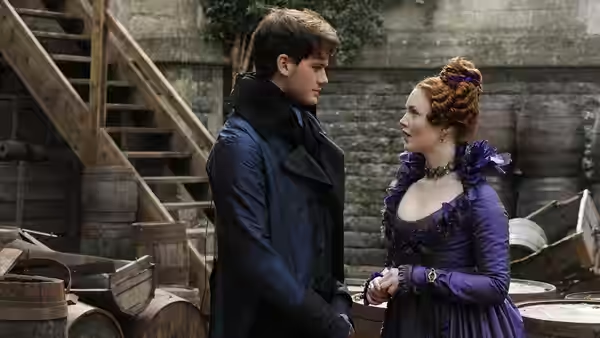
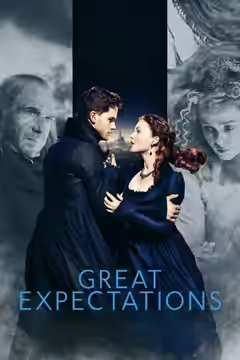
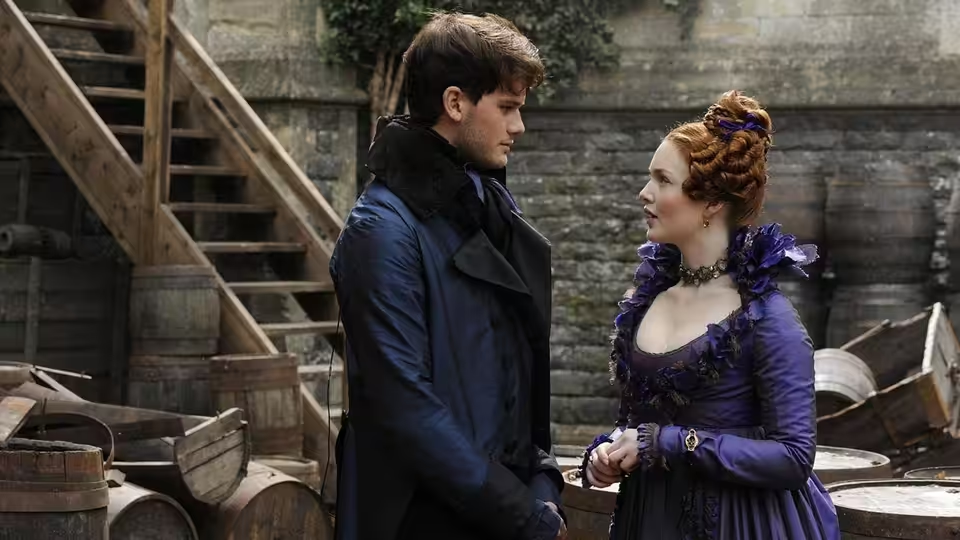
Pip (Jeremy Irvine) and Estella (Holliday Grainger) face each other in a stone courtyard
Film review

Great Expectations

2012 · Directed by Mike Newell · 2h 08m · Kijkwijzer 12

In a sentenceWe kept waiting for Helena Bonham Carter or Ralph Fiennes to come back

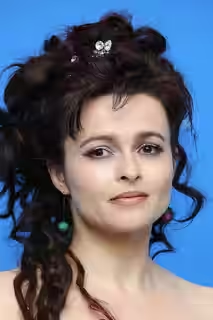
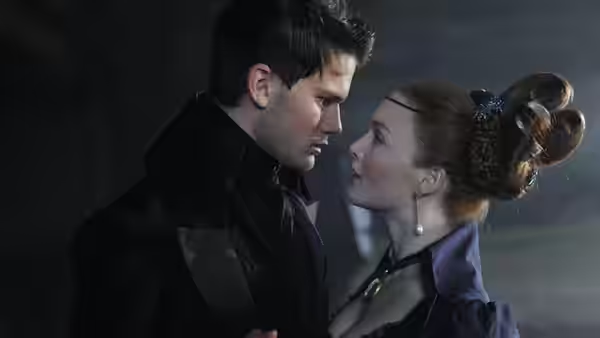
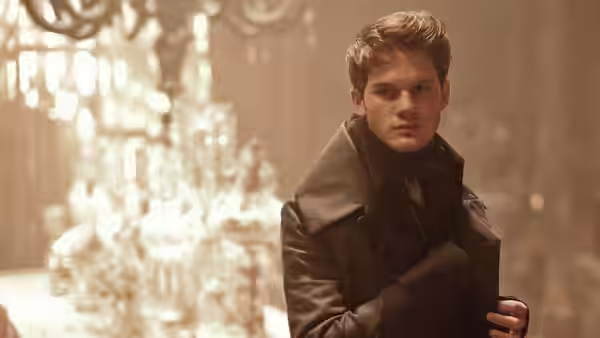
Philip ‘Pip’ Pirrip (Jeremy Irvine) and Estella Havisham (Holliday Grainger) are the young lovers at the centre of Mike Newell’s adaptation of Charles Dickens’s novel. Around their romance stand Miss Havisham (Helena Bonham Carter), in an elaborate wedding costume, and Abel Magwitch (Ralph Fiennes). Mr. Jaggers (Robbie Coltrane), Mrs. Joe (Sally Hawkins) and Joe Gargery (Jason Flemyng) also figure in Pip’s story. David Nicholls writes the screenplay, bringing Pip and Estella’s relationship together with an ensemble that also includes Wemmick (Ewen Bremner) and Mr. Pumblechook (David Walliams).

Fi1m review

Mike Newell’s Great Expectations gives its supporting cast more to work with than its central romance. There are performances worth watching, but the adaptation is too cautious and compressed to make enough of them.

Mike Newell’s Great Expectations is watchable, carefully made and too cautious to recommend without a particular interest in its cast. David Nicholls compresses Charles Dickens’s novel into 128 minutes, leaving the actors to supply much of the feeling that the script has little time to develop. The supporting players often manage it. The central romance is less secure, and a film with so many strong performers should not leave us waiting quite so often for someone else to take over.

Jeremy Irvine gives Philip ‘Pip’ Pirrip an appealing openness, but his performance does not make the character’s feelings complicated enough to sustain all this attention. Holliday Grainger’s Estella Havisham is more compelling, although the pairing remains uneven. Too often, we find ourselves accepting the importance of their romance because the script insists on it. The screenplay keeps their relationship prominent without giving it enough room to become persuasive, and the careful presentation cannot supply what is missing between them.

Helena Bonham Carter has a firmer grasp of what makes Miss Havisham worth watching. The elaborate wedding costume could easily do the acting for her, but she finds the passion beneath it. We were moved by her, because she lets us see how much feeling survives beneath the character’s forbidding appearance. Beatrix Aruna Pasztor’s costume design makes an immediate impression, but the performance keeps our attention.

Ralph Fiennes also makes a strong impression as Abel Magwitch, bringing enough feeling to the role to unsettle the film’s otherwise careful manners. He gives us something to care about without making each emotion seem like another item the adaptation must include. Sally Hawkins, as Mrs. Joe, and David Walliams, as Mr. Pumblechook, provide welcome changes of emphasis. Their performances have a definition that the young leads cannot always match, although the contrast also makes the central scenes feel thinner.

John Mathieson’s cinematography favours a grey palette that gives the drama a sombre consistency, though the effect becomes tiring. Jim Clay’s production design rewards a look around the frame even when the storytelling feels dutiful. Yet the surroundings receive a care that the relationships do not always get, and we become too conscious of how neatly everything has been presented. Richard Hartley’s music supplies a romantic emphasis that the leads do not always earn.

Tariq Anwar’s editing has the awkward job of making a compressed screenplay feel unhurried. There is enough momentum to keep the story comprehensible, but too little time to sit with the people once the necessary information has arrived. The later stretch feels particularly hurried, without gaining much urgency from the pace. We do not need every detail of a novel retained, but we do need time to care about what happens to its characters.

A literary adaptation need not justify itself by being radically different, and the familiar complaint that another version is unnecessary seems beside the point. What matters is whether the characters feel worth meeting here. Too often, this version settles for a recognisable performance or a carefully dressed scene when the relationships need more attention. Watch it for Helena Bonham Carter and Ralph Fiennes only if waiting for their next appearance sounds like enough of an evening.

Critical consensus AI synthesised

55
Positive
1
Mixed
9
Negative
3

Most critics find Mike Newell’s Great Expectations watchable and well performed, but too cautious to make a persuasive case for another adaptation. Praise clusters around the supporting cast, particularly Helena Bonham Carter’s Miss Havisham and Ralph Fiennes’s Magwitch, who provide much of the energy and feeling the reviews find missing elsewhere. Several critics also admire the production’s handsome appearance, though that polish does not settle doubts about its emotional force.

The spread runs from enjoyment with reservations to disappointment, with most reviews sitting between those positions. Eye for Film is the most enthusiastic, especially about Bonham Carter and her elaborate wedding costume. The young leads divide opinion: Total Film praises the central romance and its performances, while IndieWire faults Jeremy Irvine. Complaints otherwise centre on compression, familiarity and a reluctance to take risks; some find the film attractive but safe, others grim or drab.

Evening Standard
13 December 2012
65*

The review finds Newell’s adaptation enjoyable despite its uneven young leads, with the experienced cast providing much of its appeal. It especially praises Helena Bonham Carter for revealing Miss Havisham’s hidden passion.

Read the full review →
Screen Daily
11 September 2012 · Mark Adams
64*

The accessible page identifies this as Mark Adams’s review, but its verdict is behind the paywall. No specific praise or complaint is visible in the available text.

Read the full review →
IndieWire
11 September 2012 · C+ · Jason Anderson
63

Anderson finds the adaptation stiff and ultimately superfluous, despite its strong production and cast. He praises Helena Bonham Carter and Ralph Fiennes as effective casting choices, while criticizing Jeremy Irvine’s performance and the condensed screenplay.

Read the full review →
The Guardian
29 November 2012 · Peter Bradshaw
60*

Bradshaw finds the adaptation watchable and accessible, but less emotionally powerful than Dickens’s story. He praises the performances, especially the cameo turns by Sally Hawkins and David Walliams.

Read the full review →
Time Out
27 November 2012 · ★★★ · Cath Clarke
60

The available metadata frames this as another adaptation arriving soon after a television version. It poses the question of what distinguishes Mike Newell and David Nicholls’s take, but the page provides no further verdict or praise to report.

Read the full review →
Total Film
26 November 2012 · ★★★ · Kate Stables
60

Stables finds the adaptation visually beautiful and well acted, but too cautious and rushed to do justice to Dickens. She singles out the central romance and the leads’ performances as what lifts it above its cosy approach.

Read the full review →

Straight answers AI written, from our review

Is Great Expectations worth watching?
Great Expectations is worth considering for Helena Bonham Carter and Ralph Fiennes, but we find it too cautious and compressed to recommend more broadly, and score it 57 out of 100. Their supporting performances supply feeling that the uneven central romance lacks, so it chiefly suits viewers with a particular interest in the cast.
How long is Great Expectations, and what is it rated?
Great Expectations runs 2h 08m and is rated 12 by the Kijkwijzer in the Netherlands. It is a drama and romance film.
Where can I watch Great Expectations in the Netherlands?
Great Expectations is streaming on Amazon Prime Video in the Netherlands, and it is also available to rent from Apple TV from €3.99. Availability is checked daily; the links above go straight to each service.
How violent or frightening is Great Expectations, and is it suitable for children?
Great Expectations has a UK 12A certificate, which calls for parental judgement for younger children and requires those under 12 to be accompanied by an adult at the cinema. We cannot offer a more specific warning about violence or frightening scenes from our review, which concentrates on the romance and performances rather than potentially upsetting content.
How does Great Expectations compare to The Heiress?
Great Expectations is the weaker choice beside The Heiress if we want a period romance that makes wounded pride and hesitation painfully clear. We recommend The Heiress for its exact, unsentimental treatment of family relationships; Great Expectations offers affecting supporting performances, but its central relationship never becomes persuasive enough.
Is Great Expectations based on a true story or a book?
Great Expectations is adapted from Charles Dickens’s novel, with a screenplay by David Nicholls, rather than presented as a true story. We find the compression into 128 minutes leaves too little room for the relationships to develop, though the story remains comprehensible without prior knowledge of the book.
What should I watch after Great Expectations?
After Great Expectations, try The Heiress (1949, Fi1m 90): For a period romance that makes wounded pride and hesitation painfully clear. Then Jane Eyre (2011, Fi1m 77): Another literary romance, with more unease in the rooms and between the lovers; and The Age of Innocence (1993, Fi1m 86): Elaborate clothes and rooms make the cost of social obedience felt.

Cast

If you liked this, try…

  1. The Heiress (1949, Fi1m 90)For a period romance that makes wounded pride and hesitation painfully clear.

  2. Jane Eyre (2011, Fi1m 77)Another literary romance, with more unease in the rooms and between the lovers.

  3. The Age of Innocence (1993, Fi1m 86)Elaborate clothes and rooms make the cost of social obedience felt.

  4. The Music Room (1958, Fi1m 88)A decaying household gives stubborn pride somewhere specific, and painful, to live.

  5. Bright Star (2009, Fi1m 82)Quiet attention to clothes and gestures gives this literary romance its force.