Chloé Zhao’s adaptation of Maggie O’Farrell’s novel is a grief film first and a Shakespeare film a distant second, and Jessie Buckley carries it. The middle hour cries too much and too prettily; the last act, in London, earns most of what the rest asks for.
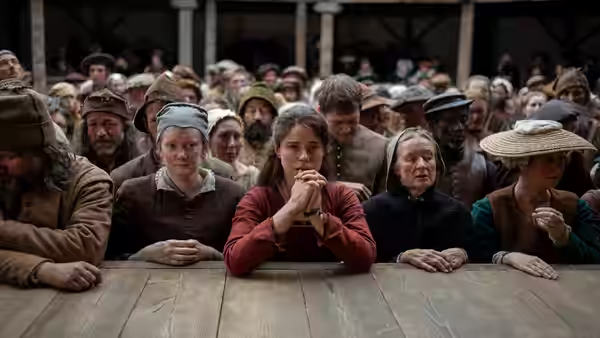
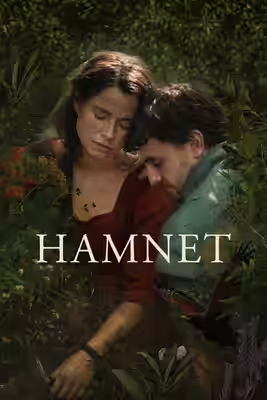
Stratford-upon-Avon, some years before anyone has heard of the plays. Agnes (Jessie Buckley) lives at the edge of the forest, keeps a hawk, knows which plant does what, and is talked about in the town as something close to a witch. Will (Paul Mescal) is a glover’s son teaching Latin to pay off his father’s debts. They marry, they have children, and one of those children is a boy called Hamnet. Anyone who knows the outline of Shakespeare’s life knows what happened to that boy, and Chloé Zhao’s film, written with Maggie O’Farrell from O’Farrell’s novel, assumes you do. It is not a film about how the plays got written. It is a film about a mother, and the plays arrive late and from the side.
It is good, and we recommend it with a reservation the size of its middle hour. Buckley is the reason to go. Zhao has made a film that knows exactly what it wants you to feel and when, and for long stretches we felt it and minded being managed. Then the last act moves to London and we stopped minding.
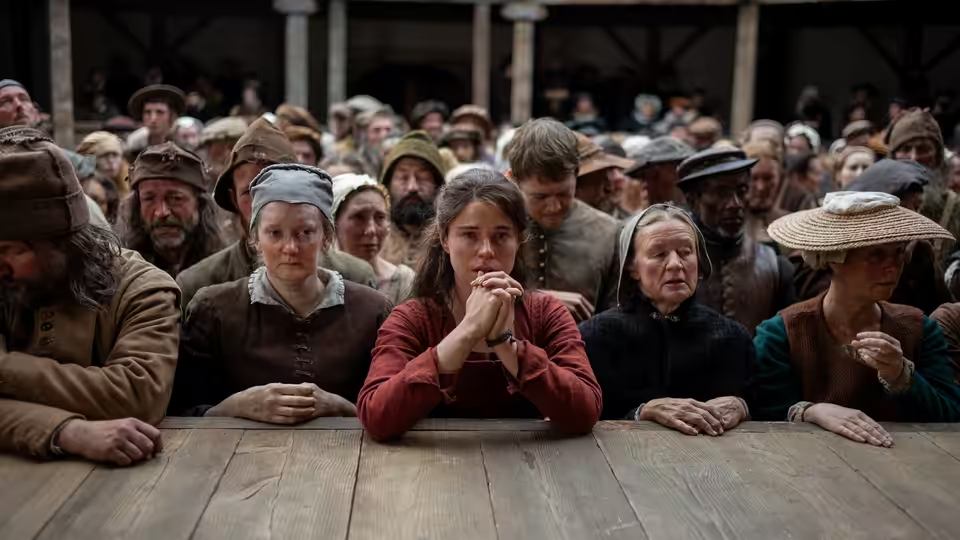
Łukasz Żal, who shot Cold War and The Zone of Interest, keeps the camera close and mostly at the height of a face. The forest is green daylight and moving leaves; the house in the town is fire and window and not much else, so that people are lit from one side and everything behind them falls into shadow. Fiona Crombie’s production design makes the Shakespeare house a working place, low beams and a glove workshop off the hall, rather than a museum with the ropes taken down. Malgosia Turzanska dresses everyone in undyed wool and linen with mud on the hems. Nobody looks laundered, and it helps.
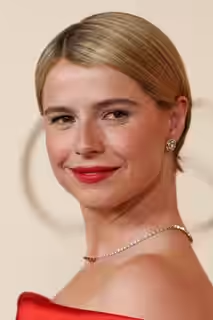
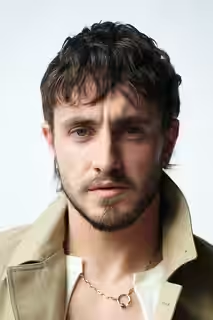
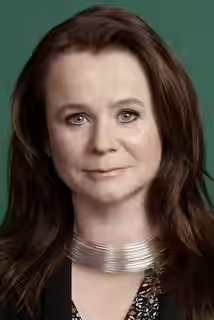
Buckley plays Agnes as someone always listening to something nobody else in the house can hear. She is barefoot and quick in the woods and watchful indoors, and when the film asks her to fall apart she does it without once reaching for the audience. Mescal’s Will is quiet, hesitant and half-absent, and Zhao keeps him at the edge of the frame. That is a choice with a cost: there is not a line in the film that sounds like it came from the man who wrote the plays, and we think that was deliberate and we are not sure it was wise. Emily Watson’s Mary has buried children of her own and says so plainly. Joe Alwyn is solid as Agnes’s brother Bartholomew. Jacobi Jupe as Hamnet and Olivia Lynes as Judith are the best kind of child actors, the kind you forget are acting.
The trouble is the stretch after illness enters the house. The film settles on grief at one pitch and holds it. Buckley weeps, Mescal weeps, Watson weeps, and Richter’s strings come in under nearly all of it. Zhao and Affonso Gonçalves, who edited together, hold on faces well past the point where the face has told us everything. We cried in the bedroom scenes, and we noticed, halfway through crying, that the music had told us to, and we resented it. The feeling was real. So was the resentment.
In its last twenty minutes the film goes to London, and we will not describe what happens there. We can say that it is where the title and the play finally meet, that Noah Jupe, Jacobi’s brother, is cast as the actor playing Hamlet, and that this is the cleverest single idea in the film. We sat through the credits. Whatever we thought of the hour before it, the ending is paid for by Buckley’s face and by Zhao, for once, letting a scene run without a hand on our shoulder.
Her earlier films, The Rider and Nomadland, were made by watching people and waiting. Here she has a plot with a fixed end and a well-loved novel to honour, and the waiting has gone. At 125 minutes nothing drags, but nothing wanders either, and we missed the wandering.
It is a 12A, and the certificate is about right: nothing here a twelve-year-old cannot see, though a good deal they may not want to. Take someone who does not mind crying in public. You will both be doing it.