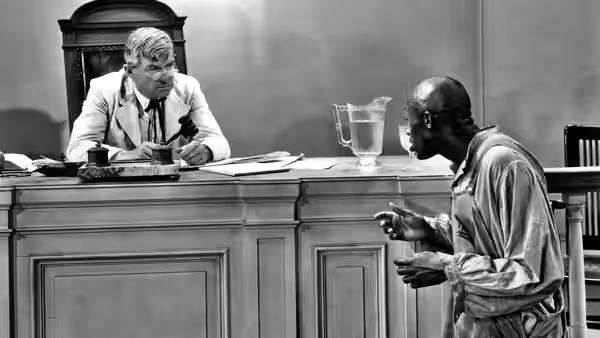
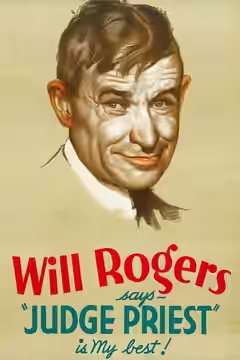
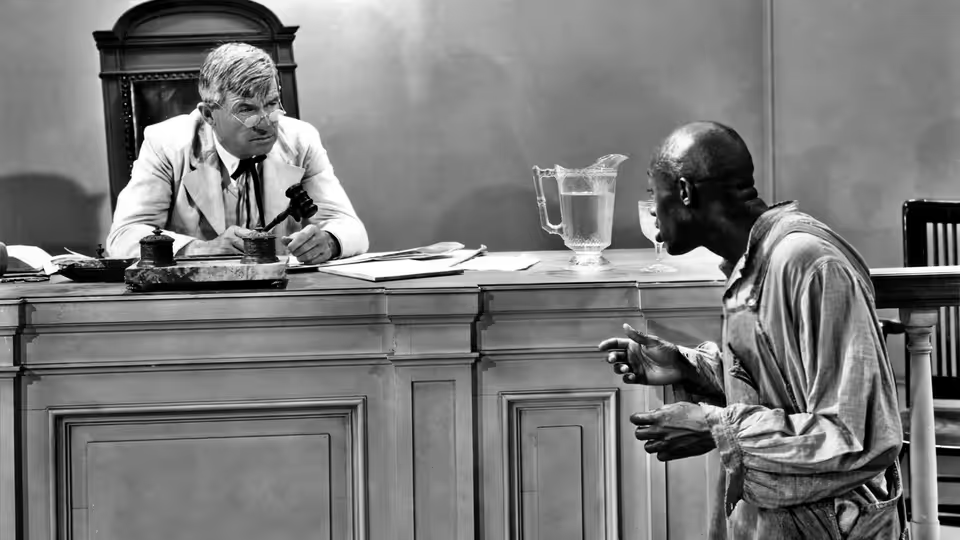
Judge William Pitman 'Billy' Priest (Will Rogers) listens as a man addresses him at the bench
Film review

Judge Priest

1934 · Directed by John Ford · 1h 20m

In a sentenceWill Rogers makes a persuasive case for giving the judge better material

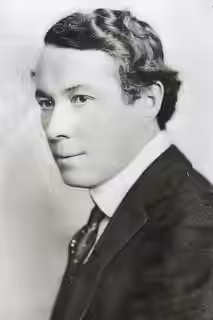
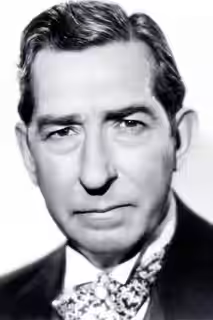
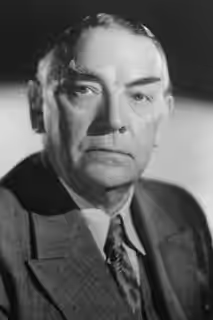
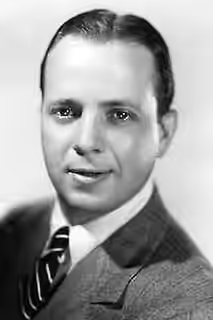
Judge William Pitman ‘Billy’ Priest (Will Rogers) takes the central role in this comedy-drama directed by John Ford. The characters around him include Jerome Priest (Tom Brown), Ellie May Gillespie (Anita Louise) and Reverend Ashby Brand (Henry B. Walthall). David Landau plays Bob Gillis, while Rochelle Hudson appears as Virginia Maydew and Berton Churchill as Senator Horace Maydew. Combining comedy, drama and romance, the film places Rogers at the head of an ensemble that also includes Brenda Fowler as Mrs. Caroline Priest.

Fi1m review

Will Rogers gives Judge Priest an appealing centre, but John Ford’s loosely assembled comedy-drama offers him a thin story. There is pleasure in the performance, rather less reason to become involved in the film.

Judge Priest is an uneven comedy-drama whose chief attraction is Will Rogers. John Ford gives him the central role, and Rogers supplies enough personality to make the film agreeable without making it particularly satisfying. The trouble is a thin story, which keeps asking the appeal of its leading man to compensate for what the writing has not supplied. At 80 minutes, it is a modest commitment, though brevity does not make its loose construction disappear.

Rogers plays Judge William Pitman ‘Billy’ Priest, and the confidence with which he inhabits the character is the film’s strongest asset. We enjoyed his comedy; it gave us a reason to remain interested when the story did not. There is a distinction between making a character pleasant company and giving that character something compelling to do, and the film depends heavily on the former. Rogers makes that dependence bearable, but we kept wishing the material would offer him more resistance.

The screenplay credits belong to Lamar Trotti and Dudley Nichols, with Irvin S. Cobb credited as writer. The mixture of comedy, drama and romance promises several ways into the film, yet the ingredients do not acquire enough force together. A slight story can work perfectly well if its smaller incidents accumulate into something richer. Here, the looseness too often feels like an excuse to postpone the business of developing one, leaving Rogers responsible for sustaining our attention.

The attempts at local colour are a further difficulty because they need to provide interest where the plotting is spare. Some are less persuasive than the central performance, and the film’s pleasure becomes intermittent rather than cumulative. We do not need every detail to advance a plot, or every supporting character to arrive carrying an explanation. We do need those details to make the company more absorbing, and too much here seems content merely to accompany the judge.

George Schneiderman is the cinematographer, Paul Weatherwax the editor and Samuel Kaylin supplies the music. The weakness we would put first, however, is the writing: nothing in the film’s presentation makes the story feel sufficiently developed. Its loose assembly matters because the comedy has to keep renewing our interest without much help from what happens next. A more insistent pace would not necessarily improve that; the material needs substance rather than simply less time between its attractions.

Ford’s undertaking is appealing enough: a comedy-drama that makes room for a central personality instead of requiring constant incident. Measured against that aim, Rogers is a considerable success, and it would be ungenerous to dismiss the film as merely inadequate. But affection for a performer has limits, especially when the surrounding material provides so little pressure or surprise. Seek it out for Rogers if his company is the attraction; do not expect the story to earn an equal share of the evening.
Critical consensus AI synthesised

2 of 6
Positive
1
Mixed
0
Negative
1
Variety
31 December 1933 · Variety Staff
70*

The critic finds that Will Rogers makes the Judge Priest character his own, despite a thin story. Rogers and Stepin Fetchit provide much of the comedy, while some attempts at local color are less effective.

Read the full review →
Time Out
· TM
40*

The review describes the film as a loose amalgam, less fully realized than Ford’s later reworking. It singles out that later version as the more personalized and perfected film.

Read the full review →

Straight answers AI written, from our review

Is Judge Priest worth watching?
Judge Priest is worth considering for Will Rogers’s appealing central performance, but we score it 58 because the thin story gives us little reason to become involved. His comedy sustains interest through the loose construction; we would recommend it only if his company matters more to you than a well-developed comedy-drama.
How long is Judge Priest, and what is it rated?
Judge Priest runs 1h 20m. It is a comedy and drama film.
Where can I watch Judge Priest in Austria?
Judge Priest is not on any streaming or rental service in Austria at the moment. It is available in 8 other countries; change your country at the top of the page to see where. Availability is checked daily.
How does Judge Priest compare to Ruggles of Red Gap?
Judge Priest is the less satisfying of these two character-led comedies; we recommend Ruggles of Red Gap for its humour and the bite beneath its generous manners. Both have thin plotting, but Charles Laughton’s likeable performance makes that easier to forgive in Ruggles of Red Gap, while Will Rogers has too much to carry in Judge Priest.
What should I watch after Judge Priest?
After Judge Priest, try Ruggles of Red Gap (1935, Fi1m 84): Another character-led comedy, with more bite beneath its generous manners. Then Local Hero (1983, Fi1m 86): An unhurried comedy that makes its supporting company worth lingering over.

Cast

If you liked this, try…

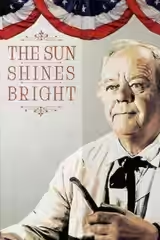
  1. The Sun Shines Bright (1953) · not on Fi1m yetFord returns to Judge Priest with a more fully developed film.

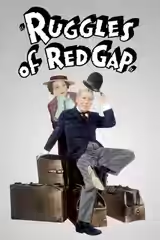
  2. Ruggles of Red Gap (1935, Fi1m 84)Another character-led comedy, with more bite beneath its generous manners.

  3. Local Hero (1983, Fi1m 86)An unhurried comedy that makes its supporting company worth lingering over.

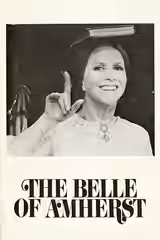
  4. The Belle of Amherst (1976) · not on Fi1m yetFor the pleasure of a central performance that commands an evening.

  5. The Dish (2000) · not on Fi1m yetSmall-town personalities give a gently paced comedy its most reliable pleasures.

Judge Priest (1934) review: Rogers deserves a stronger story (Austria) | Fi1m