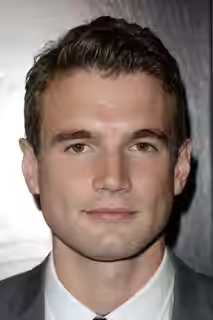
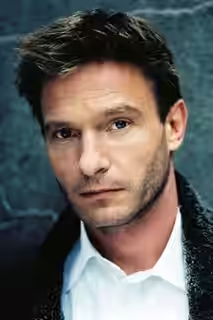
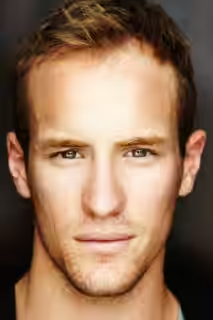
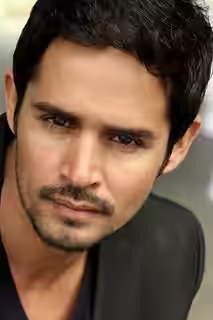
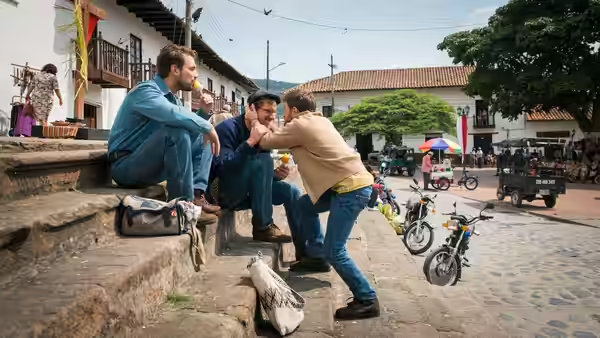
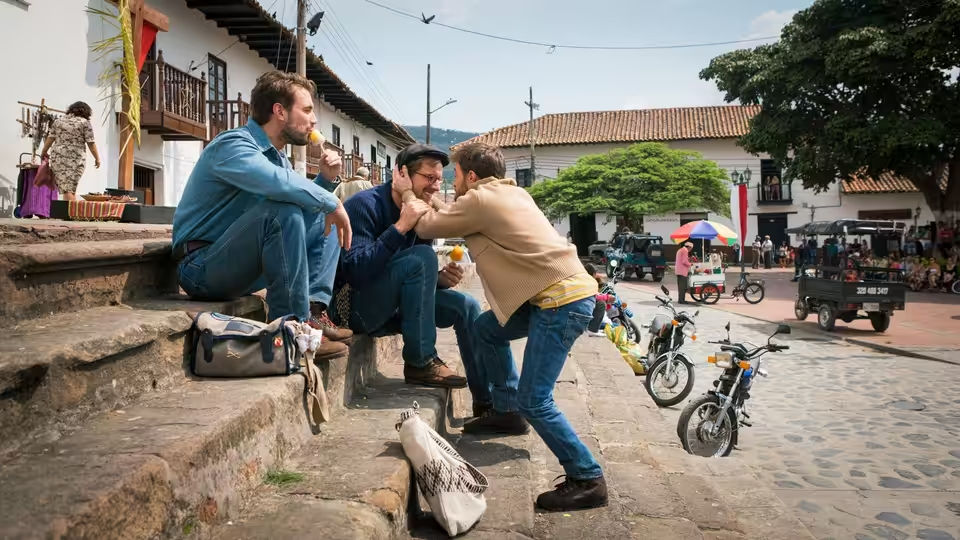
Two travelers greet each other on stone steps beside a busy town street
Film review

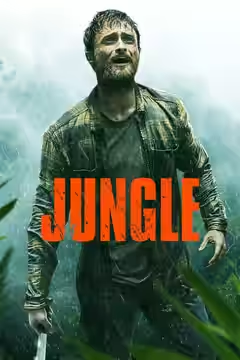
Jungle

2017 · Directed by Greg McLean · 1h 55m · MPA R

In a sentenceDaniel Radcliffe rots convincingly for two hours and the film still cannot make us fear for him

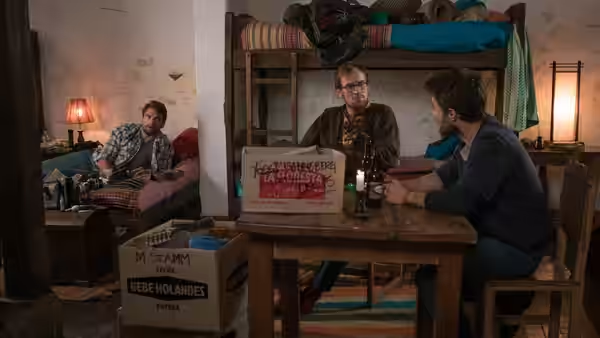
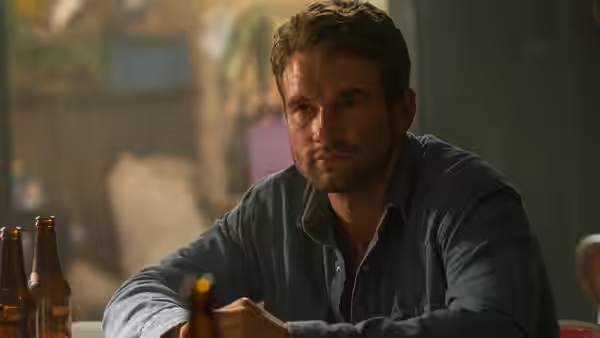
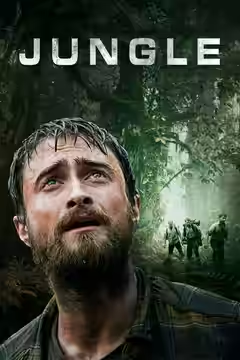
Yossi (Daniel Radcliffe) is a young traveller a long way from home, looking for the kind of adventure his parents would not sign off on. In a town on the edge of the rainforest he falls in with Marcus (Joel Jackson) and Kevin (Alex Russell), two other travellers passing through, and the three are approached by Karl (Thomas Kretschmann), an older man who says he knows a way through the jungle to a village no tourist has seen. They set out on foot with more confidence than kit. Marcus’s feet blister, Kevin loses patience with him, and Karl’s stories stop adding up. Back home, Yossi’s father (Jacek Koman) and mother (Angie Milliken) are the people he keeps thinking of as the walk gets harder and the forest closes in.

Plays from YouTube when you press play; nothing loads from them until then.

Fi1m review

Daniel Radcliffe starves, sinks and rots with total conviction, and Greg McLean’s film never finds a way to make the forest around him frightening. A remarkable story, told in the right order and at the wrong pitch.

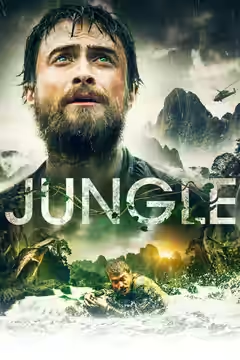
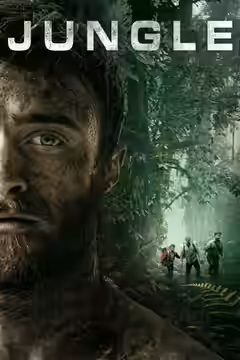
Greg McLean takes Daniel Radcliffe into the rainforest and leaves him there for most of two hours. Jungle is a survival story that knows how extraordinary its ordeal is and assumes that telling it in order will do. Too dutiful, in other words. For long stretches the telling does not do, and we spent much of the middle hour respecting Radcliffe’s effort and waiting for the film to frighten us.

The first forty minutes are the most conventional and, oddly, the best. Justin Monjo’s script sets up the party with the efficiency of a war film: the dreamer, the practical one, the soft one, the stranger who knows the way. Thomas Kretschmann plays Karl with a held-back geniality that keeps us guessing whether he is a fraud or just a man who has been out here too long, and Joel Jackson’s Marcus, blistered and increasingly pitiful, gives the walk its one real argument. Alex Russell’s Kevin has less to do than a second lead should. Sean Lahiff cuts this stretch briskly and the film moves.

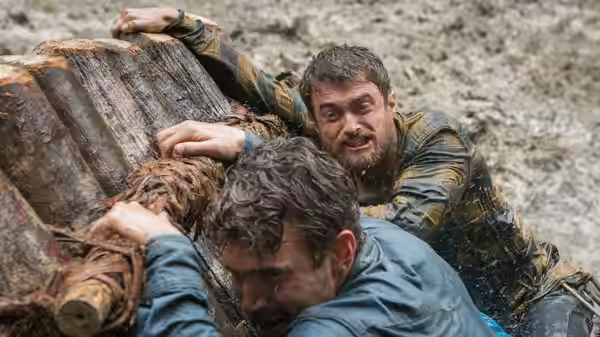
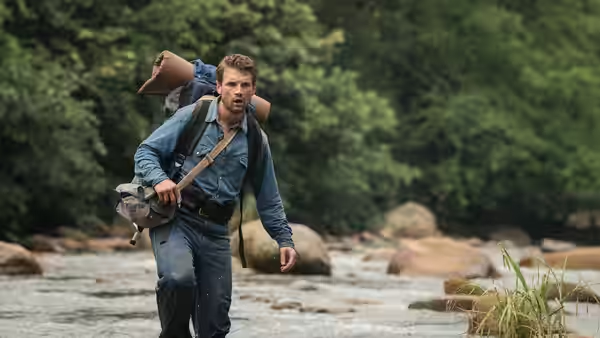
Then the walk turns into an ordeal, and the film has to become something else, and McLean does not seem sure what. Stefan Duscio shoots the forest green and gold and dripping, and it is handsome, but it is never threatening. The camera looks at trees; it does not make us feel shut in by them. Rain falls, mud rises, a jaguar appears and is dealt with, and the danger arrives in episodes rather than as pressure. Matthew Putland’s production design and Vanessa Loh’s costumes do the honest work of rotting Radcliffe’s clothes off him, but a man in wet rags is not the same as a man we fear for.

We did feel something, and we should say what. There is a stretch in the second half we will not describe, in which the film stops looking at the forest and looks hard at Yossi instead, and we winced, then covered our eyes, then were grateful, because for two minutes the film had our whole body. It is the one sequence where McLean’s background in horror is allowed to help. The hallucinations of home that Monjo writes in, with Jacek Koman and Angie Milliken as Yossi’s parents and John Bluthal as his uncle, tell us that Yossi misses his family and is losing his grip, which we had rather assumed.

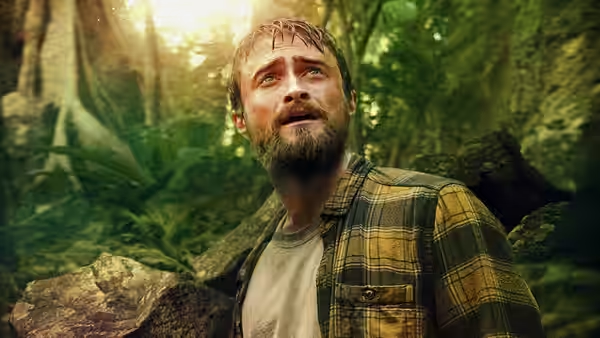
Radcliffe is good, and better than the film around him. He plays Yossi as a nice boy who has run out of nice, and by the last half hour the weight loss, the sunburn and the flat, exhausted eyes are doing more storytelling than the script. He does not overplay the madness, which is the trap in this kind of part. When the scenes fail, and several do, it is never because of him.

Johnny Klimek’s score is the film’s most persistent mistake. It swells under every rise and dip in Yossi’s fortunes and tells us what to feel about thirty seconds before the image does, so the image, when it arrives, feels like confirmation. A survival film lives on silence, and McLean has one of the loudest jungles we can remember. Lahiff’s editing, so quick in the first act, settles in the second half into trudge, collapse, vision, trudge, and the 115 minutes begin to feel like a good many more.

Against the standard of the genre this is minor. Touching the Void and 127 Hours both understood that the horror of being stranded somewhere terrible is mostly time, and both made time itself the enemy. Jungle keeps interrupting it. The reviews so far land about where we do, mixed to poor, and we have no quarrel with them except to say that Radcliffe deserves more than the word “committed” usually gives an actor.

Worth an evening if you collect survival stories and can forgive a film for standing in front of a good one. The 15 certificate is earned in the second half. On a small screen the forest shrinks to a pleasant place for a walk, which is roughly what the film makes of it anyway.
Critical consensus AI synthesised

43
Positive
0
Mixed
5
Negative
6
Screen Daily
4 August 2017 · festival review · Sarah Ward
64*

The accessible page does not reveal the critic’s verdict. It describes the film as a survivalist drama-turned-thriller but provides no specific praise or complaint.

Read the full review →
The New York Times
19 October 2017 · Jeannette Catsoulis
64*

The article is identified as a review, but its verdict cannot be verified from the inaccessible page. Its specific praise or criticism is likewise unavailable.

Read the full review →
Time Out
15 October 2017 · ★★★ · Anna Smith
60

Smith gives the film a middling rating, presenting it as a nervy adventure-thriller. The available description singles out its tense Amazon survival premise and notes that it avoids the gruelling horror associations of the director’s earlier work.

Read the full review →
Variety
23 August 2017 · festival review · Guy Lodge
45*

Lodge finds the film engagingly taut at first, but increasingly muddled as its protagonist becomes isolated. He praises the polished direction and vivid cinematography, while faulting the script’s thin characterization and unilluminating hallucinations.

Read the full review →
The Hollywood Reporter
8 August 2017 · festival review · Harry Windsor
40*

Windsor finds the film a middling survival thriller, weakened by rushed scenes and unconvincing embellishments. He praises Daniel Radcliffe’s committed performance and singles out the film’s vivid, gruesome survival imagery.

Read the full review →
Los Angeles Times
19 October 2017 · Robert Abele
35*

Abele finds the film an earthbound slog that lacks momentum and psychological depth. He praises its cinematography and Daniel Radcliffe’s convincing physical performance.

Read the full review →

Straight answers AI written, from our review

Is Jungle worth watching?
Jungle is only worth watching if you collect survival stories and can forgive a film for standing in front of a good one; we scored it 44. Daniel Radcliffe starves and rots with total conviction, but Greg McLean's forest is never frightening and Johnny Klimek's score tells us what to feel before the image does.
How long is Jungle, and what is it rated?
Jungle runs 1h 55m and is rated R by the MPA in the US. It is an adventure and thriller film.
Where can I watch Jungle in the US?
Jungle is streaming on Amazon Prime Video, Starz, The Roku Channel, Tubi, Apple TV and Hulu in the US, and it is also available to rent from Amazon Prime Video and Apple TV from $3.99. It leaves The Roku Channel on 1 October. Availability is checked daily; the links above go straight to each service.
How violent or frightening is Jungle, and is it suitable for children?
Jungle carries a 15 certificate in the UK and an R in the US, and the rating is earned in the second half rather than the first. The early walk is mud, blisters and a brief jaguar; later there is a hard, wince-making sequence focused on Yossi's body that we will not describe. Not for children, and the squeamish should expect at least one stretch behind their hands.
How does Jungle compare to Touching the Void?
Jungle is the weaker of the two, and Touching the Void is the film to see if you want to feel stranded. Kevin Macdonald understands that the horror of being stuck somewhere terrible is mostly time, and lets the waiting press on you; McLean keeps interrupting it with episodes, swelling music and visions of home. Radcliffe's performance is the reason to watch Jungle at all.
What should I watch after Jungle?
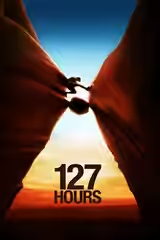
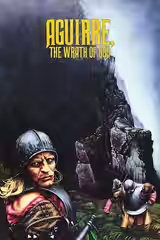
After Jungle, try Touching the Void (2003, Fi1m 87): Two men, one rope, one mountain; the waiting is the terror and it never lets up. Then 127 Hours (2010, Fi1m 81): One man wedged in a canyon, and Boyle makes five days feel like a fever; and Aguirre, the Wrath of God (1972, Fi1m 91): Herzog’s conquistadors drift down the Amazon into madness; the river does the acting.

Cast

Awards

AACTA Award for Best Cinematography, 2017

Nominated
AACTA Award for Best Cinematography

If you liked this, try…

  1. Touching the Void (2003, Fi1m 87)Two men, one rope, one mountain; the waiting is the terror and it never lets up.

  2. 127 Hours (2010, Fi1m 81)One man wedged in a canyon, and Boyle makes five days feel like a fever.

  3. Aguirre, the Wrath of God (1972, Fi1m 91)Herzog’s conquistadors drift down the Amazon into madness; the river does the acting.

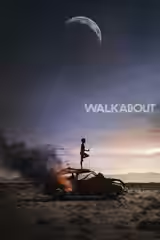
  4. Walkabout (1971, Fi1m 85)Two children lost in the Australian desert, shot as if the land were dreaming them.

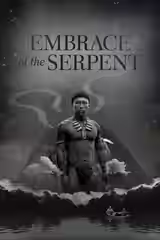
  5. Embrace of the Serpent (2015, Fi1m 82)A Colombian shaman guides two explorers through the rainforest, decades apart, in black and white.