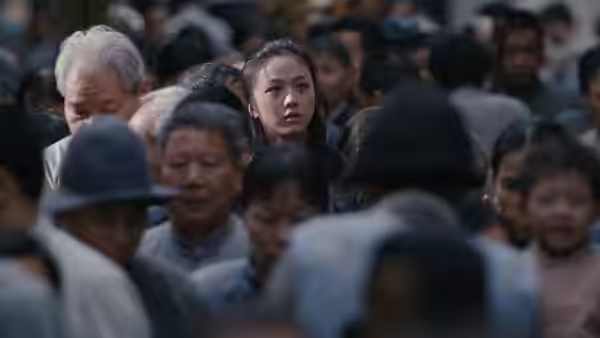
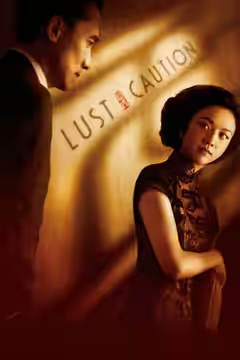
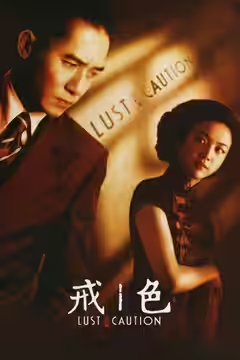
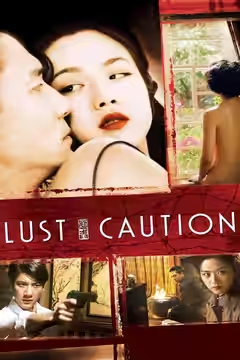
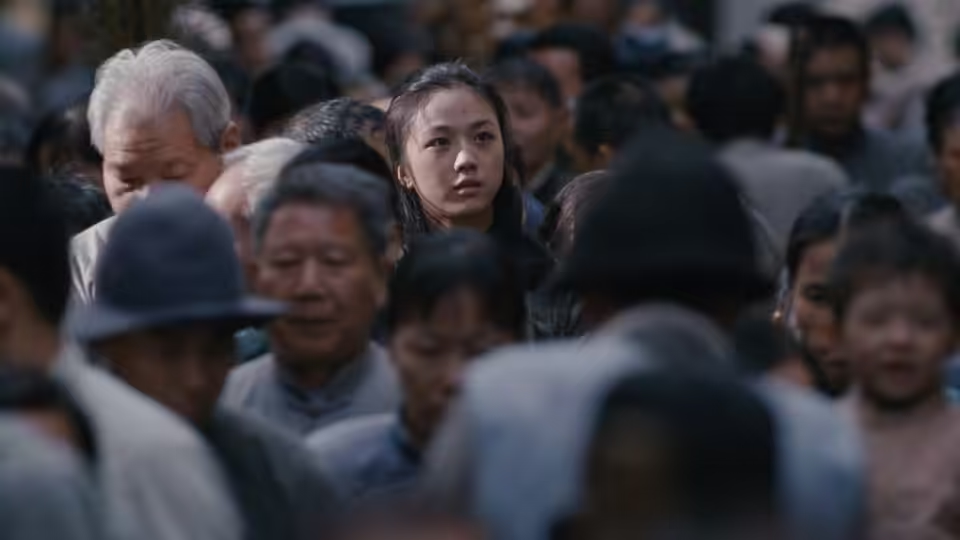
Wong Chia Chi (Tang Wei) looks ahead while surrounded by a crowded street
Film review

Lust, Caution

2007 · Directed by Ang Lee · 2h 38m

In a sentenceTony Leung looks at a woman the way other men look at a loaded gun, and then picks it up anyway

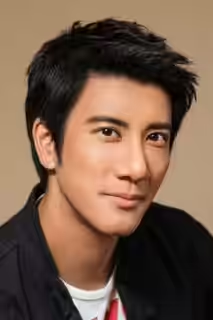
Shanghai, 1942, under Japanese occupation. In the house of Mr. Yee (Tony Leung), a senior official in the collaborationist government, four women play mahjong while his wife (Joan Chen) keeps the gossip going. One of them, a Mrs. Mak, is not who she says she is. She is Wong Chia Chi (Tang Wei), and the film goes back four years to Hong Kong to show how she got to the table: a shy student from Shanghai, a patriotic drama troupe led by Kuang Yu Min (Leehom Wang), a cheering first-night audience, and the idea, hatched over drinks, that the troupe should stop acting and kill a traitor. Wong takes the lead role, a businessman’s wife with money and time on her hands, and sets about befriending Mrs. Yee.

Plays from YouTube when you press play; nothing loads from them until then.

Fi1m review

Ang Lee’s spy film is slow by design and better for it: 158 minutes of mahjong, cigarettes and watching, built around a remarkable Tang Wei. Most critics found it cold; we found it frightening, and we think they missed what the silences are doing.

Ang Lee follows Brokeback Mountain (2005) with a spy film in which almost nothing happens quickly. The source is a short novel by Eileen Chang; the shape is Hitchcock’s Notorious turned inside out, a woman sent into a dangerous man’s bed on behalf of a cause, and what the bed does to the cause. Lee’s gamble is to spend most of his 158 minutes on the waiting, at mahjong tables and in cafés, and to let the sex and the violence arrive as interruptions. It is a good film and a demanding one.

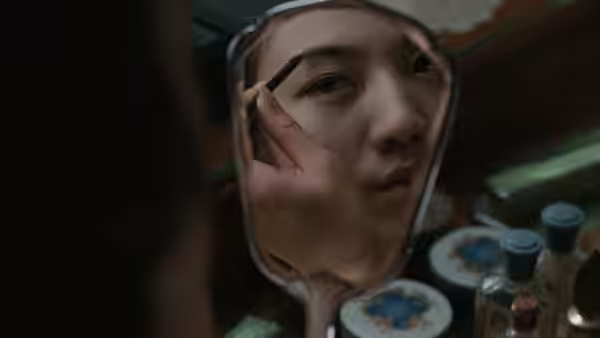
Tang Wei plays Wong Chia Chi twice over: a shy student from Shanghai who finds she can hold a stage, and Mrs. Mak, the bored, well-dressed wife she assembles from borrowed clothes and other women’s cigarette habits. The first woman never quite disappears inside the second. There is a flicker of panic before every smile settles. In a Japanese tavern she sings an old song for Yee, a performance inside a performance inside a performance, and by the end of it we were no longer sure who was pretending, and we are not convinced she was either.

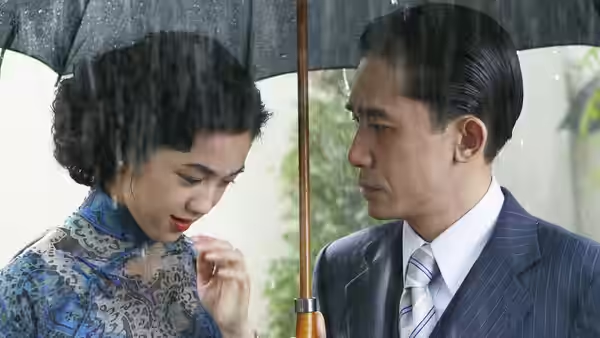
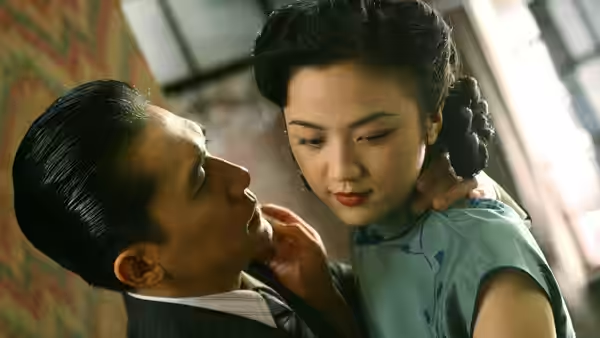
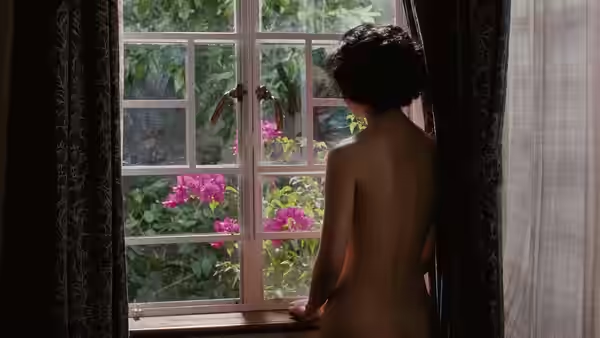
Tony Leung plays Yee as a man who has spent so long expecting a knife that he has stopped expecting anything else. He sits with his back to walls. He watches doors. He barely raises his voice and never drops his shoulders, and his cruelty comes out in small things: keeping a woman waiting, letting a conversation die. The sex scenes, which earned the 18 certificate, are not there to be enjoyed. They are the only place either character stops acting, and Lee shoots them as something close to combat. The first of them frightened us. It is violent, and it is meant to be.

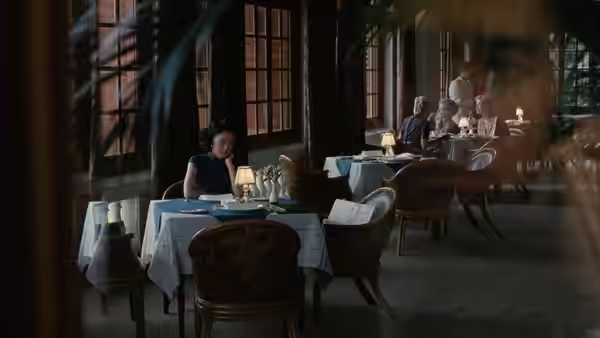
Rodrigo Prieto shoots Hong Kong in soft, warm daylight and Shanghai in brown and grey, so the occupied city looks permanently like late afternoon. The mahjong room is lit from the table up, and the tiles are the loudest thing in it. Lau Sai-Wan and Shandy Lui Fung-Shan build a Shanghai of rationing queues and shuttered shops, and a Yee house of lacquer and locked doors. The cheongsams by Lai Pan and Shandy Lui Fung-Shan tell a story of their own, Wong’s getting tighter and finer as the lies get bigger. Tim Squyres cuts the games as duels, hand to hand to face, so that a discarded tile reads as a question. Alexandre Desplat’s score is a few strings under the longer silences, and it stays out of the mahjong room.

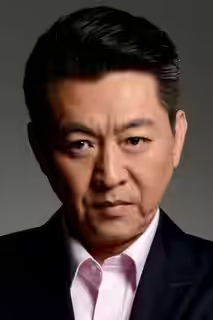
Not all of it holds. Leehom Wang’s Kuang Yu Min, the idealist who recruits Wong, needs to be a man she might have loved, and we did not believe it, because Wang plays him as earnest and nothing else and the screenplay by James Schamus and Wang Hui-ling gives him speeches where it gives everyone else glances. The Hong Kong section runs longer than it needs to. After the move to Shanghai there is a stretch where the resistance, in the shape of Tou Tsung-hua’s Old Wu, briefs and re-briefs, and we found ourselves checking the time. The politics stay in the background. The film tells us Yee works for the Japanese and never asks why.

Most critics have been cooler than this. The reviews split almost down the middle, between those who found the film absorbing and those who found it bloodless and overlong. We think the second camp were waiting for a speech the film was never going to make. These are people who cannot say what they feel because saying it would get them killed, and Lee has built the film the same way. Yee and Wong barely talk because talking is dangerous, and he trusts us to notice.

Crouching Tiger, Hidden Dragon (2000) and Brokeback Mountain were both about wanting with nowhere to go. This is the one where the wanting is also the weapon. See it on a long evening, in one sitting, with the phone in another room. The first hour will test you and the second will tell you why. It runs 158 minutes and carries an 18, and it earns both.

Critical consensus AI synthesised

59
Positive
8
Mixed
3
Negative
6

Most critics lean favourable, though not by much: eight of seventeen reviews are positive, six negative, three mixed. Where they agree is on Tang Wei, praised by admirers and detractors alike for the intensity of her performance as Wong and for the moments when her character’s feelings break the surface. Ang Lee’s patience is the other common thread: several reviews describe a slow build that pays off, with looks and gestures doing the work of dialogue, and Time Out admires an early scene aboard a stylised Hong Kong tram.

The reservations cluster around length and temperature. The trade press reviewing from the festival, Variety and The Hollywood Reporter among them, finds the film bloodless and overlong, with conversations that never catch fire; The New Yorker reaches a similar verdict. The spread is wide, from strong praise to outright boredom, and the British reviews on release are markedly warmer than the American and festival ones.

Los Angeles Times
5 October 2007 · Kenneth Turan
85*

Turan praises the film as an intense, ambitious meditation on emotional and political deception. He especially singles out Tang Wei’s breakout performance for its startling intensity and emotional range.

Read the full review →
The Guardian
25 April 2008 · Rob Mackie
85*

Mackie finds the film absorbing and among the year’s best, praising Ang Lee’s subtle, intelligent approach. He singles out the nuanced storytelling and beautifully realised setting, which reward close attention.

Read the full review →
Empire
30 November 2007 · Damon Wise
80*

Wise finds the film’s long, subtle build ultimately provocative and satisfying. He singles out Tang Wei and Tony Leung’s nuanced performances, especially the way Leung’s villain develops unexpected humanity.

Read the full review →
Radio Times
★★★★ · Damon Wise
80

The critic presents the film as a daring, provocative spy thriller. They single out its inspiration from 1940s films, especially Hitchcock’s Notorious.

Read the full review →
Time Out
15 October 2007 · ★★★★ · Wally Hammond
80

The review describes Ang Lee’s spy romance as absorbing and important. It singles out an early scene aboard a stylised Hong Kong tram for praise.

Read the full review →
Total Film
4 January 2008 · ★★★★ · Total Film
80

The review finds the film a complex, elegant slow-burner whose restraint rewards patience. It praises the subtle performances and the way looks and gestures convey the characters’ motives and emotions.

Read the full review →

Straight answers AI written, from our review

Is Lust, Caution worth watching?
Lust, Caution is worth watching for anyone who can sit through 158 minutes of mahjong, cigarettes and watching, and we scored it 76. Ang Lee's spy film is slow by design, built around a remarkable Tang Wei and a frightening, watchful Tony Leung. The Hong Kong section runs long and the resistance briefings drag, but the silences are doing the work most critics missed.
How long is Lust, Caution, and what is it rated?
Lust, Caution runs 2h 38m. It is an action and drama film.
Where can I watch Lust, Caution in Singapore?
Lust, Caution is not on any streaming or rental service in Singapore at the moment. It is available in 32 other countries; change your country at the top of the page to see where. Availability is checked daily.
How violent or frightening is Lust, Caution, and is it suitable for children?
Lust, Caution carries an 18 certificate and is not suitable for children or teenagers. The sex scenes are explicit and shot as something close to combat; the first of them frightened us, and it is violent by intent rather than accident. The squeamish should know that the film treats sex and violence as interruptions to long stretches of quiet, which makes them land harder.
How does Lust, Caution compare to Notorious?
Lust, Caution takes the plot of Notorious, a woman sent into a dangerous man's house and bed for a cause, and turns it inside out, spending most of its length on the waiting rather than the suspense. Hitchcock's is the tighter and the better film, exceptionally tense at a fraction of the length. Lee's is slower, far more explicit and more interested in what the bed does to the cause.
Is Lust, Caution based on a true story or a book?
Lust, Caution is based on a short novel by Eileen Chang, not on a documented true story. The review does not measure how closely Ang Lee's film follows the book, and you do not need to have read it; the film explains how Wong Chia Chi reaches the Yee mahjong table in its own four-year flashback.
What should I watch after Lust, Caution?
After Lust, Caution, try Notorious (1946, Fi1m 92): Hitchcock’s original of this plot: Ingrid Bergman sent into a dangerous man’s house, and bed. Then Black Book (2006, Fi1m 80): Verhoeven’s Dutch wartime thriller does the same job faster, louder and with far fewer scruples; and In the Mood for Love (2000, Fi1m 91): Tony Leung again, in another cheongsam-filled story about what two people cannot say aloud.

Cast

Awards

Golden Horse Award for Best Feature Film, 2007

Won
Golden Horse Award for Best Feature Film

Venice Film Festival, 2007

Won
Golden Lion

If you liked this, try…

  1. Notorious (1946, Fi1m 92)Hitchcock’s original of this plot: Ingrid Bergman sent into a dangerous man’s house, and bed.

  2. Army of Shadows (1969) · not on Fi1m yetMelville’s French resistance film, where the waiting is the work and nobody is thanked.

  3. Black Book (2006, Fi1m 80)Verhoeven’s Dutch wartime thriller does the same job faster, louder and with far fewer scruples.

  4. In the Mood for Love (2000, Fi1m 91)Tony Leung again, in another cheongsam-filled story about what two people cannot say aloud.

  5. The Handmaiden (2016, Fi1m 85)Park Chan-wook’s con game in occupied Korea, where every seduction is also a plan.