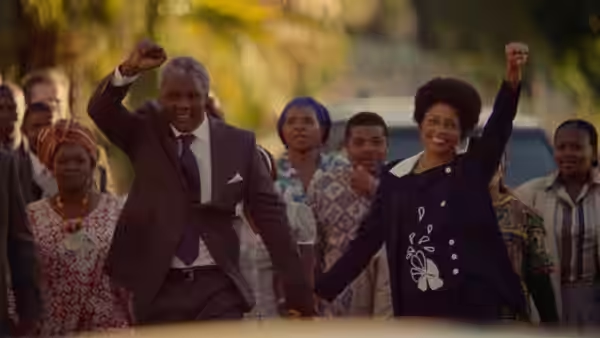
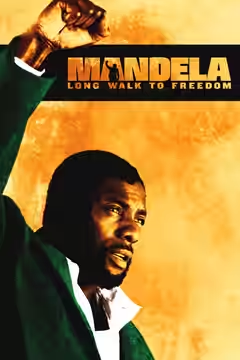
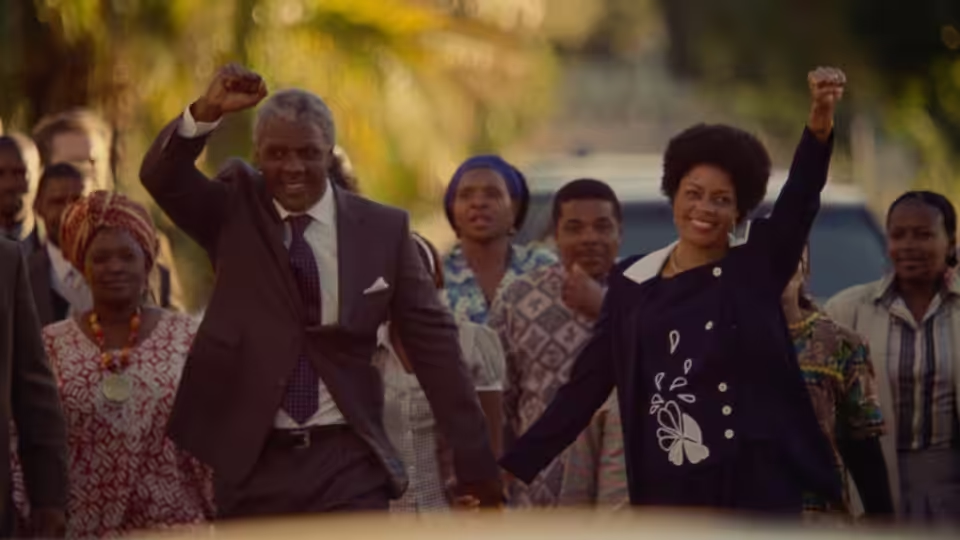
Nelson Mandela (Idris Elba) and Winnie Madikizela (Naomie Harris) raise their fists among supporters
Film review

Mandela: Long Walk to Freedom

2013 · Directed by Justin Chadwick · 2h 21m

In a sentenceIdris Elba makes Mandela interesting; the film keeps reminding us he is important

Nelson Mandela (Idris Elba) is the central figure in a historical drama that follows his life alongside those of Winnie Madikizela (Naomie Harris) and Walter Sisulu (Tony Kgoroge). Evelyn Mase (Terry Pheto), Ahmed Kathrada (Riaad Moosa) and Govan Mbeki (Fana Mokoena) also form part of his story. The film moves through Mandela’s personal relationships and political struggles, placing the people around him within the same account. Its broad sweep follows a public figure while keeping his private life in view.

Plays from YouTube when you press play; nothing loads from them until then.

Fi1m review

Idris Elba and Naomie Harris bring conviction to a biopic too hurried to give them enough room. Justin Chadwick’s respectful account is competently made, but its sweep through Mandela’s life leaves too much unexplored.

Justin Chadwick’s Mandela: Long Walk to Freedom is a disappointing biopic with two performances that deserve a less crowded film. Its 141 minutes attempt to give a broad account of Nelson Mandela’s life, and William Nicholson’s screenplay struggles to find enough time for the people involved. There is care here, and a reasonable wish to make a complicated history accessible. The difficulty is that the film keeps moving before we have had much chance to think about what it has shown.

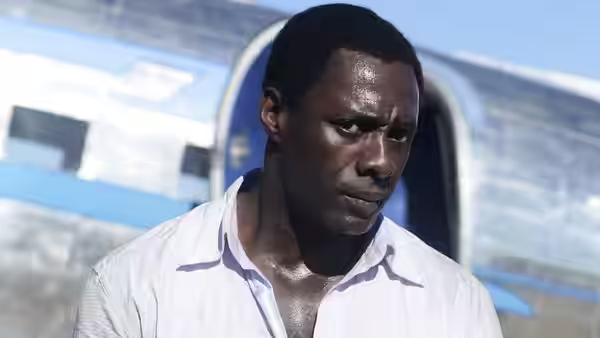
Idris Elba is the reason to stay interested. His early scenes have an ease and confidence that let Mandela seem like somebody whose company might be enjoyable, without constantly insisting on his significance. We warmed to that charm, then felt frustrated as the hurried progression kept interrupting it. Elba has enough control to suggest more than the writing supplies, but too often we are waiting for another glimpse of the person he is trying to play.

Naomie Harris gives Winnie Madikizela a comparable force, and her presence makes the shortage of time for individual characters more noticeable. We want longer with her because she makes the character worth attending to, not because another part of the biography needs covering. The film is stronger whenever these performances are allowed to hold our attention. Both actors supply a conviction that the succession of episodes cannot sustain.

Nicholson’s problem is selection. By trying to include so much, the screenplay repeatedly settles for a short account where a sustained scene might have made the choices clearer. Rick Russell’s editing gets us through the material, but the transitions do not create enough continuity between one episode and the next. We can follow the sequence without feeling we have understood the decisions, particularly when the film reaches for political complexity and then moves on.

Lol Crawley’s cinematography gives the film a handsome, composed appearance, though that composure can make the respectfulness feel even more restrictive. Johnny Breedt’s production design makes the surroundings persuasive; the scenes seldom last long enough for those places to become familiar. Alex Heffes’s music supports the earnest mood but does little to make the emotional emphasis less predictable. These are capable contributions to a film whose basic approach gives them limited room to surprise us.

A life-spanning biopic has to leave things out, and there is no virtue in demanding that it become an exhaustive history. The more useful question is whether its chosen scenes make a person’s thinking intelligible. Here, the admiration is clear, while the difficult business of examining Mandela’s political choices receives less attention. The film’s sincerity makes that limitation regrettable, because its interest in the subject never seems in doubt.

There is an audience for a broad introduction carried by actors this committed, and the film does not deserve to be dismissed as careless. Yet the repeated hurry leaves it emotionally distant for too much of its length. Elba and Harris give it moments worth attending to, without solving the problems around them. Consider it for those performances; for a searching political drama, look elsewhere.
Critical consensus AI synthesised

56
Positive
4
Mixed
8
Negative
5

The reviews lean mixed on Mandela: Long Walk to Freedom, with much firmer agreement about Idris Elba than about the film around him. Most critics praise his charisma, control and ability to convey Mandela’s humanity, even when they find the storytelling dutiful. The Los Angeles Times also singles out Naomie Harris’s compelling Winnie Mandela. The more favourable reviews find the familiar biographical approach moving and worthwhile despite its limited complexity.

Reservations centre on the attempt to fit a long, complicated life into a procession of key events. Several critics find the chronology rushed, the politics simplified and Mandela himself kept emotionally distant. The spread is wide: some accept the conventional structure as a serviceable introduction, while others find that reverence drains the drama. The Evening Standard is particularly dismissive of the disconnected milestones and educational-video approach. Even among the detractors, Elba remains a recurring exception to the disappointment.

Los Angeles Times
27 November 2013 · Kenneth Turan
80*

Turan finds the familiar biographical story worth experiencing again, despite its illustrated-history style and celebratory tone. He especially praises Idris Elba’s charismatic performance and Naomie Harris’s compelling portrayal of Winnie Mandela.

Read the full review →
The Hollywood Reporter
8 September 2013 · festival review · David Rooney
75*

Rooney finds the biopic stirring and increasingly effective, though its opening feels uneven and its storytelling lacks complexity. He especially praises Idris Elba’s commanding, subtly detailed performance as Mandela.

Read the full review →
IndieWire
27 November 2013 · Stephen Aspeling
70*

The critic finds the film an important, lovingly dramatized political epic, though it would have benefited from more time to explore Mandela’s struggles. Idris Elba’s performance is singled out as terrific and central to the film’s drive.

Read the full review →
Screen Daily
8 September 2013 · Tim Grierson
65*

The review text is inaccessible, so its verdict cannot be determined. No specific praise or complaint is visible in the available page text.

Read the full review →
The New York Times
29 November 2013
65*

The URL indicates a review of the specified film, but the article text could not be accessed. Its verdict and any specific praise or criticism cannot be confirmed.

Read the full review →
Empire
11 July 2013 · Angie Errigo
60*

Errigo finds the biopic vivid and substantial but says its conventional march through Mandela’s life rarely catches fire. She praises Idris Elba’s commanding performance and the film’s affecting celebration of Mandela’s dignity.

Read the full review →

Straight answers AI written, from our review

Is Mandela: Long Walk to Freedom worth watching?
Mandela: Long Walk to Freedom is worth considering for Idris Elba and Naomie Harris, but we score its hurried account of Mandela’s life 58 out of 100. Their conviction gives this broad introduction some appeal, though the crowded screenplay leaves too little room to explore personal relationships or political choices. We would look elsewhere for a searching political drama.
How long is Mandela: Long Walk to Freedom, and what is it rated?
Mandela: Long Walk to Freedom runs 2h 21m. It is a drama and history film.
Where can I watch Mandela: Long Walk to Freedom in Colombia?
Mandela: Long Walk to Freedom is available to buy from Apple TV from CO$34900.00. Availability is checked daily; the links above go straight to each service.
How violent or frightening is Mandela: Long Walk to Freedom, and is it suitable for children?
Mandela: Long Walk to Freedom has a UK 12A certificate, so children under 12 need an accompanying adult at the cinema. That classification does not establish how violent or frightening particular scenes are, and we cannot offer a more specific content assessment here. We would not treat it as a blanket recommendation for younger children.
How does Mandela: Long Walk to Freedom compare to Malcolm X?
Mandela: Long Walk to Freedom is the less satisfying political biography beside Malcolm X, which we recommend for its fuller attention to conviction, contradiction and personal change. Elba and Harris bring force to a hurried life story, while Denzel Washington’s searching performance benefits from more room. Spike Lee’s film can be solemn and slow, but it offers the deeper examination.
What should I watch after Mandela: Long Walk to Freedom?
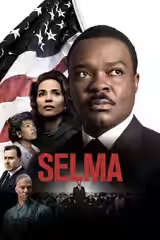
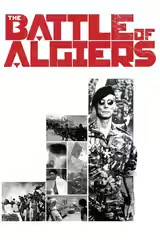
After Mandela: Long Walk to Freedom, try Malcolm X (1992, Fi1m 79): A political life given time for conviction, contradiction and personal change. Then Selma (2014, Fi1m 84): A tighter historical focus makes room for political work and private doubt; and The Battle of Algiers (1966, Fi1m 93): For a more demanding account of resistance, violence and colonial power.

Cast

If you liked this, try…

  1. Malcolm X (1992, Fi1m 79)A political life given time for conviction, contradiction and personal change.

  2. Selma (2014, Fi1m 84)A tighter historical focus makes room for political work and private doubt.

  3. The Battle of Algiers (1966, Fi1m 93)For a more demanding account of resistance, violence and colonial power.

  4. The Official Story (1985, Fi1m 81)Political history becomes personal through one woman’s increasingly difficult questions.

  5. A United Kingdom (2016) · not on Fi1m yetAnother public struggle shaped by a relationship under sustained political pressure.