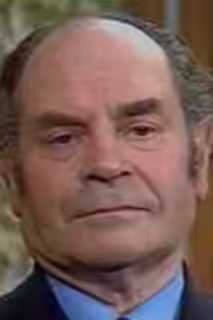
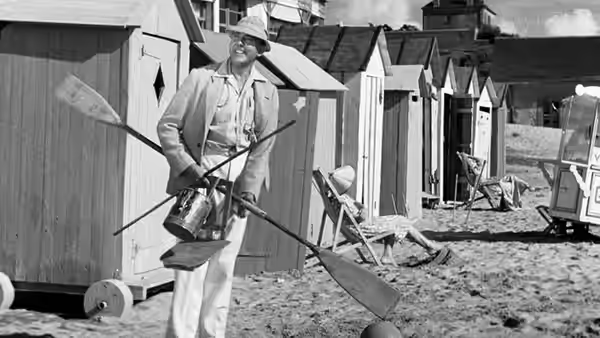
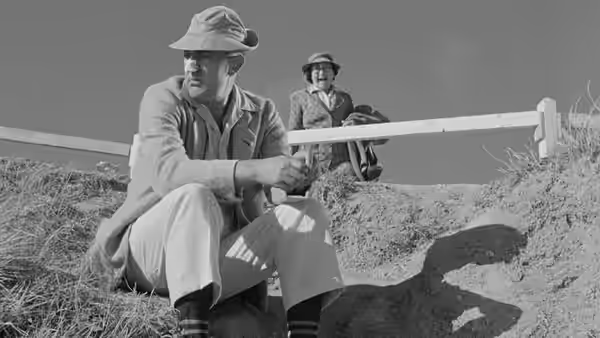
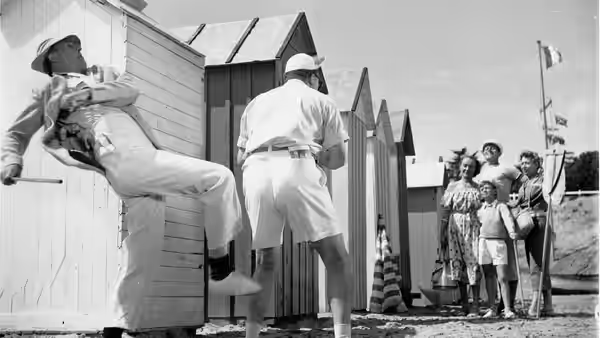
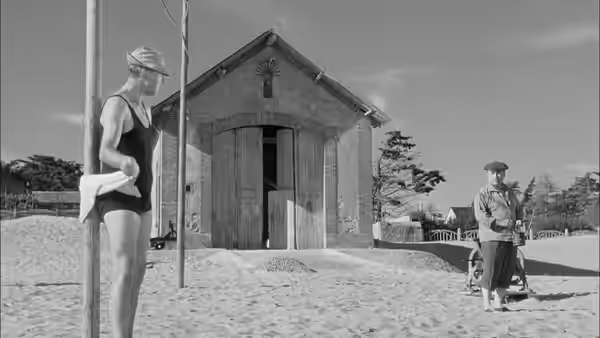
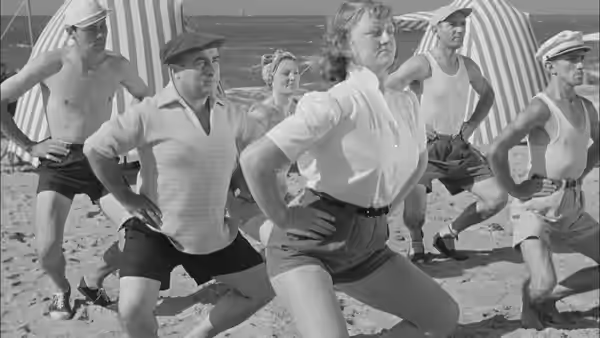
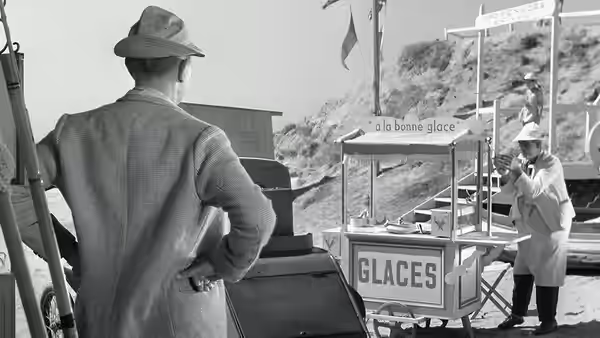
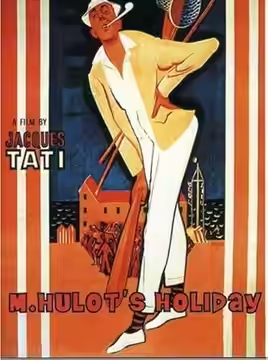
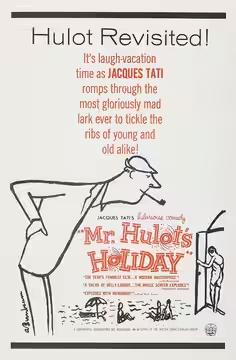
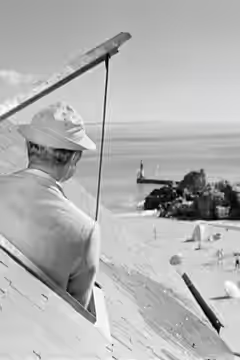
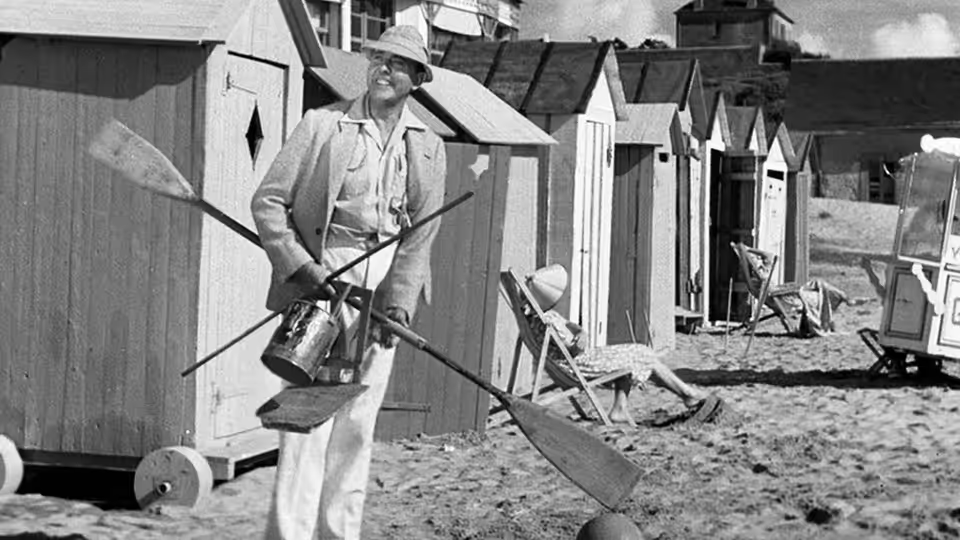
Monsieur Hulot (Jacques Tati) carries beach gear between the changing huts
Film review

Monsieur Hulot's Holiday

1953 · Directed by Jacques Tati · 1h 27m

In a sentenceJacques Tati leaves a hotel door open and we are still laughing about it

Monsieur Hulot (Jacques Tati) takes a holiday at a resort, where his clumsiness makes the simplest arrangements difficult. Martine (Nathalie Pascaud) and the Hotel Proprietor (Lucien Frégis) are among the people around him as he tries to enjoy his stay. At the hotel, he leaves a door open and lets in a draught, turning an ordinary entrance into a disturbance for the guests. Hulot means well, but his attempts to take part in resort life keep bringing him into collision with the routines everyone else expects to follow.

Fi1m review

Jacques Tati’s holiday comedy is funny, patient and unusually kind to the people it catches behaving foolishly. A few routines linger too long, but its careful timing makes small mishaps worth close attention.

Jacques Tati’s Monsieur Hulot’s Holiday is a warm, precise comedy, and we recommend it with a small warning about its leisurely pace. Hulot is on holiday, but his well-meaning attempts to join in keep inconveniencing the people around him. Tati gives that simple situation enough care to make an open door worth watching. The pleasure comes from noticing how little it takes to make a gathering uncomfortable.

We laughed aloud when Hulot left the hotel door open and let the draught cause trouble. The mistake is so small, and the inconvenience spreads so readily, that the comedy hardly seems to require any effort. It also tells us how to watch the film: keep looking at what happens around Hulot, rather than concentrating exclusively on the man himself. He can be funny without having to perform another feat of clumsiness.

Jacques Mercanton and Jean Mousselle’s photography keeps that sort of physical joke readable. We need to understand where Hulot stands and what his movements disturb, and the images give us that information without fuss. The hotel-door routine works because we can connect a small action with the inconvenience it causes. There is pleasure in being allowed to make that connection without having every consequence pointed out to us.

Editors Jacques Grassi, Charles Bretoneiche and Suzanne Baron are important to the humour. Their timing lets a mishap register before the next piece of business competes with it, although this patience sometimes becomes a liability. A few routines carry on after we have understood everything they are going to do. We would lose a little of the lingering, but keep the pauses that let Hulot’s good intentions become embarrassingly clear.

Henri Schmitt and Roger Briaucourt’s production design gives the hotel a useful ordinariness; nothing needs to look especially comic for a door to become a problem. The surroundings suit a comedy in which fitting in ought to be easy and somehow isn’t. Alain Romans’s music helps the holiday feel unhurried, though its friendliness occasionally makes the comedy feel too comfortable. The semi-silent humour is most rewarding when it keeps us alert to the next small disturbance.

Tati’s performance makes the clumsiness endearing without asking us to pretend it would be pleasant to have Hulot nearby. We recognise the effort to behave properly even while the behaviour becomes a nuisance. The connection with older silent-film comedy is evident in the pantomime, and some of that business can feel familiar. What keeps it engaging is Tati’s interest in the embarrassment of someone who means well and still gets things wrong. He allows us to enjoy the mistake without making the person seem worthless.

We would choose it for an evening when conversation can wait and nobody needs the plot to hurry them along. The occasional slack stretch is a real reservation, especially for anyone who prefers comedy to keep escalating. Yet the care taken over a guest’s smallest mistake makes close watching worthwhile. Give it your attention rather than leaving it on while you do something else.

Critical consensus AI synthesised

72
Positive
4
Mixed
1
Negative
1

Most critics respond warmly to Monsieur Hulot’s Holiday, with praise centred on Tati’s visual comedy, precise timing and gentle treatment of the clumsy, well-meaning Hulot. The favourable reviews value the way resort mishaps become carefully managed pantomime, with little need for speech. The Guardian singles out the draught caused by Hulot leaving a hotel door open as a particularly effective joke. The comedy’s observational detail earns praise alongside its handling of physical humour.

The spread is wide, however, and the chief disagreement concerns how consistently the routines amuse. Variety enjoys the timing and resort mishaps but finds the film less funny than Tati’s previous feature. The New Yorker takes that reservation much further, finding only intermittent laughs and judging that most of the borrowed silent-film routines miss their mark. Its appreciation of the boat-launching scene offers a small point of agreement with the more enthusiastic reviews.

Empire
1 January 2000 · David Parkinson
95*

The review calls the film one of the best and most important ever made. It praises Tati’s visual comedy and innovative cinematic techniques.

Read the full review →
The Guardian
8 August 2003 · Peter Bradshaw
90*

Bradshaw finds the film gentle, charming and sophisticated, with its semi-silent humour superbly managed. He singles out the comic draft caused by Hulot leaving the hotel door open.

Read the full review →
Time Out
· GA
75*

The review presents the film as an especially enjoyable comedy. It singles out Tati’s gentle portrait of the clumsy, well-meaning Hulot on vacation.

Read the full review →
Variety
31 December 1952 · Variety Staff
75*

Variety finds the film funny and observant, though less amusing than Tati’s previous feature. It praises Tati’s precise timing and pantomime, especially in the comic vacation-resort mishaps.

Read the full review →
The New York Times
17 June 1954
65*

The review’s verdict cannot be determined because the article is inaccessible. Its specific praise or criticism likewise cannot be verified.

Read the full review →
The New Yorker
11 June 1954 · John McCarten
30*

McCarten finds the film only intermittently funny and less amusing than Tati’s earlier work. He singles out the boat-launching scene as a laughable moment, but says the film’s old silent-film routines largely miss the mark.

Read the full review →

Straight answers AI written, from our review

Is Monsieur Hulot's Holiday worth watching?
Monsieur Hulot's Holiday is worth watching for its warm, carefully timed physical comedy, and we score it 86 out of 100. We recommend it to anyone happy to watch small mishaps develop at leisure, though a few routines linger too long and it needs closer attention than its gentle manner might suggest.
How long is Monsieur Hulot's Holiday, and what is it rated?
Monsieur Hulot's Holiday runs 1h 27m. It is a comedy film.
Where can I watch Monsieur Hulot's Holiday in Australia?
Monsieur Hulot's Holiday is streaming on MUBI and Amazon Prime Video in Australia. Availability is checked daily; the links above go straight to each service.
How does Monsieur Hulot's Holiday compare to The General?
Monsieur Hulot's Holiday is the gentler, more leisurely choice beside The General, with both films making apparent accidents depend on exact comic timing. We recommend The General for action and railway ingenuity despite its thin romance; Hulot better suits an appetite for small social embarrassments, though its lingering routines sometimes test our patience.
What should I watch after Monsieur Hulot's Holiday?
After Monsieur Hulot's Holiday, try The General (1926, Fi1m 91): For physical comedy whose apparent accidents depend on exact timing. Then Local Hero (1983, Fi1m 86): A visitor meets a community with little interest in hurrying.

Cast

Awards

Academy Awards, 1956

Nominated
Best Writing, Original Screenplay

Louis Delluc Prize, 1953

Won
Louis Delluc Prize

If you liked this, try…

  1. Good Morning (1959) · not on Fi1m yetNeighbourly routines and small discourtesies receive the same patient comic attention.

  2. The General (1926, Fi1m 91)For physical comedy whose apparent accidents depend on exact timing.

  3. Local Hero (1983, Fi1m 86)A visitor meets a community with little interest in hurrying.

  4. The Band's Visit (2007) · not on Fi1m yetAnother visit away from home, with awkwardness treated kindly throughout.

  5. Playtime (1967) · not on Fi1m yetTati gives social awkwardness more space and even more elaborate obstacles.