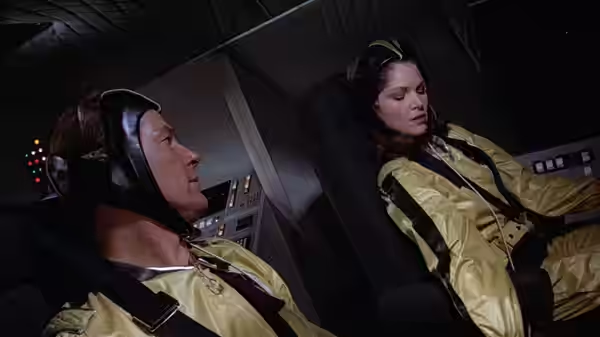
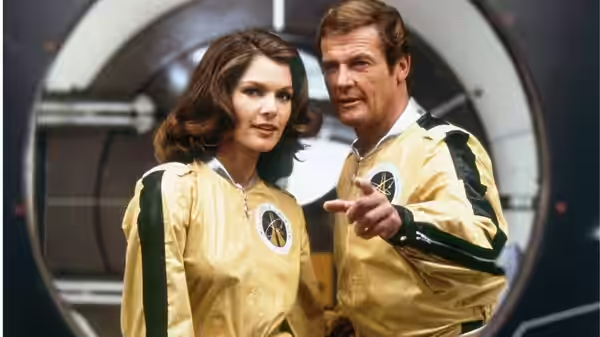
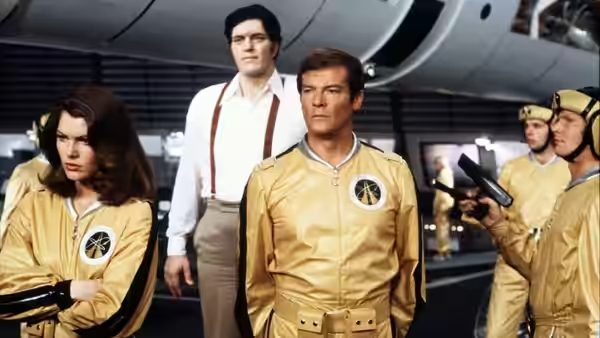
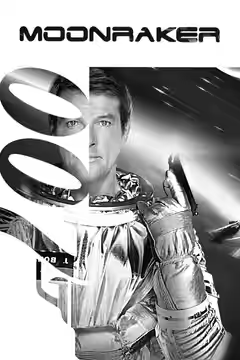
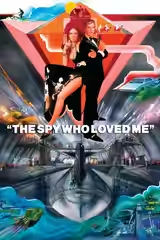
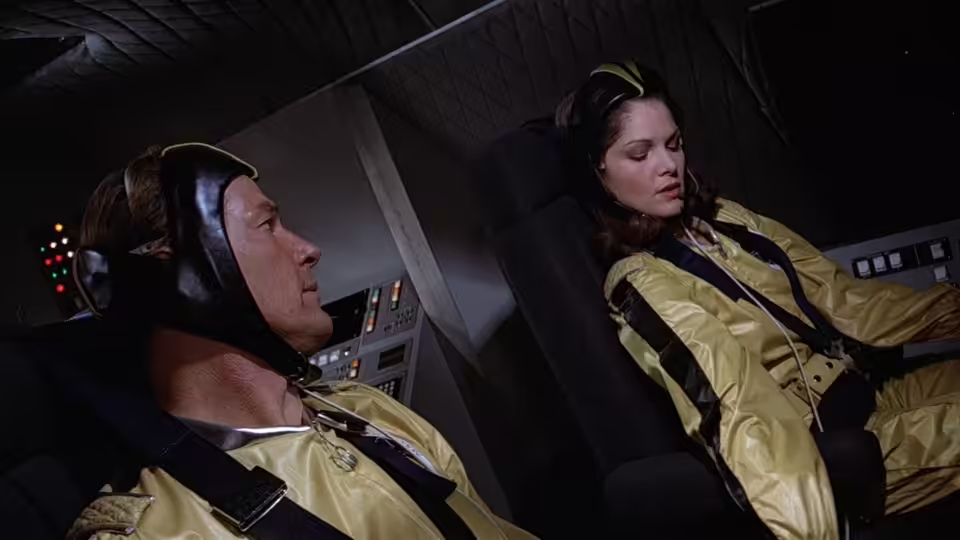
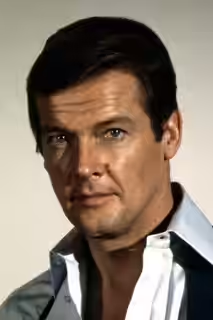
James Bond (Roger Moore) and Holly Goodhead (Lois Chiles) sit strapped into spacecraft seats
Film review

Moonraker

1979 · Directed by Lewis Gilbert · 2h 06m · FSK 12

In a sentenceKen Adam builds a space station and Roger Moore raises one eyebrow at it

A Moonraker space shuttle, built by the American industrialist Hugo Drax (Michael Lonsdale) and on loan to Britain, is stolen in mid-air from the back of the aircraft carrying it. M (Bernard Lee) sends James Bond (Roger Moore) to Drax’s estate in California to ask how. Drax receives him with polished contempt. Bond meets Dr. Holly Goodhead (Lois Chiles), a scientist on loan from NASA who knows more than she lets on, and Corinne Dufour (Corinne Cléry), Drax’s helicopter pilot, who knows more than is safe. A ride in an astronaut-training centrifuge nearly kills him. Blueprints in Drax’s safe point to Venice, and the steel-toothed giant Jaws (Richard Kiel), last seen falling out of a plane, is already there ahead of him.

Fi1m review

Lewis Gilbert sends Bond after Star Wars and comes back with the handsomest and silliest of the Roger Moore films. Ken Adam’s sets and Michael Lonsdale’s bored, courteous villain are worth an evening; the slapstick, mostly, is not.

Two years after The Spy Who Loved Me, Lewis Gilbert is back as director, Christopher Wood on the script, Richard Kiel as Jaws, and so is the plot: a rich man with a private army steals something from the great powers, and Bond follows him through pretty cities to a lair. Star Wars has come out since, so this time the lair is in orbit. Moonraker takes its title and villain’s name from Ian Fleming’s novel and little else, and it is where the Roger Moore films gave up on being thrillers. We enjoyed a good deal of it and believed none of it.

The pre-title sequence is the best thing in the film. Bond is pushed out of a plane without a parachute, dives after the man who has one and takes it from him in mid-air, and the camera falls alongside them. Stunt performers did it in free fall, and there is no cheating. We held our breath, then laughed out loud when Jaws, following them down, pulled his ripcord and got a handful of string.

Ken Adam’s design is the real star. Drax’s estate is all chandeliers and gilt, so the launch control room next door looks like an insult. The glass laboratory in Venice is white, hard-edged and lit from inside. The space station is the last of Adam’s great villain rooms: spokes and a hub, a chamber with a turning floor. Jean Tournier lights the earthbound half with the flat brightness of a holiday brochure, which suits Venice and does nothing for the actors, and the station in cold blue-white. Jacques Fonteray puts Drax’s technicians in matching jumpsuits, so the estate looks staffed by a cult.

Michael Lonsdale is the other reason to stay. He plays Hugo Drax as a man so rich that villainy bores him, and delivers each threat as if dictating a letter he expects someone else to sign. “Look after Mr Bond,” he tells a henchman. “See that some harm comes to him.” Wood gives him the film’s only good lines and Lonsdale lets them drop rather than land. Whenever he and Moore share a room the film picks up.

Then there is the rest. Wood and Gilbert have decided that Jaws, a proper menace two years earlier, is now a clown, so he is dropped from a height, driven through a wall and dunked in a canal, and gets up each time to a comedy cue from John Barry. In Venice Bond’s gondola grows wheels and drives across St Mark’s Square, and the film cuts to a pigeon doing a double-take. We laughed, then felt a little ashamed of ourselves, then realised the film had no such qualms. The chases that follow are staged with skill and no fear, because nothing can hurt this Bond and everyone on screen knows it.

Moore is charming, entirely at ease and never once looks as though he could be killed. Chiles is handed a doctorate and a name that is a schoolboy joke, and plays Goodhead with a cool competence the script keeps interrupting so Bond can rescue her. Corinne Cléry, as Drax’s pilot, is the only person who ever looks frightened, and her few minutes are worth more than most set pieces. Barry’s score is his most romantic in years, slow strings and long brass lines, and the march he writes for the shuttles is better than most of what it accompanies. John Glen cuts the action tight and the comedy as though under instruction, so the double-takes stick out.

The Spy Who Loved Me kept one foot on the ground; this one floats off. It runs 126 minutes and carries a PG.

See it for the first five minutes, for Adam’s rooms and for Lonsdale. If you want a Bond film that frightens you, this is not it, and it never wanted to be.
Critical consensus AI synthesised

60
Positive
4
Mixed
2
Negative
3

Most critics find Moonraker a well-made, thoroughly silly Bond film, and the praise gathers around the same departments: the production design, the visual effects, especially the space station, and the stuntwork, which several reviews credit with making the preposterous look plausible. Roger Moore’s wise-cracking Bond is generally thought to suit the material, and Jaws and the villain are singled out as likeable turns.

The reservations are about everything else. The plot is called thin, arbitrary and nonsensical, the slapstick fights predictable, and the whole thing a rerun of The Spy Who Loved Me with the gadgets turned up. The spread is wide: The New York Times rates it among the most buoyant entries in the series, while Sight and Sound and The New Yorker see a repetitious formula with Bond reduced to an indestructible cartoon. Later reassessments are kinder than the notices of 1979, generally arguing that the scale and good humour outweigh the daftness.

The New York Times
29 June 1979 · Vincent Canby
90*

Moonraker is one of the most buoyant Bond films, focused on dizzying entertainment through elaborate stunts and production values. The screenplay and cast deliver slick, imaginative movie-making in the tradition of early film pioneers.

Read the full review →
RogerEbert.com
1 January 1979 · Roger Ebert
70*

The film follows the standard Bond formula with exotic locations and sci-fi effects but does not break new ground. The art direction and special effects, particularly the space station, are singled out as highlights.

Read the full review →
Variety
31 December 1978 · Variety Staff
70*

The stunts and gadgets live up to expectations in this standard Bond outing, with strong visual effects and stuntwork making preposterous ideas believable. Roger Moore adapts well to the role as the wise-cracking hero.

Read the full review →
Empire
1 January 2000 · Ian Nathan
65*

The critic sees this as the point where the Roger Moore Bond era fully embraced the preposterous, losing touch with its origins, yet finds it playful, energetic and memorable thanks to its set pieces.

Read the full review →
Time Out
10 September 2012 · CA
65*

Moonraker improves on recent Bond films thanks to strong special effects, witty references, and tongue-in-cheek tone, though the thin plot and predictable slapstick fights limit it. Likeable turns from Jaws and the villain help hold it together.

Read the full review →
Sight and Sound
35*

The film is essentially a remake of The Spy Who Loved Me, with Bond reduced to an indestructible cartoon figure in loosely connected set pieces and a picture-postcard itinerary. Literal-minded objections arise about the arbitrary plot and unconvincing spectacle.

Read the full review →

Straight answers AI written, from our review

Is Moonraker worth watching?
Moonraker is worth an evening for Ken Adam's sets, Michael Lonsdale's bored, courteous villain and a free-fall opening with no cheating in it; we scored it 58. It is the silliest of the Roger Moore Bond films, and anyone wanting a thriller that could frighten them should look elsewhere in the series.
How long is Moonraker, and what is it rated?
Moonraker runs 2h 06m and is rated 12 by the FSK in Germany. It is an action and adventure film.
Where can I watch Moonraker in Germany?
Moonraker is available to rent from Amazon Prime Video and Apple TV from €1.99. Availability is checked daily; the links above go straight to each service.
How violent or frightening is Moonraker, and is it suitable for children?
Moonraker carries a PG in the UK and is one of the least frightening Bond films, with chases staged so nobody on screen seems in any danger. Jaws is played for laughs, the violence is bloodless and the innuendo goes over children's heads. Older children will enjoy the space station; the squeamish have nothing to fear.
How does Moonraker compare to The Spy Who Loved Me?
Moonraker reuses the director, the writer, Jaws and the plot of The Spy Who Loved Me, then moves the villain's lair into orbit. The earlier film is the better of the two, keeping one foot on the ground where this one floats off into slapstick. Choose Moonraker for Adam's rooms and Lonsdale's Drax; choose the earlier film for a Bond adventure that still behaves like one.
Is Moonraker based on a true story or a book?
Moonraker is based, very loosely, on Ian Fleming's novel of the same name, and is not a true story. The film takes the title and the villain's name, Hugo Drax, and little else; the space shuttle plot is its own invention. Knowing the book will not help you follow it and may only annoy you.
Do you need to have seen the other James Bond films before Moonraker?
Moonraker stands alone and needs no knowledge of earlier James Bond films to follow, since the plot is self-contained and Bond is introduced as ever. Only the giant Jaws carries over from The Spy Who Loved Me, and his return is explained in a line. It is not the best place to start, being the series at its silliest.
What order should I watch the James Bond films in?
Release order is the safe choice for James Bond, and it is the order our collection page lists them in. Moonraker is number 12 of the 27 James Bond titles on Fi1m; before it comes The Spy Who Loved Me and after it For Your Eyes Only. The full order.

Cast

Awards

Academy Awards, 1980

Nominated
Best Visual Effects

If you liked this, try…

  1. The Spy Who Loved Me (1977, Fi1m 77)The same team, the same Jaws, and a plot that still touches the ground.

  2. Danger: Diabolik (1968) · not on Fi1m yetMario Bava’s comic-strip thief, with sets Ken Adam would have envied.

  3. Our Man Flint (1966) · not on Fi1m yetThe American Bond spoof that took the gadgets seriously and nothing else.

  4. Flash Gordon (1980) · not on Fi1m yetSpace adventure that knows it is ridiculous and dresses accordingly.

  5. Kingsman: The Secret Service (2014) · not on Fi1m yetA love-hate reply to the Moore era, with better fights and worse manners.