Collection
James Bond
Sixty years of one spy: six Bonds, two dozen films, and a running argument about which of them got it right.
Which order? Release order. The two outsiders, the 1967 Casino Royale and Never Say Never Again, are not Eon films and sit at the end.
James Bond
- 1
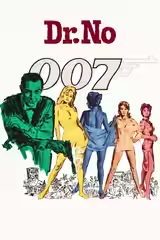 Dr. No 1962The first Bond is smaller, quicker and odder than the series it started, and Connery’s introduction still lands. Half a dozen things in it have dated badly and the middle third dawdles, but the good parts hold.Fi1m 77
 - 2
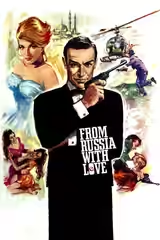 From Russia with Love 1963Terence Young’s second Bond film is the leanest the series has made: Istanbul in daylight, a train across Europe and Robert Shaw as a killer Bond cannot talk his way past. The women are short-changed and the last reel is padding; the rest holds.Fi1m 84
 - 3
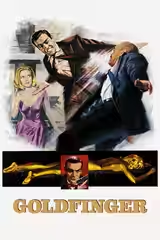 Goldfinger 1964The third Bond film is where the series found its shape: the car, the song, the sets, the villain who explains himself. It is confident, fast and often funny, and it treats its women worse than we can quite laugh off.Fi1m 82
 - 4
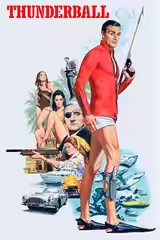 Thunderball 1965The fourth Bond film is the grandest of Connery’s run and the first to feel padded. Ken Adam’s sets, John Barry’s brass and Luciana Paluzzi’s assassin are worth the evening; the underwater battle that closes it is not.Fi1m 66
 - 5
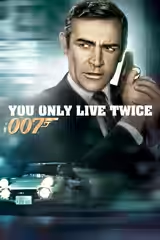 You Only Live Twice 1967The fifth Bond film has the grandest set the series had yet built and a leading man who has stopped pretending to enjoy himself. Ken Adam’s volcano, John Barry’s score and Tetsuro Tamba earn the evening; Roald Dahl’s script and the middle hour do not.Fi1m 62
 - 6
 On Her Majesty's Secret Service 1969Peter R. Hunt’s one Bond film has a lead who cannot act, a middle that dawdles and a last half hour that nothing else in the series has matched. We recommend it, and we recommend patience with the man in the suit.Fi1m 83
 - 7
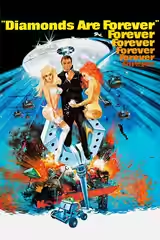 Diamonds Are Forever 1971Connery’s return is a shrug, and the film seems to know it. Las Vegas, John Barry and two courteous killers keep it watchable; a script that loses track of its own diamonds and a leading man going through the motions keep it from being much more.Fi1m 58
 - 8
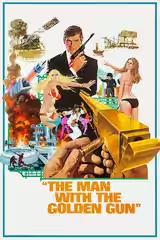 The Man with the Golden Gun 1974Christopher Lee’s Scaramanga is the most elegant killer the series has produced, and the film around him is a tired one, padded with slide whistles and a sheriff on holiday. Worth it for the villain; not enough else to recommend an evening.Fi1m 56
 - 9
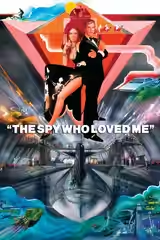 The Spy Who Loved Me 1977Roger Moore’s third Bond is the one where the formula settles into comfort: a KGB rival to flirt with, a giant with steel teeth, a car that swims. Ken Adam’s sets do most of the work and the plot is happy to let them.Fi1m 77
 - 10
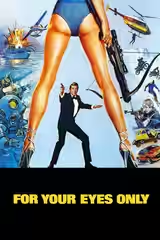 For Your Eyes Only 1981John Glen’s first Bond puts away the space station and sends Roger Moore back to earth, with a heroine who carries a crossbow and villains who bleed. The stunts are among the best in the series; the jokes and the score are not.Fi1m 68
 - 11
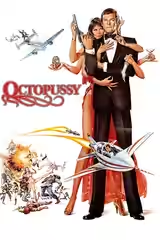 Octopussy 1983John Glen’s Bond film has a proper Cold War plot at the bottom of it and keeps burying it under jokes. India looks splendid, Louis Jourdan and Steven Berkoff are good value, and Roger Moore is running out of road. One for the fond.Fi1m 64
 - 12
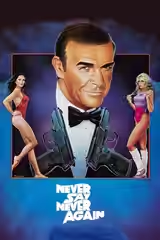 Never Say Never Again 1983Sean Connery returns to Bond twelve years on, greyer, drier and better company than the film around him. Klaus Maria Brandauer and Barbara Carrera give it two proper villains; a slack script, a wayward score and a great deal of seawater do their best to undo them.Fi1m 64
 - 13
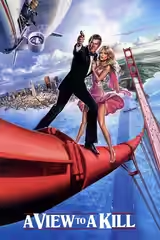 A View to a Kill 1985Roger Moore’s last Bond hands the picture to Christopher Walken and Grace Jones and lets Moore stroll along behind them. Two villains, one parachute jump and a John Barry score are worth something; the rest is a series going through its motions.Fi1m 46
 - 14
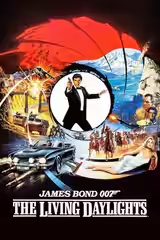 The Living Daylights 1987Timothy Dalton’s first Bond is a proper spy story with the jokes taken out, and the best-made entry in years. Its villains are small and its Afghan detour is long, but the first hour is as tense as the series has been since the sixties.Fi1m 74
 - 15
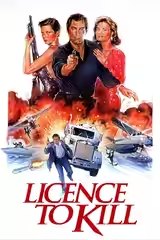 Licence to Kill 1989Timothy Dalton’s second and last Bond sacks him early and lets him spend the rest on a grudge, and it is the toughest the series had been in years. It also looks like television, the score is thin, and the jokes keep wandering back in.Fi1m 70
 - 16
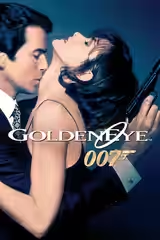 GoldenEye 1995Pierce Brosnan makes a persuasive Bond in a brisk, entertaining revival that knows the old habits need questioning. Martin Campbell delivers the action; the attempts to give Bond more emotional weight are less convincing.Fi1m 78
 - 17
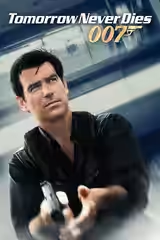 Tomorrow Never Dies 1997Brosnan’s second Bond is brisk, loud and well made, with a villain who sells the news he manufactures and a partner who fights better than he does. It runs out of ideas well before it runs out of explosions.Fi1m 64
 - 18
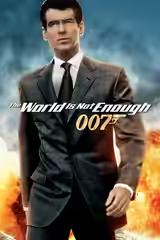 The World Is Not Enough 1999Michael Apted’s Bond opens with the best chase the series has staged in years and then spends two hours looking for something to match it. Sophie Marceau is the reason to stay; Denise Richards, as a nuclear physicist, is the reason people still laugh.Fi1m 58
 - 19
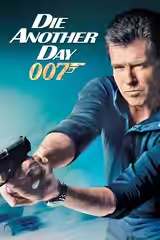 Die Another Day 2002The twentieth Bond starts as the toughest of Brosnan’s four, with a beard, a cell and a grudge, and ends as a cartoon with an invisible car and a computer-drawn wave. The fencing duel is the reason to stay.Fi1m 50
 - 20
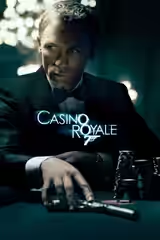 Casino Royale 2006Daniel Craig gives *Casino Royale* the danger and emotional weight its harder approach needs. Martin Campbell makes the action count, and Eva Green gives Bond someone worth listening to; only a protracted final stretch weakens our enthusiasm.Fi1m 86
 - 21
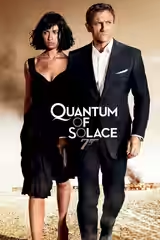 Quantum of Solace 2008Marc Forster’s sequel gets Bond’s grief right and the rest wrong: a villain with a small plan, a plot about water, and action cut so fast you cannot tell who is in which car. Craig and a night at the opera keep it watchable.Fi1m 58
 - 22
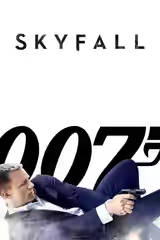 Skyfall 2012Sam Mendes makes an absorbing Bond thriller, with Daniel Craig and Judi Dench giving its personal troubles proper weight. Roger Deakins’ photography rewards close attention, though the screenplay explains more about Bond than we need.Fi1m 81
 - 23
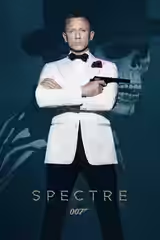 Spectre 2015Sam Mendes’s second Bond opens with a tracking shot through Mexico City that is as good as anything in the series, then spends two hours reassembling old parts. Craig is still worth watching, the pictures are handsome, and the story under them barely exists.Fi1m 58
 - 24
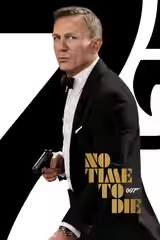 No Time to Die 2021Daniel Craig’s fifth and final Bond is handsome, sincere and too long. It opens with one of the series’ best action sequences and closes with real feeling; the plot in between, and the villain carrying it, do not earn the 163 minutes.Fi1m 67
James Bond

Only what we have reviewed is listed. Missing one? Search for it and press Request a review, or ask Discover.