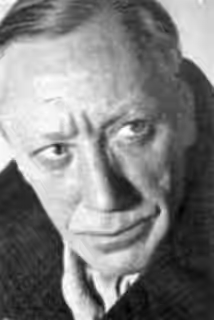
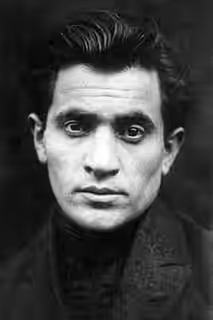
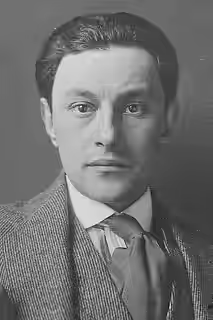
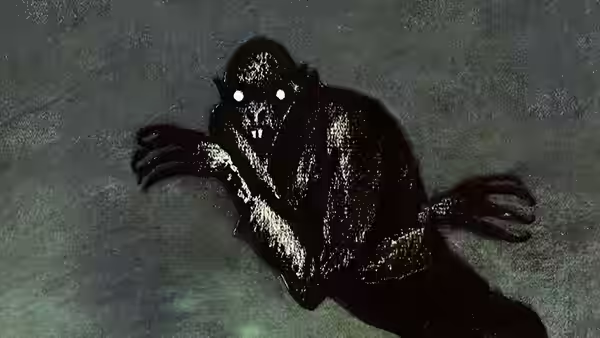
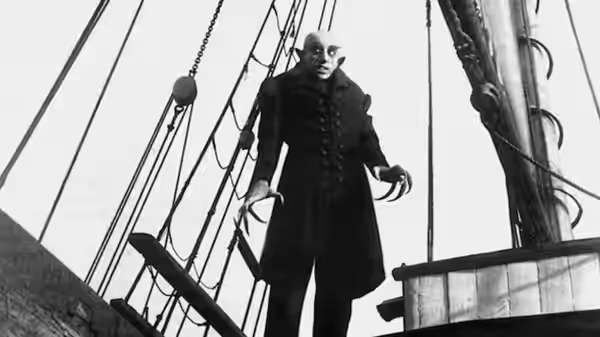
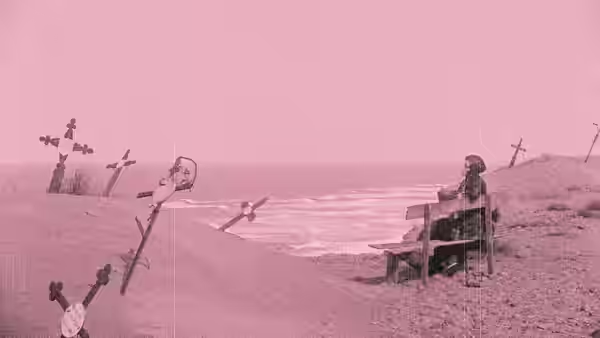
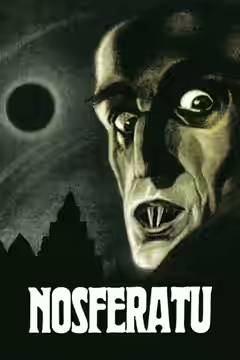
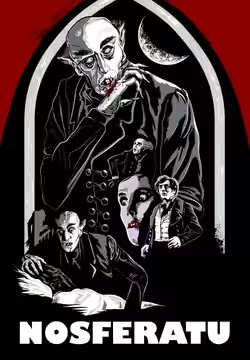
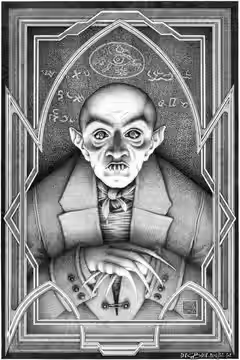
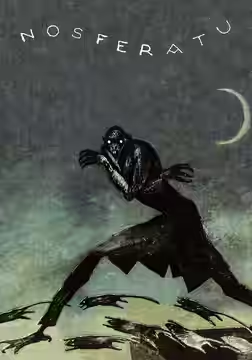
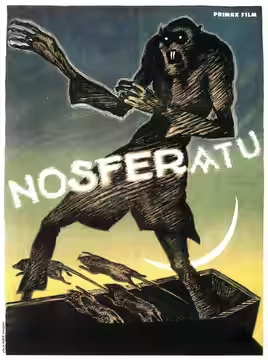
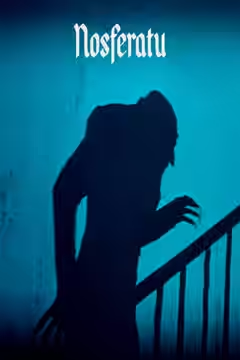
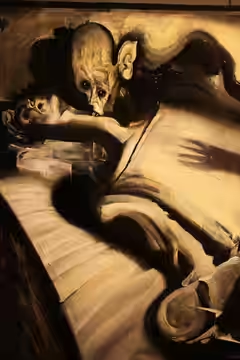
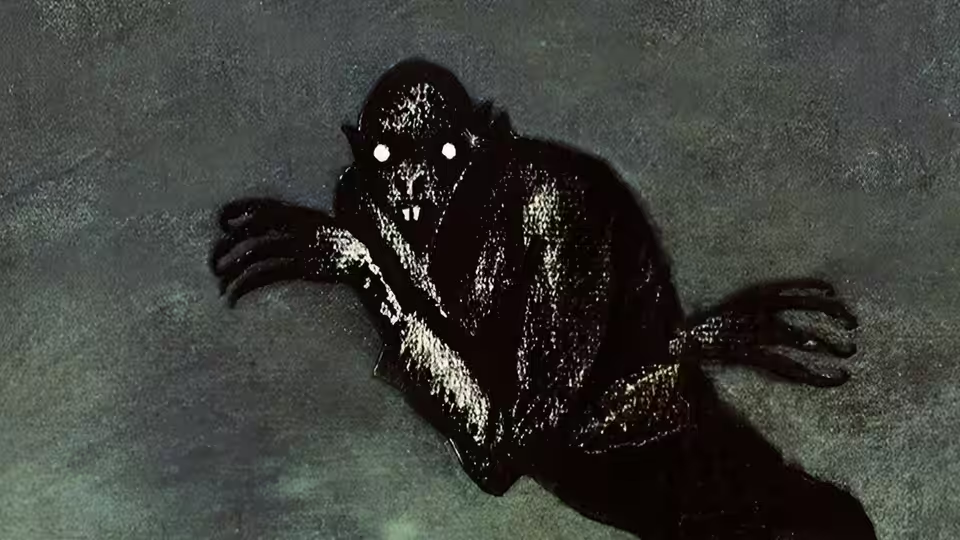
Count Orlok (Max Schreck) raises his clawed hands in the darkness
Film review

Nosferatu

1922 · Directed by F. W. Murnau · 1h 34m · KAVI K-18

In a sentenceCount Orlok makes standing in a doorway look like sufficient grounds for leaving the country

In Wisborg in 1838, Hutter (Gustav von Wangenheim) leaves his wife Ellen (Greta Schröder) to travel to Count Orlok’s castle. His employer, Knock (Alexander Granach), has sent him to arrange a property sale: the count wants a house opposite the couple’s home. Hutter treats the journey as a chance to earn money, despite Ellen’s distress and the warnings he encounters along the way. At the castle, Count Orlok (Max Schreck) receives his visitor with a welcome that offers little reassurance. The business requires Hutter to stay with a host whose interest in him extends beyond the paperwork.

Plays from YouTube when you press play; nothing loads from them until then.

Fi1m review

F. W. Murnau’s Nosferatu remains frightening because it gives us time to look at Max Schreck’s Count Orlok. The broader performances can distract, but the carefully framed spaces keep their menace.

Nosferatu is still frightening, and F. W. Murnau earns that response without needing us to make allowances for 1922. This loose adaptation of Bram Stoker’s Dracula, scripted by Henrik Galeen, understands how long we will keep looking at a person who seems almost, but not quite, human. Its stretches of broad acting and slow exposition are worth putting up with. The director gives Count Orlok enough time and space to become a physical presence we would rather not have in front of us.

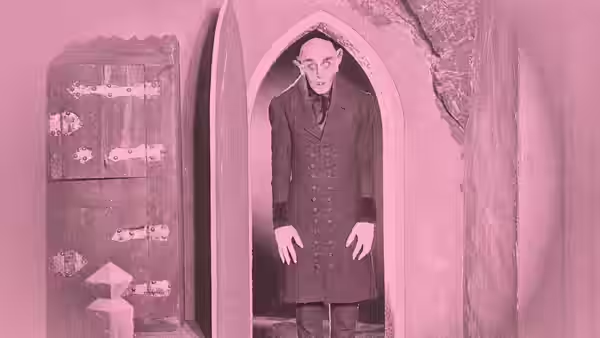
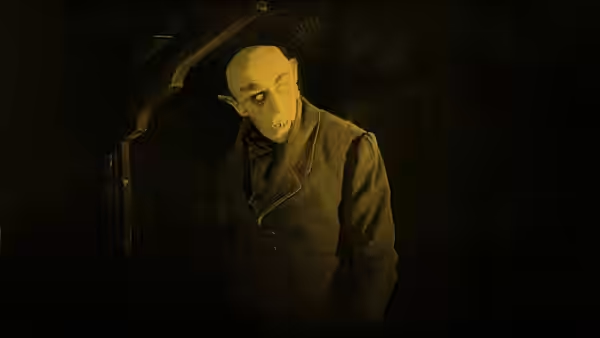
Max Schreck does much of the work by holding himself rigidly while the other performers expend considerably more energy. We were frightened by Orlok standing in a doorway, his body fitting the opening with an unpleasant exactness. There is time to inspect him, and inspection does not help: the ears, the long fingers and the fixed attention only become more troubling. The performance offers little encouragement to imagine spending an agreeable evening with this count.

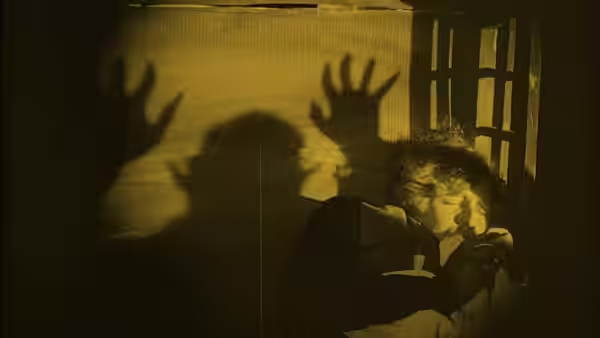
Günther Krampf and Fritz Arno Wagner, the cinematographers, make that effect depend on the space around him as well as on the face. We can read the shapes in the frame clearly, which makes it harder to dismiss what occupies them as a momentary glimpse. Doorways give the figure a hard outline; empty areas leave us waiting for something to enter.

Albin Grau’s costumes help keep Orlok forbidding, particularly the severe coat that encloses his thin body. The clothes allow little suggestion of comfort or ease, and the make-up makes his face difficult to read as friendly. Hans Erdmann’s music gives the held images a sense of forward movement, though the count’s pauses are what most effectively sustain our unease. The costume and the actor’s bearing make even a motionless figure worth watching closely.

Not every performance benefits from such close attention, and Gustav von Wangenheim’s Hutter can be exhaustingly demonstrative. His cheerfulness is established well before the acting stops insisting on it, so the opening takes longer to settle than it needs to. Greta Schröder gives Ellen a more useful watchfulness, allowing anxiety to remain in a look rather than always announcing it with a gesture. The slower passages ask for patience even after the threat has become clear.

We do not need a vampire to be charming. Max Schreck leaves little chance of mistaking this one for an unsuitable romantic prospect. In a genre that can become preoccupied with the count’s manners, this insistence on making him repellent remains welcome.

At 94 minutes, it asks for patience in places, but there is no need to approach it as homework. The images are clear, the fear is direct, and the count needs no explanation of his historical importance before he can disturb us. Choose an evening when nobody needs the story to hurry.
Critical consensus AI synthesised

88
Positive
10
Mixed
0
Negative
0
Radio Times
★★★★★ · Alan Jones
100

Jones calls the film the most frightening incarnation of the vampire count in horror history. He praises Max Schreck’s mesmerising performance and the tension sustained by Murnau’s silent imagery.

Read the full review →
Slant Magazine
27 November 2007 · ★★★★/4 · Rob Humanick
100

The critic calls the film a silent masterpiece and one of cinema’s preeminent firsts. He especially praises Murnau’s striking visual imagery and Max Schreck’s performance and makeup.

Read the full review →
Time Out
21 October 2013 · ★★★★★ · Tom Huddleston
100

The critic calls the film ground zero for horror cinema. The available description singles out its place in the birth of the genre, while noting its loose adaptation of Dracula.

Read the full review →
Empire
1 January 2011 · Kim Newman
90*

Newman gives the film a strongly positive verdict, calling it essential and the greatest screen Dracula. He singles out Max Schreck’s nightmarish performance as the vampire, while noting a few unwise directorial choices.

Read the full review →
IndieWire
25 October 2010 · robbiefreeling
90*

The critic calls the film exceptionally chilling and more bewitching than other adaptations of Stoker’s story. They single out Max Schreck’s unnerving performance and Murnau’s striking use of space and composition.

Read the full review →
Variety
31 December 1921 · Variety Staff
80*

The review is clearly positive about the film’s direction and visual craft. It singles out the imaginative cinematography and Max Schreck’s effective pantomime performance.

Read the full review →

Straight answers AI written, from our review

How long is Nosferatu, and what is it rated?
Nosferatu runs 1h 34m and is rated K-18 by the KAVI in Finland. It is a horror and fantasy film.
Where can I watch Nosferatu in Finland?
Nosferatu is not on any streaming or rental service in Finland at the moment. It is available in 15 other countries; change your country at the top of the page to see where. Availability is checked daily.
What should I watch after Nosferatu?
After Nosferatu, try Vampyr (1932, Fi1m 85): For another vampire film where ordinary rooms become difficult to trust. Then The Spirit of the Beehive (1973, Fi1m 87): A child’s encounter with screen horror makes the countryside feel quietly threatening.

Cast

If you liked this, try…

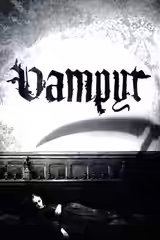
  1. Vampyr (1932, Fi1m 85)For another vampire film where ordinary rooms become difficult to trust.

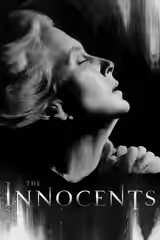
  2. The Innocents (1961) · not on Fi1m yetA governess, two children and frightening uncertainty about what the camera shows.

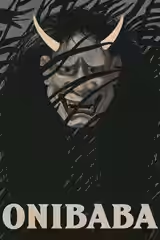
  3. Onibaba (1964) · not on Fi1m yetReeds, desperate people and a mask that makes human cruelty harder to dismiss.

  4. The Spirit of the Beehive (1973, Fi1m 87)A child’s encounter with screen horror makes the countryside feel quietly threatening.

  5. A Girl Walks Home Alone at Night (2014) · not on Fi1m yetA vampire wanders empty streets, with loneliness taking its place beside fear.