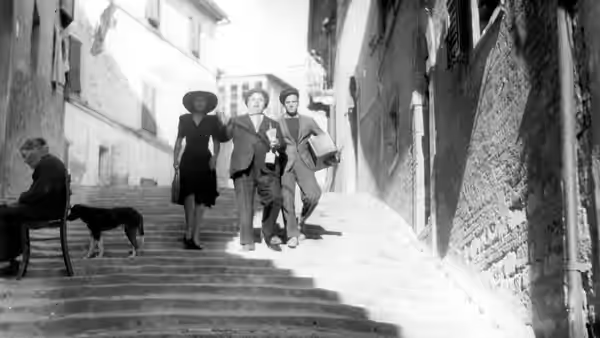
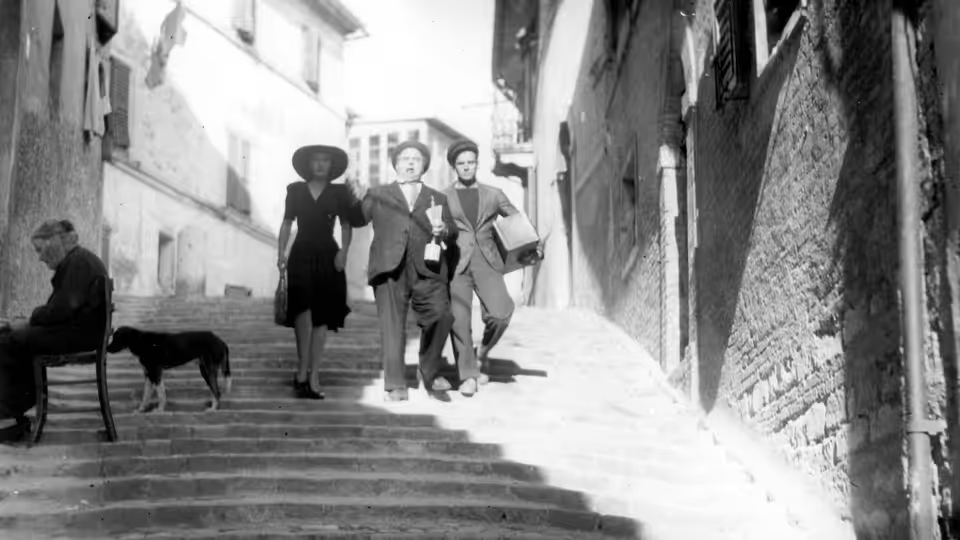
Three people descend a narrow street past a seated man and a dog
Film review

Obsession

1943 · Directed by Luchino Visconti · 2h 20m · Medierådet 15

In a sentenceA crime drama whose strongest recommendation is a man who still looks hopeful

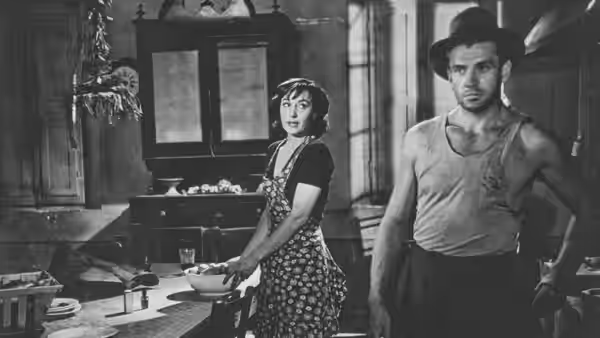
In the Po Valley in northern Italy, Gino Costa (Massimo Girotti), a drifter, stops at a roadside inn run by Giuseppe Bragana (Juan de Landa) and his wife, Giovanna Bragana (Clara Calamai). Giuseppe gives Gino work, while Giovanna is drawn to the stranger. Gino wants her to leave with him, but she is reluctant to give up the security of the inn for life on the road. Meals, repairs and the work of running the business keep the three together as the attraction develops.

Fi1m review

Luchino Visconti’s crime drama makes desire feel urgent and ordinary, with Massimo Girotti and Clara Calamai giving it an uncomfortable closeness. Its patience sometimes becomes sluggishness, but the people remain worth watching when the story slows.

Luchino Visconti’s Obsession is worth an evening for the performances and the uncomfortable closeness of its people. It gives desire the urgency of a chance that may not come again, while remembering that the people involved still need food, work and somewhere to sleep. We recommend it with a reservation about the pace: 140 minutes is a long time to sustain this degree of unhappiness. The film sometimes lingers after a scene has made its point.

Massimo Girotti makes Gino Costa’s hopefulness painfully convincing, with desperation never far behind it. His face has an openness that keeps the character’s desires understandable even when his judgement gives us little confidence. We were moved by the eagerness in that performance; Girotti makes being wanted seem important enough to cloud everything else. Even when Gino seems certain about what he wants, Girotti leaves enough uncertainty in his expression to make us worry about him.

Clara Calamai’s Giovanna Bragana is a less immediately inviting presence, and the performance is stronger for that. Her dissatisfaction can be abrasive, but her reluctance to exchange the security of the inn for the road makes sense. Calamai keeps the practical cost of romance visible, preventing Giovanna from becoming merely someone for Gino to desire. Juan de Landa’s Giuseppe Bragana contributes a coarse, intrusive presence that makes their shared domestic space uncomfortable without making him negligible as a person.

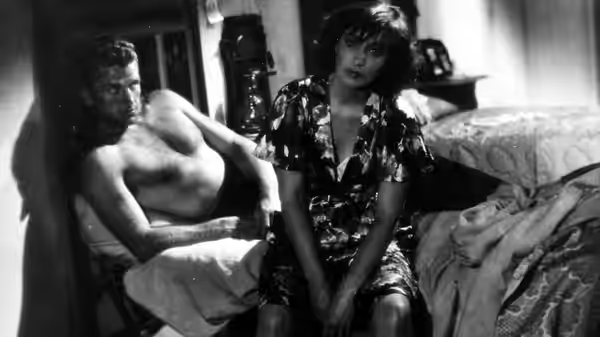
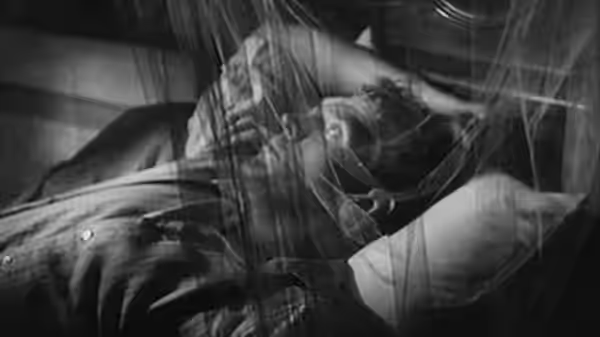
Domenico Scala and Aldo Tonti’s photography gives that space its importance. The inn’s rooms feel occupied by people with jobs to do, and the kitchen looks like somewhere a person must spend the day working. The bodies within these rooms seem heavy and inconveniently close, while the road outside offers little reassurance despite the space to move. The images make it easy to understand the appeal of leaving, and harder to imagine what a life without this place would look like.

Mario Serandrei’s editing lets us spend enough time with the characters to notice discomfort that a more hurried film might pass over. That patience helps the attraction seem to develop among ordinary interruptions and obligations. It also becomes the film’s chief weakness: some encounters continue to underline feelings that the actors have already made plain. We do not need a quicker succession of incidents, but we do need the longer scenes to change our understanding more often than they do.

Giuseppe Rosati’s music can be too insistent about the distress on screen. Its intensity suits the characters’ desperation, though it occasionally tells us how much to feel when Calamai and Girotti have done enough. Visconti is more persuasive when he trusts their physical presence and allows the surroundings to remain ordinary. The inn needs no extra help to seem an unhappy place to be stuck.

As a crime drama, Obsession gives unusual attention to the small practical reasons people remain in arrangements they resent. The characters’ misery will not suit an evening in need of relief, and Visconti offers little distance from their dissatisfaction. Yet the attraction between these people remains credible without being made pleasant or sensible. Choose it when there is time to watch the actors closely, and no urgent need to be cheered up.

Critical consensus AI synthesised

2 of 6
Positive
1
Mixed
1
Negative
0
The AV Club
30 August 2002 · Noel Murray
75*

Murray finds Ossessione compelling as both a murder story and a slice of life. He singles out Massimo Girotti’s desperate, hopeful performance as a strength.

Read the full review →
The New York Times
6 December 2002
64*

The page could not be accessed, so the critic’s verdict and specific praise or complaint cannot be verified. The available page text contains no review content.

Read the full review →

Straight answers AI written, from our review

Is Obsession worth watching?
Obsession is worth watching for its painfully convincing performances and close attention to the practical costs of desire; we score it 75 out of 100. We recommend it to anyone drawn to unhappy, complicated people, though its 140 minutes include scenes that linger after the actors have made their feelings clear.
How long is Obsession, and what is it rated?
Obsession runs 2h 20m and is rated 15 by the Medierådet in Denmark. It is a crime and drama film.
Where can I watch Obsession in Denmark?
Obsession is not on any streaming or rental service in Denmark at the moment. Availability is checked daily.
How violent or frightening is Obsession, and is it suitable for children?
Obsession has no UK or US certificate listed, so there is no age rating here to guide children’s viewing. We would steer children away from its sustained unhappiness and strained adult relationships, though the information available does not establish how graphic its violence or frightening its scenes are. It suits adults prepared for a slow, uncomfortable crime drama.
How does Obsession compare to Daybreak?
Obsession shares Daybreak’s concern with working people whose romantic troubles become a matter for the police, but gives particular weight to food, work and shelter. We favour Daybreak for absorbing confinement and Jean Gabin’s wounded force, and Obsession for the ordinary pressures surrounding its central attraction. Both earn their bleakness through performances, though Obsession’s patience sometimes becomes sluggishness.
Is Obsession based on a true story or a book?
Obsession is based on a novel by James M. Cain, rather than presented as a true story. Knowing the book is not necessary to follow the attraction between a drifter and an innkeeper’s wife, or her reluctance to sacrifice security for romance. We recommend it for those credible human pressures rather than any claim of fidelity to the source.
What should I watch after Obsession?
After Obsession, try Le Jour se lève (1939, Fi1m 82): For working people whose romantic troubles become a matter for the police. Then Double Indemnity (1944, Fi1m 92): For criminal attraction, persuasive performances and little confidence in human judgement.

Cast

If you liked this, try…

  1. Le Jour se lève (1939, Fi1m 82)For working people whose romantic troubles become a matter for the police.

  2. Double Indemnity (1944, Fi1m 92)For criminal attraction, persuasive performances and little confidence in human judgement.

  3. In a Lonely Place (1950) · not on Fi1m yetFor a romance in which suspicion makes ordinary intimacy increasingly difficult.

  4. The Housemaid (1960) · not on Fi1m yetFor domestic desire that makes every shared room feel dangerous.

  5. The Headless Woman (2008) · not on Fi1m yetFor the unsettling overlap between possible crime and continuing everyday life.

Obsession (1943) review: A gripping drama that sometimes drags (Denmark) | Fi1m