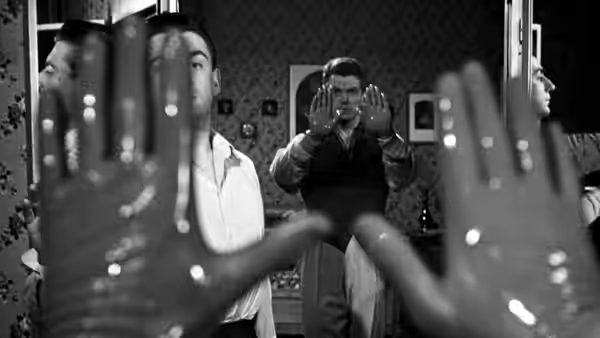
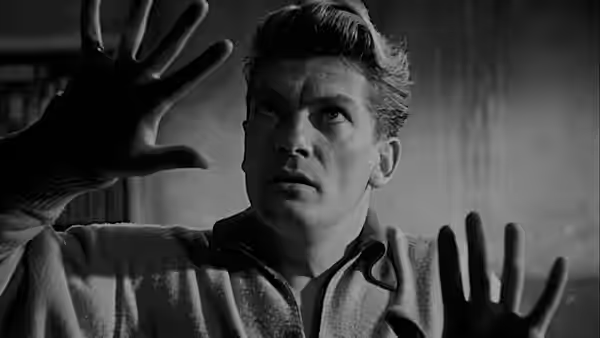
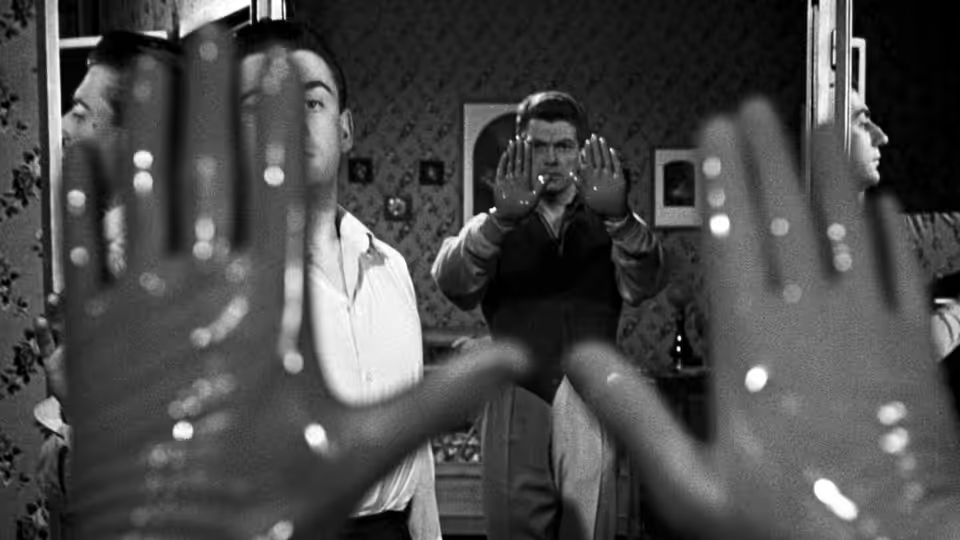
A man raises his hands before a mirror as others watch from the room
Film review

Orpheus

1950 · Directed by Jean Cocteau · 1h 35m

In a sentenceWe came for the love story and left suspicious of the bathroom mirror

Jean Cocteau moves the Orpheus and Eurydice legend into a postwar setting. Orphée (Jean Marais) and Eurydice (Marie Déa) are the lovers, while Death (María Casares) takes human form. The world of the dead lies close to their own, with mirrors providing a passage into it. Their romance unfolds where familiar surroundings can turn supernatural and where the division between life and death can be crossed. An ordinary reflection is no guarantee that the glass will remain a barrier.

Plays from YouTube when you press play; nothing loads from them until then.

Fi1m review

Jean Cocteau’s Orpheus is an inventive, unsettling fantasy that makes an ordinary mirror feel unsafe. Its romance can seem remote and the pace occasionally slackens, but we recommend giving its strange images time to work.

Jean Cocteau’s Orpheus is worth seeing for the ease with which it makes ordinary things unsettling. The romance is sometimes distant, and the pace occasionally drifts, but the fantasy has a confidence that carries us through those weaker passages. Cocteau brings the Orpheus and Eurydice legend into a postwar setting and makes a mirror a possible entrance to the world of the dead. He gives us time to look at the glass and consider what passing through it might mean.

Jean Marais gives Orphée the gravity the story needs, although his solemnity can also keep us at a distance. María Casares is more compelling as Death: her presence makes the supernatural feel uncomfortably close, without needing an effect to announce it. François Périer’s Heurtebise brings a welcome lightness to a film that sometimes seems reluctant to relax. These performances give us different ways of approaching the strangeness, and Périer is particularly useful when the others threaten to become too imposing to care about.

Nicolas Hayer’s cinematography makes the mirror effects persuasive because the surface remains so ordinary. The glass needs to retain the look of something we might pass without a thought, and the images allow it to do that. Jean d’Eaubonne’s production design gives the fantasy a similarly useful grounding in recognisable surroundings, where a supernatural threshold need not advertise itself. We felt a small, unreasonable chill at those mirrors, because a familiar surface had stopped offering the reassurance of a barrier.

Jacqueline Sadoul’s editing helps the visual tricks feel matter-of-fact, allowing us to register them without making each one an occasion for applause. There is enough time to enjoy the impossibility, and the film does not seem embarrassed by the simplicity of its means. Georges Auric’s music supports the solemn mood, although we found less to remember in the score than in the images. At times, a little less musical insistence on the seriousness of the occasion would have been welcome.

The weakness is that Cocteau can be so absorbed in strange possibilities that the romance feels underattended. Marie Déa gives Eurydice a human scale, but the character has less chance to command our attention than Death. When the pace slackens, that imbalance becomes harder to ignore, and we begin waiting for another impossible image rather than feeling much concern for the lovers. At 95 minutes this is hardly an endurance test, but a few passages ask for patience that the performances do not entirely repay.

Fantasy often tries to persuade us by furnishing an imaginary place down to the last detail. Cocteau changes the behaviour of familiar things and expects us to supply some imagination of our own, which gives Orpheus a welcome directness despite its solemn patches. The visible simplicity of the tricks never stopped them working on us; there is considerable pleasure in being unsettled by something we know cannot happen. Give it a patient evening, and resist the urge to treat every strange image as a riddle with a correct answer.

Critical consensus AI synthesised

82
Positive
7
Mixed
1
Negative
0
Radio Times
★★★★★ · Calum Baker
100

The critic calls Cocteau’s retelling magical and melancholic, and arguably his most accessible film. They single out its dreamlike treatment of the myth and its postwar setting for praise.

Read the full review →
Empire
1 January 2000 · David Parkinson
95*

Parkinson praises the film as a captivating, technically accomplished masterpiece. He singles out Cocteau’s surreal visual imagination and ingenious mirror effects for making its dreamlike Underworld so magical.

Read the full review →
The Guardian
18 October 2018 · Peter Bradshaw
85*

Bradshaw finds Cocteau’s film strange, rapturous and brilliantly elastic. He especially praises its low-tech effects, which make mirrors and other thresholds into eerie portals.

Read the full review →
Slant Magazine
30 August 2011 · ★★★★ · Chris Cabin
80

The critic praises Cocteau’s film as a deeply personal, technically inventive work with great emotional power. He singles out its striking visual effects and Criterion’s strong audio and image presentation.

Read the full review →
Time Out
15 March 2012
80*

The description gives a positive verdict, saying Cocteau pulls off a near-impossible combination. It singles out the blend of the Orpheus-Eurydice legend and visual tropes from his earlier films.

Read the full review →
Variety
31 December 1949 · Variety Staff
70*

The review finds the film poetic and imaginatively realized, though slow at times. It praises the expertly handled special effects and the performances of Jean Marais and Maria Casares.

Read the full review →

Straight answers AI written, from our review

Is Orpheus worth watching?
Orpheus is worth watching for its inventive, unsettling fantasy, and we score it 82 out of 100. We recommend it to anyone willing to give its simple mirror effects time to work, though the romance can feel distant and the pace occasionally drifts.
How long is Orpheus, and what is it rated?
Orpheus runs 1h 35m. It is a romance and fantasy film.
Where can I watch Orpheus in Bulgaria?
Orpheus is not on any streaming or rental service in Bulgaria at the moment. It is available in 5 other countries; change your country at the top of the page to see where. Availability is checked daily.
How does Orpheus compare to A Matter of Life and Death?
Orpheus is stranger and more unsettling than A Matter of Life and Death, which we recommend more readily for its humour and more affecting romance. Both bring lovers up against the rules of the afterlife, but we favour Orpheus for making familiar surroundings feel unsafe; the comparison favours A Matter of Life and Death for warmth and emotional involvement.
What should I watch after Orpheus?
After Orpheus, try A Matter of Life and Death (1946, Fi1m 92): Another romance in which the afterlife has rules the living must negotiate. Then Wings of Desire (1987, Fi1m 88): For another otherworldly romance that keeps its attention on ordinary human longing.

Cast

If you liked this, try…

  1. Beauty and the Beast (1946) · not on Fi1m yetAnother Jean Cocteau romance where familiar objects acquire unsettling lives of their own.

  2. Black Orpheus (1959) · not on Fi1m yetThe same myth takes on heat, movement and a different musical life.

  3. A Matter of Life and Death (1946, Fi1m 92)Another romance in which the afterlife has rules the living must negotiate.

  4. After Life (1998) · not on Fi1m yetA quieter journey beyond death, built around the difficulty of choosing memories.

  5. Wings of Desire (1987, Fi1m 88)For another otherworldly romance that keeps its attention on ordinary human longing.