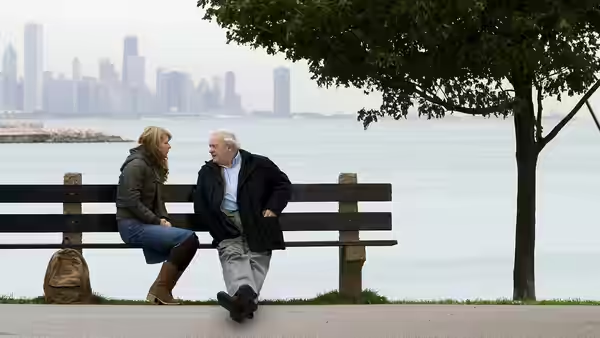
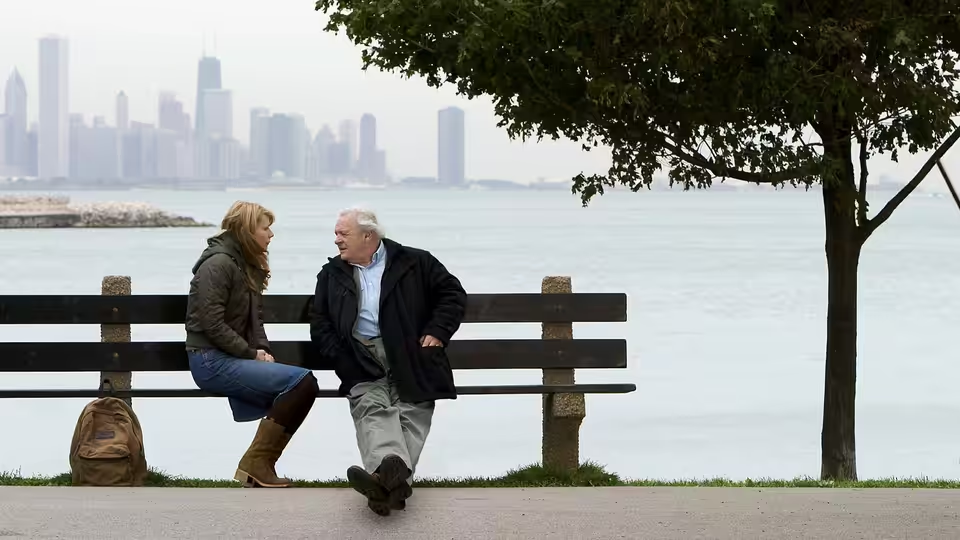
Catherine (Gwyneth Paltrow) and Robert (Anthony Hopkins) talk on a bench beside the water
Film review

Proof

2005 · Directed by John Madden · 1h 40m

In a sentenceA family fights over a notebook nobody on screen or off is allowed to read

Catherine Llewellyn (Gwyneth Paltrow) has spent years looking after her father Robert (Anthony Hopkins), a celebrated mathematician whose mind failed long before his body did, in the family house. He has just died. Late one night she sits up with the television on and argues with him anyway, about champagne and about whether she has inherited his illness along with his gift. Upstairs, his former student Hal Dobbs (Jake Gyllenhaal) is working through a hundred notebooks of scribble, hoping for one page of sense. Her sister Claire (Hope Davis) flies in from New York with hair conditioner, a funeral to run and a plan to sell the house and take Catherine back with her. Then a locked drawer in the study turns up a notebook that changes the question.

Fi1m review

John Madden films David Auburn’s play with care and a strong cast, and Gwyneth Paltrow is as good here as she has been anywhere. But the camera rarely leaves the porch, the romance never convinces, and the proof at the centre stays a blank.

Catherine Llewellyn has been nursing her father, Robert, a mathematician whose mind went before his body did. Now he has died. She has done no work of her own, and she is afraid she has inherited his illness as well as his gift. John Madden’s film of David Auburn’s play, adapted by Auburn and Rebecca Miller, asks one question across its 100 minutes: when a remarkable proof turns up in a locked drawer, who wrote it? It is a good question, well acted and handsomely staged. It is also, from first scene to last, a play that has been let out into the garden and asked not to go far.

Paltrow is the film’s spine. Her Catherine is sleepless, unwashed and quick to wound, and she carries the film on a face that keeps checking itself for faults. In the first scene she sits on the sofa at four in the morning and argues with her father about whether knowing he is dead counts as being sane. Hopkins pours cheap champagne and asks whether she has eaten. We were caught off guard: when he says the plain thing about his own death, we felt the loss arrive before the film had told us anything about either of them.

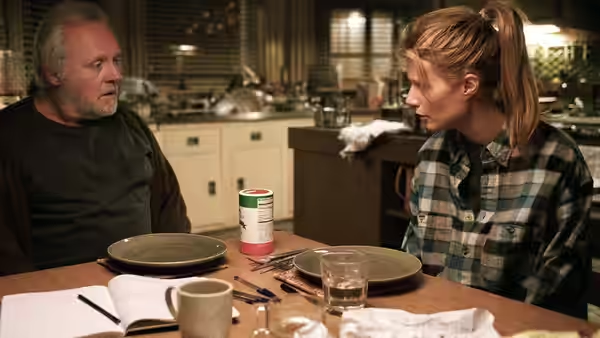
Hopkins plays Robert mostly in flashback, rumpled, fond and fast, and he declines the invitation to do madness as a turn. The illness shows as a man slightly too pleased with his own cleverness, which is how it would look to a daughter. Hope Davis is the other reason to watch. Her Claire is a decent woman who has mistaken competence for love, and the two sisters in the kitchen, each certain the other is the one who cannot cope, give the film its best sustained scenes. Davis is better than the part, which Auburn and Miller write as the villain until they remember she is not one.

Gyllenhaal is the weak corner. Hal is likeable and a little blank; the script gives him a band, a crush and a suspicion, and the romance with Catherine arrives on schedule after the funeral. We did not believe a minute of it, and we grew impatient waiting for the film to notice. That matters, because the second half, which we will not describe, turns on whether Hal trusts her, and we had no stake in what Hal thought about anything.

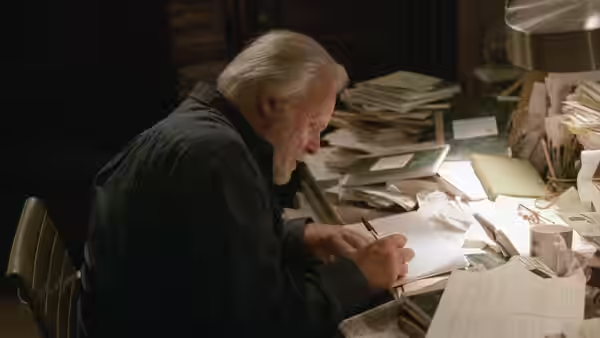
Alwin H. Küchler shoots the house in flat grey autumn light, so a kitchen at noon looks like a kitchen at dusk, and keeps the flashbacks a shade warmer so we always know which year we are in. Alice Normington stacks Robert’s study with notebooks and leaves the rest of the house looking as if nobody has bought anything for a decade. Jill Taylor puts Catherine in her father’s cardigans and Claire in clothes that have been ironed. Stephen Warbeck’s score is piano and strings, held back, and at its best when it stops. Mick Audsley cuts between present and past cleanly, perhaps too cleanly: the flashbacks keep arriving to settle things we were about to work out for ourselves, and the film is less tense each time.

The proof itself is never shown and barely described. This is sensible, since nobody on a sofa could check it, and it also means the object everyone is fighting over is a blank page. We take Hal’s word that it is important the way we take a briefcase in a thriller, and the film wants a great deal more from it than that. Madden, who made Shakespeare in Love, knows how to open a play up, and the few times he does so here, a funeral, a party, a lecture hall, the film breathes. Then it goes back inside and sits down on the porch.

It is worth an evening for Paltrow and Davis, in a quiet room, with no expectation of a mystery solved by cleverness. The film answers the question about the proof. The question about Catherine it leaves open, which is the right way round.

Critical consensus AI synthesised

59
Positive
2
Mixed
2
Negative
1

With only five reviews in so far, the picture leans mildly positive but stops well short of enthusiasm. Most critics find it an intelligent, intimate character drama and praise Gwyneth Paltrow, with Eye for Film also singling out her scenes with Hopkins. The reservations gather around the plot: several note that keeping the mathematical proof itself off screen drains the central question of force, and the final stretch is felt to be unresolved or too reliant on flashback. The one outright dissent comes from Slant Magazine, which finds the adaptation flat, Paltrow unconvincing, and the scenes added to the play damaging.

Empire
27 January 2006 · Anna Smith
70*

Smith finds the film an affecting, brooding character drama that does justice to its themes. She praises Gwyneth Paltrow’s performance, while noting that the unexplained mathematical proof weakens the plot’s impact.

Read the full review →
Total Film
10 February 2006 · ★★★ · Total Film
60

The review finds the film elegant and intelligent but too bleak and hollow to fully embrace. It praises Gwyneth Paltrow’s fierce, vulnerable performance, while faulting the romance and the film’s unresolved final stretch.

Read the full review →
Slant Magazine
1 September 2005 · ★½/4 · Jason Clark
38

Clark pans the adaptation as flat, unconvincing, and badly altered from the play. He particularly criticizes Gwyneth Paltrow’s performance and the added scenes that he says undermine the characters.

Read the full review →
Eye for Film
10 February 2006 · Anton Bitel
75*

The critic finds the film engaging and nuanced, praising its writing and sensitive performances. Paltrow and Hopkins are singled out for the believable, touching relationship they create.

Read the full review →
Paste
20 September 2005 · Amanda Petrusich
55*

Petrusich finds the film compelling in its treatment of Catherine’s uncertain genius and sanity, though its final answer remains elusive. She praises its tense, intimate style but criticizes the film for obscuring the mathematical proof and resolving the story’s tension through flashbacks.

Read the full review →

Straight answers AI written, from our review

Is Proof worth watching?
Proof is worth an evening for Gwyneth Paltrow and Hope Davis, and we scored it 64. The sisters arguing in the kitchen are the best of it; the romance with Jake Gyllenhaal's Hal never convinces, and the proof everyone fights over stays a blank page. Watch it in a quiet room, expecting a family drama rather than a mystery solved by cleverness.
How long is Proof, and what is it rated?
Proof runs 1h 40m. It is a drama and mystery film.
Where can I watch Proof in Switzerland?
Proof is available to rent from Amazon Prime Video from CHF 4.50. Availability is checked daily; the links above go straight to each service.
How does Proof compare to Pi?
Proof is the calmer and better-acted of the two, while Pi is the stranger and more alive. Madden's film sits on a porch and lets Paltrow, Hopkins and Davis talk; Aronofsky's number theorist comes apart in grainy black and white under relentless pressure. Choose Proof for performances and grief, Pi for a paranoid thriller that makes mathematics feel dangerous.
What should I watch after Proof?
After Proof, try Pi (1998, Fi1m 78): Darren Aronofsky’s number theorist comes apart in black and white on a far smaller budget. Then A Woman Under the Influence (1974, Fi1m 86): Gena Rowlands shows what a film about sanity looks like when nothing is tidied; and Rachel Getting Married (2008, Fi1m 84): Sisters, a family event and a long-held grievance that will not stay in its box.

Cast

If you liked this, try…

  1. Pi (1998, Fi1m 78)Darren Aronofsky’s number theorist comes apart in black and white on a far smaller budget.

  2. The Savages (2007) · not reviewed yetTwo siblings, a failing father and a house to clear, played for rueful comedy.

  3. A Woman Under the Influence (1974, Fi1m 86)Gena Rowlands shows what a film about sanity looks like when nothing is tidied.

  4. The Man Who Knew Infinity (2015) · not reviewed yetRamanujan at Cambridge; the mathematics is on the board and the loneliness is real.

  5. Rachel Getting Married (2008, Fi1m 84)Sisters, a family event and a long-held grievance that will not stay in its box.