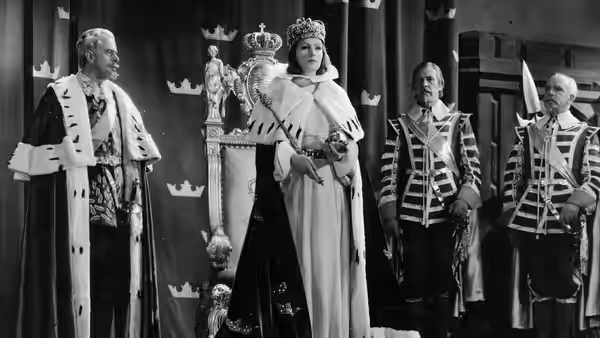
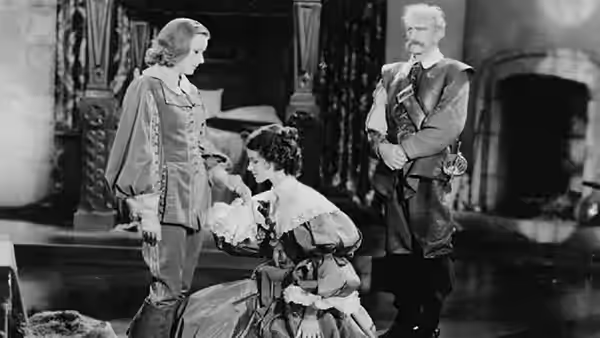
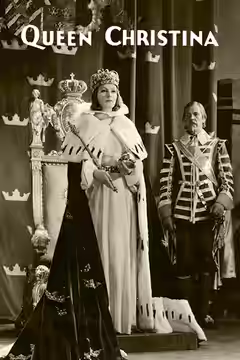
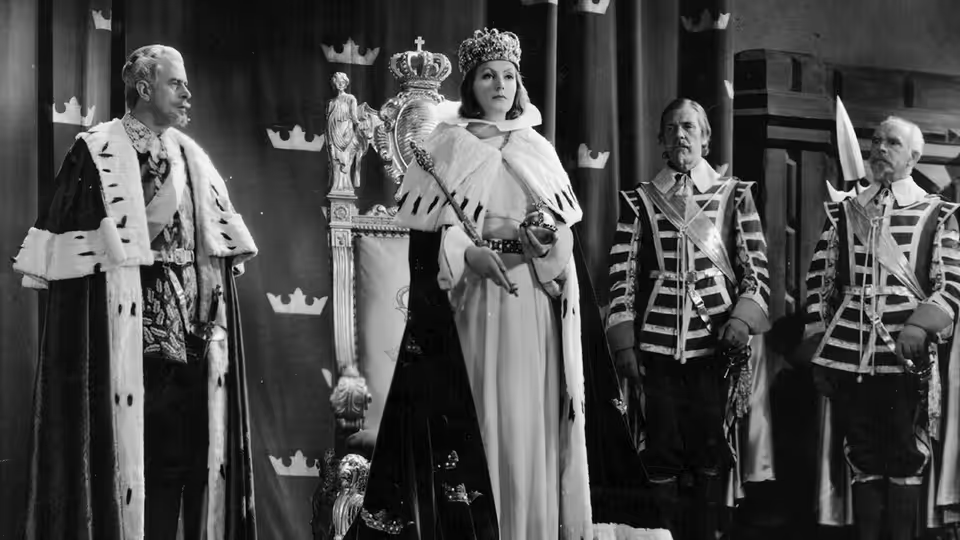
Christina (Greta Garbo) stands crowned among courtiers and uniformed guards in the palace
Film review

Queen Christina

1934 · Directed by Rouben Mamoulian · 1h 39m · KMRB 12

In a sentenceWe would happily watch Greta Garbo think while someone quietly shortened the film around her

Queen Christina is a historical romantic drama starring Greta Garbo as Christina, John Gilbert as Antonio and Ian Keith as Magnus. Lewis Stone plays Oxenstierna, Elizabeth Young plays Ebba and C. Aubrey Smith plays Aage. Reginald Owen appears as Charles, David Torrence as the Archbishop and Georges Renavent as the French Ambassador. Rouben Mamoulian directs, with cinematography by William H. Daniels, editing by Blanche Sewell and music by Herbert Stothart. The film runs 99 minutes, with production design by Edgar G. Ulmer and costumes by Adrian.

Plays from YouTube when you press play; nothing loads from them until then.

Fi1m review

Greta Garbo gives Queen Christina enough feeling to justify the evening for her admirers. Rouben Mamoulian’s historical romance is less persuasive whenever its stately presentation takes precedence over its people.

Queen Christina is worth considering for Greta Garbo, provided that a single performance is enough to carry an evening. Rouben Mamoulian’s historical romance gives her ample prominence, but it can be ponderous about feelings she makes clear without much help. The result is a decent film that we would recommend chiefly to viewers already interested in its star. At 99 minutes, it still asks for more patience than we expected.

Greta Garbo’s Christina has a welcome capacity for irritation, which stops the performance becoming merely dignified. She can seem formidable without losing the suggestion that being formidable is tiring. We were moved by the weariness we read in her face: it makes Christina feel like someone who needs a little relief from being watched. The performance is persuasive enough that we kept wishing the surrounding drama would allow it to be simpler.

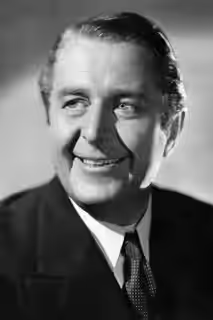
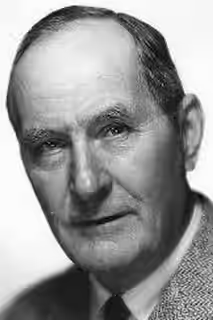
John Gilbert’s Antonio has a warmth that helps, although the performance seems too careful to be wholly convincing. We wanted a little more friction in the acting, a sense that someone might be capable of surprising the leading actress. Ian Keith’s Magnus and Lewis Stone’s Oxenstierna have a weight that suits this kind of drama. Yet too much of the supporting acting strikes us as dutiful, leaving her to provide most of the uncertainty and interest.

William H. Daniels’s cinematography gives Greta Garbo’s face the attention it deserves. The images seem most expressive when there is little to compete with her, and her expression holds our attention without much assistance. Edgar G. Ulmer’s production design is handsome, but we found its formality a little oppressive, making the people seem uncomfortably formal too. Adrian’s costumes feel better attuned to Christina, helping her seem individual without making her look out of place.

Blanche Sewell’s editing allows the acting room to settle, which is useful with Greta Garbo and less useful when the drama starts to feel ceremonious. We grew impatient with the solemnity; too often, a feeling seems clear before the film is ready to move on. Herbert Stothart’s music adds to that heaviness for us, pressing the emotion more firmly than the performances require. None of this makes the film unwatchable, but it keeps us conscious of the effort being made.

As historical romance, Queen Christina feels too cautious to make its romantic feelings fully persuasive. The genre can accommodate solemnity, but it needs some sense that private feeling might upset all the careful arrangements, and here that possibility remains too remote for us. There is nothing wrong with taking time over a performance; there is a problem when the surrounding drama feels this reluctant to get on with things. We would reserve it for an evening when the leading actress matters more than the pace.

Critical consensus AI synthesised

2 of 6
Positive
0
Mixed
2
Negative
0
Time Out
15 March 2012
65*

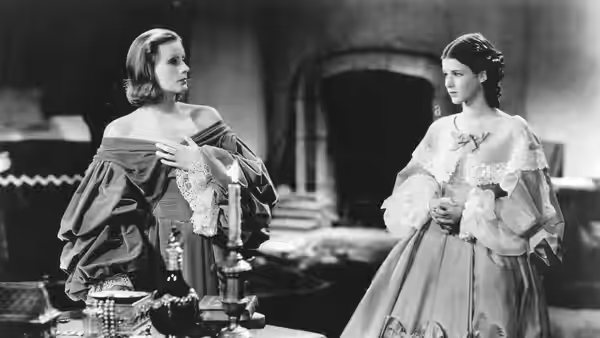
The available page does not reveal the critic’s verdict. Its description singles out Garbo’s manner and kisses with her ladies-in-waiting as suggesting otherwise than heterosexuality.

Read the full review →
The New York Times
27 December 1933 · Mordaunt Hall
64*

The article text is inaccessible, so its verdict cannot be determined. No specific praise or criticism is available to report.

Read the full review →

Straight answers AI written, from our review

Is Queen Christina worth watching?
Queen Christina is worth considering chiefly for Greta Garbo’s performance, and we score it 64 out of 100. We find the weariness and irritation in her Christina moving, but the stately presentation and slow pace make this an evening for her admirers rather than anyone seeking a gripping historical romance.
How long is Queen Christina, and what is it rated?
Queen Christina runs 1h 39m and is rated 12 by the KMRB in South Korea. It is a romance and history film.
Where can I watch Queen Christina in South Korea?
Queen Christina is not on any streaming or rental service in South Korea at the moment. It is available in 6 other countries; change your country at the top of the page to see where. Availability is checked daily.
How does Queen Christina compare to The Lion in Winter?
Queen Christina is the quieter, less persuasive royal drama beside The Lion in Winter, which we recommend for its sharper family conflict and forceful central performances. Garbo gives Queen Christina feeling that its solemn staging sometimes smothers; O’Toole and Hepburn keep the quarrelling in The Lion in Winter compelling even when the plotting begins to circle.
What should I watch after Queen Christina?
After Queen Christina, try The Lion in Winter (1968, Fi1m 81): For royal duty complicated by private desires and family hostilities. Then Orlando (1992, Fi1m 81): For period drama that questions the rules governing gender and privilege.

Cast

If you liked this, try…

  1. The Scarlet Empress (1934) · not on Fi1m yetFor another historical drama about a woman navigating royal power.

  2. The Earrings of Madame de... (1953) · not on Fi1m yetFor romance constrained by rank, marriage and the demands of appearances.

  3. The Lion in Winter (1968, Fi1m 81)For royal duty complicated by private desires and family hostilities.

  4. Orlando (1992, Fi1m 81)For period drama that questions the rules governing gender and privilege.

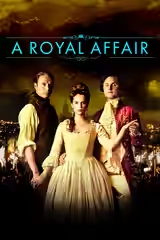
  5. A Royal Affair (2012) · not on Fi1m yetFor a court romance in which political consequences cannot stay outside.