A dry, starchy Englishman for hire, Reginald Owen spent two decades at MGM playing the man who has just been asked for money and would rather not. He was rarely the point of a film and reliably worth watching in it.
Fi1m perspective
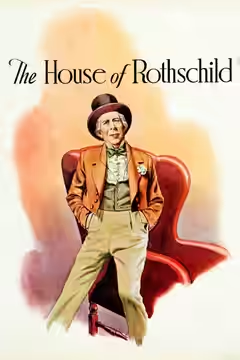
Reginald Owen's face on screen is that of a man who has just been asked for something and is working out how little of it he can give. In The House of Rothschild (1934) he is Herries, one of the Englishmen who need Rothschild credit and resent needing it, and he plays the resentment as manners: the request comes out clipped, the thanks come out clipped, and the loan is agreed as though it were the other man's idea. It is a small part. It is also the clearest picture of what he did for a living.
What he did was play the starchy Englishman, in comedy and in costume, for anyone who needed one, and Hollywood in the 1930s needed a great many. He had come out of the London theatre, where he made his stage debut in 1905 and co-wrote the play Where the Rainbow Ends around 1911, moved to the United States in 1920, and from the late 1920s was in Hollywood, where MGM kept him busy through the thirties and forties. The early parts put him in literary adaptations: Dr Watson in Sherlock Holmes (1932), then Holmes himself in A Study in Scarlet (1933), a film he also co-wrote. Few actors have done both, and it says something about the face. It could be the clever man or the man standing next to him, depending on the lines.
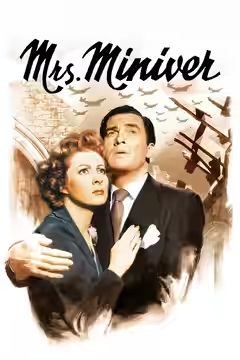
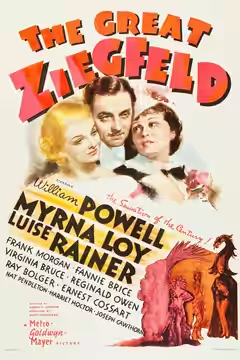
The role he is remembered for is Ebenezer Scrooge in A Christmas Carol (1938), which he took over from Lionel Barrymore, and it has outlasted almost everything else he did. We have not reviewed it and will not pretend to. What we can say is that Scrooge is a part built out of his materials, a man saying no in a well-turned sentence, and the casting made sense. After it he was an ensemble Englishman for hire: Foley in Mrs. Miniver (1942), one of the many in The Great Ziegfeld (1936), a film we scored 64 without finding him worth singling out, which is a description of the job rather than a complaint about him.
The criticism, such as it is, is that he stopped being a lead after the early 1930s and never went back. We are not sure he minded. In the year he died he told an interviewer that the stage was the only thing he could do easily and make money at, which is not a manifesto, and the work agrees with him. We found, in The House of Rothschild, that we were glad each time the film cut back to him and Arthur Byron: they are funnier and truer than the romance, and they manage it without raising their voices, while Karloff's Ledrantz is asked to sneer through the same scenes with nothing else to play.
He kept going into his eighties, into television and Disney, and Mary Poppins (1964) put him, as Admiral Boom, in front of an audience that had never heard his name. It is the starchy Englishman one last time. Start with The House of Rothschild, and watch what he does while Arliss is talking.
Biography
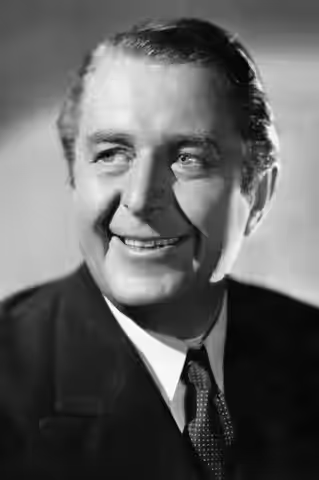
John Reginald Owen (5 August 1887 – 5 November 1972) was an English character actor. He studied at the Royal Academy of Dramatic Art and made his professional stage debut in 1905. He moved to the United States in 1920, appearing first on Broadway before settling in Hollywood, where he became a familiar presence in many Metro-Goldwyn-Mayer productions.
Owen is known for his performance as Ebenezer Scrooge in the 1938 film A Christmas Carol. He also played Dr Watson in Sherlock Holmes (1932) and the title role in A Study in Scarlet (1933). Later screen roles included Admiral Boom in Mary Poppins (1964) and General Teagler in Bedknobs and Broomsticks (1971). Other notable films include The House of Rothschild (1934), Mrs. Miniver (1942) and The Three Musketeers (1948).