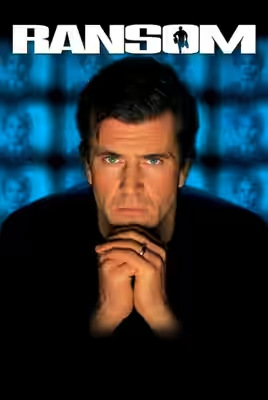
Ron Howard’s kidnap thriller is tense, slick and well acted, with Mel Gibson at his most coiled and Gary Sinise doing a great deal with a whisper. The last twenty minutes throw it away on a chase, but the first hundred earn the evening.
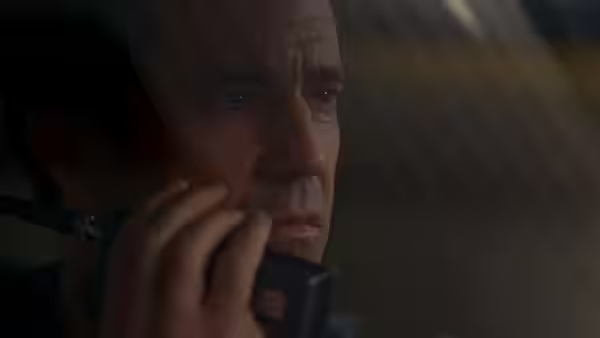
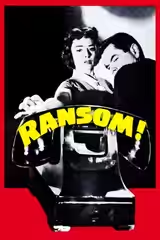
Ron Howard’s Ransom, written by Richard Price and Alexander Ignon, asks an old question: what do you do when a stranger has your child and names a price? For most of its 121 minutes it answers with a tight, well-acted thriller that knows exactly how to make a telephone frightening. Then, with twenty minutes left, it stops being that film and becomes a chase, and the chase is the least interesting thing in it. We recommend it, with that warning attached.
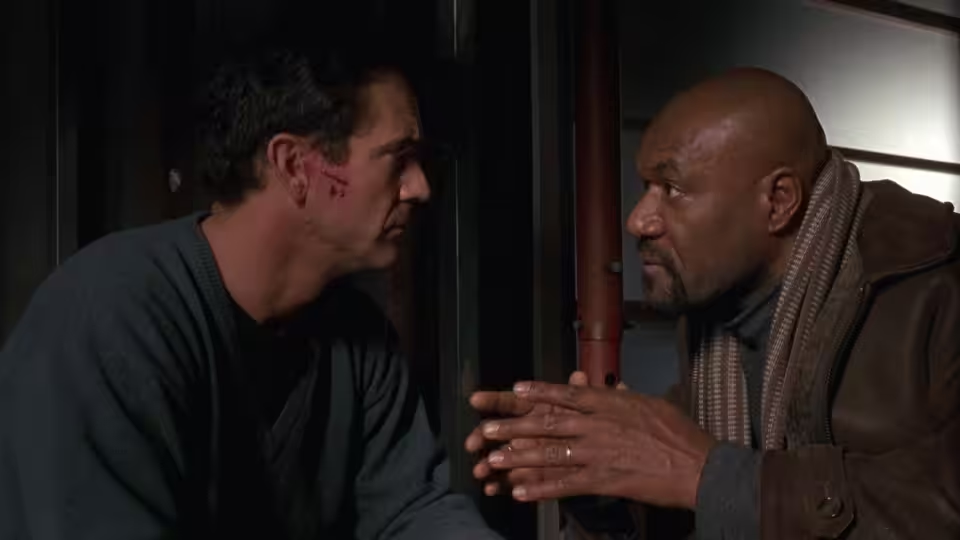
Tom Mullen (Mel Gibson) is rich, and Gibson plays him as a man who has never met a problem that could not be bargained down. When his son Sean (Brawley Nolte) is taken, the FBI moves into his penthouse, and Gibson spends the first hour pacing it, listening on headphones, trying to read the voice at the other end. It is one of his better performances: coiled, intelligent and not quite likeable. Rene Russo, as Katherine, is given mostly waiting, and does it with a stillness that makes her one eruption at her husband land. Delroy Lindo’s Agent Hawkins is calm, dry and usually right.
The kidnappers are the surprise. Gary Sinise plays Jimmy Shaker, a police detective who is also running the job, mostly in a hoarse whisper down a scrambled line. Price and Ignon write him as a man who has thought about money far longer than Tom has. Lili Taylor, as Maris, the one gang member who treats the boy as a child, gives a performance the script keeps forgetting to use. Liev Schreiber and Donnie Wahlberg, as the Barnes brothers, are jumpy and credible. The flat where they hold Sean, with a mattress on the floor and tape over the windows, is the film’s other locked room, and the cutting between the two is where the tension lives.
That cutting is the work of Daniel P. Hanley and Mike Hill, and for an hour it is close to faultless: a ransom call in the penthouse, a reaction in the hideout, back again before anyone has drawn breath. Piotr Sobociński shoots the penthouse in warm lamplight and the hideout in sour greens and greys, so we always know where we are. Michael Corenblith’s penthouse is glass and height, with the city laid out below it; Tom can see all of it from his window and cannot find his son in it. James Horner’s score is the weak link. It thumps and swells under scenes that were already tense, and in the last act it does the pushing the pictures should have done.
Halfway through, Tom does something on live television that we will not describe, though the tagline all but does. We were gripped, and we were on his side, and a minute later we were slightly ashamed of ourselves, because the film had just asked us to cheer a rich man gambling with a child’s life and we had. That is the one moment where Ransom is about something more than its plot. Howard does not quite trust it. Having raised the question of whether Tom is brave or simply used to winning, the script spends the rest of its length arranging events so that the question goes away.
Howard directs with a steadiness that is mostly a virtue and occasionally a dullness. He is good at rooms full of people under strain and less good at the street, and when the film finally leaves the flat it becomes an ordinary action picture of its decade: a car, a gun, a crowd, a man running. Once Shaker has to run and shoot like everyone else he is far less frightening than he was on the phone.
One critic found that the midpoint turn ruined the film, and we half agree: the choice is hard to believe, and the film knows it, and gets through the scene on Gibson’s conviction alone. It carries an 18 certificate and reached UK cinemas on 7 February 1997. Watch it for the first hundred minutes and for the phone calls; the last twenty you can take or leave, and by then the film has rather stopped caring too.