Todd Phillips’s first comedy is slack, crude and funnier than it has any right to be, and DJ Qualls gives it the one person we cared about. Watch it with company; alone, it is somebody else’s stag do.
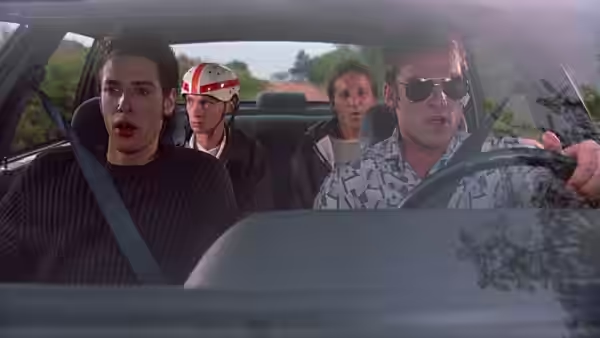
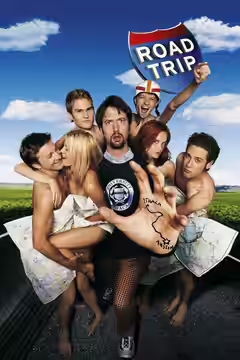
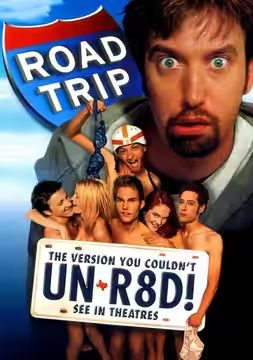
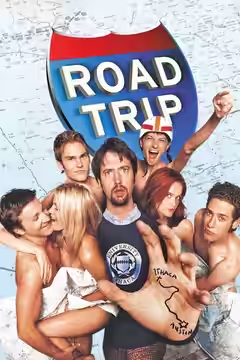
Road Trip is Todd Phillips’s first go at the kind of comedy he would later make his living from. Four students drive from New York State to Texas to intercept a videotape, and the film stops at every station on the gross-out line: the motel, the diner, the fraternity house, the sperm bank. It is slack, crude and, in stretches, properly funny, and it is kinder to its idiots than the genre usually manages. It runs 93 minutes, carries a 15, and reached British cinemas on 13 October 2000.
Phillips and his co-writer Scot Armstrong hang the whole thing on Tom Green. Green plays Barry, a student of no fixed year who takes a party of prospective students round the campus and tells them this story instead of the history, breaking off to feed a live mouse to Rubin’s snake. Green’s act, the slow blink, the flat stare, the refusal to stop a bit when it has stopped being comfortable, divides people cleanly. We found him funny about two times in three, and relieved each time the film cut away from him.
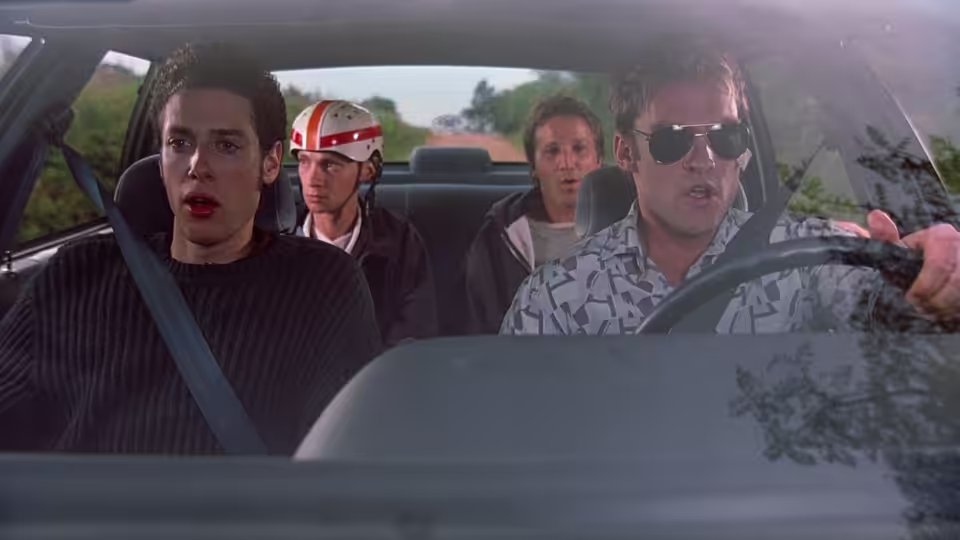
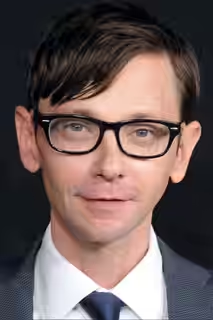
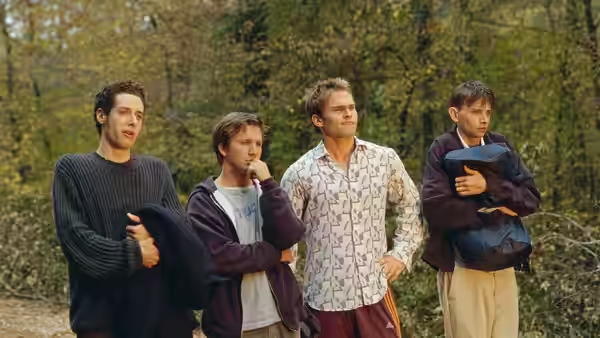
The boys in the car are sorted by type. Breckin Meyer’s Josh is the straight man, a decent boy who has done a stupid thing, and Meyer plays him without vanity. Seann William Scott, a year on from American Pie, gives E.L. the same grin and a nastier appetite; he is the one who always says yes. Paulo Costanzo’s Rubin knows a great deal and smokes through most of it. And DJ Qualls’s Kyle, all elbows and Adam’s apple, a stranger who came along only because the car is his father’s, is the best thing in the film by a distance. Qualls plays a boy who has never once been invited anywhere, and the film’s one true feeling is watching him work out that he might be enjoying himself. We laughed at Kyle more than at anyone, and we were on his side the whole way.
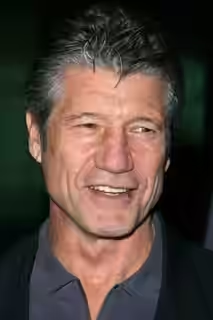
Fred Ward turns up as Earl Edwards, Kyle’s father, following the wreckage of his car across the country with a face like a slammed door, and he gets more out of a look than the script gets from most of its lines. Anthony Rapp’s Jacob, the campus oddball, is a joke that lands once and is then told for eighty minutes. Amy Smart gives Beth a warmth nobody wrote down. Rachel Blanchard’s Tiffany is a destination rather than a person, and the film half admits it.
Mark Irwin lights it flat and bright, so that every joke is in plain view, which is the correct way to photograph a man about to do something to a plate of French toast. Clark Hunter dresses the road as a run of rooms that are each slightly wrong: a motel with a bed too few, a diner whose cook should not be handling food, a sperm bank waiting room with too many magazines. Sheldon Kahn and Peter Teschner cut the set pieces tight and the stretches between them loose, so the film moves in lurches; for a comedy this short it has a surprising amount of dead road. Michael Simpson’s score keeps out of the way and lets the songs do the driving.
Two of the set pieces are good. The French toast sequence, in which Horatio Sanz’s cook is asked to remake an order and does, is the film’s most disgusting idea and its best made one, built from cutaways and reaction shots and a pause held one beat longer than we could stand. We laughed out loud and then felt faintly grubby, which is exactly what Phillips wants. The other, involving a broken bridge, the borrowed car and Kyle’s faith in physics, is over in a minute. The rest is mid-table: things happen in motel rooms and somebody is usually undressed.
Next to Animal House it is mild, and next to American Pie it is cruder, shorter and has less on its mind. Phillips would take the same shape, a few men, a lost object and a deadline, and tighten it into The Hangover nine years later. With company, a drink and low expectations it does its job. Alone and sober, it is a set of sketches with a car in it, and you will notice the car.