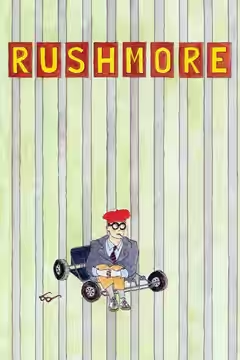
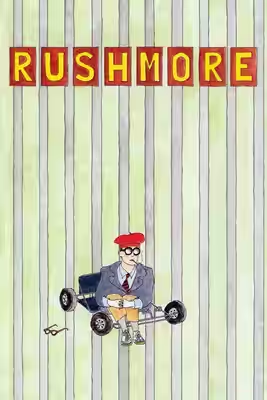
Max Fischer (Jason Schwartzman) seated in a go-kart on a paved lot
Film review

Rushmore

1998 · Directed by Wes Anderson · 1h 33m

In a sentenceNinety-three minutes with a schoolboy we would cross the playground to avoid, and somehow we were sorry to leave

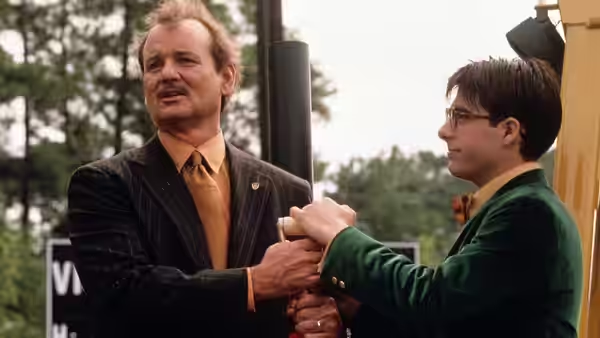
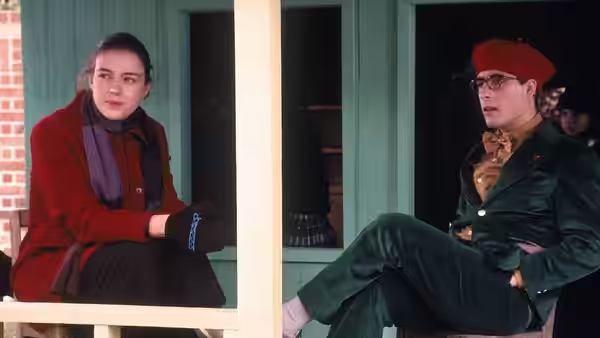
Jason Schwartzman plays Fischer, a schoolboy with ambitions that extend well beyond his education. Certain of his own importance, Fischer approaches romance and rivalry with a confidence that leaves little room for anyone else’s wishes. Bill Murray is Herman Blume, whose story becomes tangled with Fischer’s, and Olivia Williams plays Rosemary Cross. As Fischer pursues the life he thinks he deserves, the people around him contend with his self-belief, his anger and his difficulty accepting limits. Wes Anderson’s comedy follows a boy intent on being taken seriously, even when he gives others reasons not to.

Fi1m review

Wes Anderson’s Rushmore is a sharp, funny school comedy that understands how exhausting a self-appointed prodigy can be. Jason Schwartzman and Bill Murray give it an unexpected sadness, though its careful eccentricity occasionally becomes fussy.

Fischer is the sort of schoolboy who makes confidence look like a disciplinary problem. Wes Anderson’s Rushmore is a funny, sometimes touching comedy about the trouble such a boy causes when other people refuse to share his opinion of himself. We recommend it even to those who ordinarily have little patience for clever boys being difficult, although a few of its carefully arranged oddities test ours. Anderson allows Fischer to be arrogant, ambitious and romantically unreasonable without assuming that these qualities make him lovable.

Jason Schwartzman plays Fischer with a seriousness that makes the jokes work: this boy cannot see what anyone might find funny about him. Anderson and co-writer Owen Wilson give him the self-belief of someone who thinks wanting something amounts to a qualification. We laughed at his certainty, then became uncomfortable with the insistence of his romantic yearning. Schwartzman’s refusal to soften that confidence makes it possible to feel sorry for Fischer and still want someone to stop him.

Bill Murray’s Herman Blume gives Schwartzman an adult presence worthy of all that determination. Murray’s deadpan delivery allows a remark to land without asking for a laugh, and his weariness makes Fischer’s energy seem still more excessive. We can see why the boy’s self-importance might be funny to an older man, and why it might also be painfully familiar. Their pairing keeps the film from settling into the simple business of watching an obnoxious child receive his comeuppance.

Robert D. Yeoman’s photography gives the visual jokes the same care that the actors give the dialogue. The framing gives Schwartzman room to be funny without making every moment depend on his expression. David Wasco’s production design contributes to the carefully arranged surroundings; we occasionally wanted the place to look a little less supervised. That fussiness is a real limitation, because Anderson sometimes lets us notice the effort of setting up a joke before we have laughed at it.

David Moritz’s editing gives the comedy an economy that matters when the central character can be this exhausting. At 93 minutes, the film spends little time waiting for us to appreciate its cleverness, and the jokes benefit from that briskness. Mark Mothersbaugh’s music helps keep the peculiar humour buoyant without making the sadness feel like an interruption. The score lets the film acknowledge Fischer’s unhappiness without asking everyone to become solemn about it.

Olivia Williams, as Rosemary Cross, supplies an assurance that usefully checks the men’s claims on our attention. She makes the romantic material feel less sealed inside Fischer’s head, but Anderson and Wilson still give us more to understand about the men than about her. That imbalance matters in a film so alert to male self-absorption. Williams holds our interest, though the writing is happier pursuing Fischer’s unreasonable desires than giving her comparable weight.

Against the usual pleasures of a school comedy, Rushmore makes an unusually persuasive case for spending time with someone we would dislike in person. Anderson understands the attraction of a boy who refuses to be embarrassed, and keeps enough of Fischer’s anger visible to make that attraction uncomfortable. The film’s melancholy comes from recognising behaviour that adults have not necessarily left behind. Try it if painfully confident people make you laugh; expect to wince when the confidence starts to look familiar.


Critical consensus AI synthesised

79
Positive
12
Mixed
0
Negative
1
Empire
1 January 2000 · Caroline Westbrook
90*

The film is an offbeat and off-centre high-school comedy that turns the genre on its head with a unique protagonist and acerbic one-liners. It features a superb cast, including standout turns from Jason Schwartzman, Bill Murray and Olivia Williams, and is likely to attract a cult following.

Read the full review →
Sight and Sound
· Richard Kelly
90*

The critic praises Anderson and Wilson as among the best things to happen to American film, highlighting the film's unsettling self-assured protagonist, lovely romance, and inspired offbeat soundtrack. Rushmore is called an immediate American classic with terrific performances, especially from Schwartzman, Williams, and Murray.

Read the full review →
Slant Magazine
5 December 2011 · Chris Cabin
90*

The critic calls Rushmore a sublime comedy and Anderson's first masterpiece, praising its sincere, personal take on ambition, grief, and coming-of-age themes told from the ghost's point of view. He singles out the robust performances, especially the battle between Murray and Schwartzman, for evoking varied inner lives amid the humor and emotional depth.

Read the full review →
The Guardian
20 August 1999 · Andrew Pulver
90*

The critic calls Rushmore a genre-defying marvel that switches between outrageous humour and genuine pathos. It is praised as a finely-judged parable on the line between self-delusion and reality, aided by outstanding performances from Jason Schwartzman and Bill Murray.

Read the full review →
The New York Times
9 October 1998 · NYT Critic’s Pick · Janet Maslin
90*

The critic praises the film's bright, spiky portrait of an ambitious schoolboy tycoon-wannabe and its skewed, hilarious take on cutthroat boyhood rivalries and comeuppance.

Read the full review →
The New Yorker
30 November 1998 · Anthony Lane
85*

The review celebrates the film's short, smart comedy and its model of economy, highlighting the touching performance of the nerdy prodigy protagonist and the inspired pairing with Bill Murray's character.

Read the full review →

Straight answers AI written, from our review

Is Rushmore worth watching?
Rushmore is worth watching for anyone who can laugh at a painfully confident schoolboy, and we scored it 83. Jason Schwartzman and Bill Murray give Wes Anderson's comedy a sadness we did not expect, and at 93 minutes it never waits around for applause. Its carefully arranged oddities occasionally look fussy, and Olivia Williams is given less to work with than the men.
How long is Rushmore, and what is it rated?
Rushmore runs 1h 33m. It is a comedy and drama film.
Where can I watch Rushmore in Thailand?
Rushmore is not on any streaming or rental service in Thailand at the moment. It is available in 33 other countries; change your country at the top of the page to see where. Availability is checked daily.
How violent or frightening is Rushmore, and is it suitable for children?
Rushmore carries a 15 certificate in the UK, so it is not for children, but nothing in it is frightening or bloody. The comedy turns on a schoolboy's anger and his unreasonable romantic pursuit of a teacher, which is uncomfortable rather than violent. Older teenagers who can sit through a difficult character will be fine; the squeamish have nothing to fear.
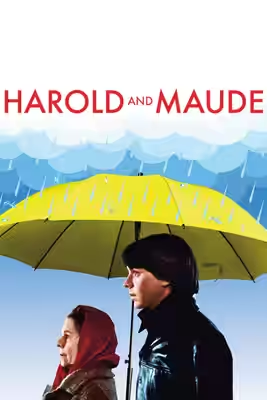
How does Rushmore compare to Harold and Maude?
Rushmore is the gentler and more tidily made of the two, while Harold and Maude is darker, ruder and less concerned with propriety. Both follow a difficult young man into an unlikely romance, but Wes Anderson's film keeps its jokes carefully arranged where Hal Ashby's lets them run loose. Choose Rushmore for polish and sadness, Harold and Maude for morbid nerve.
What should I watch after Rushmore?
After Rushmore, try Harold and Maude (1971, Fi1m 81): Another difficult young man finds romance, with darker jokes and less propriety. Then Election (1999, Fi1m 86): School ambition becomes a nastier business, with fewer excuses for its participants; and Submarine (2010, Fi1m 82): Another self-important schoolboy mistakes elaborate planning for an understanding of other people.

Cast

If you liked this, try…

  1. Harold and Maude (1971, Fi1m 81)Another difficult young man finds romance, with darker jokes and less propriety.

  2. Gregory's Girl (1981) · not reviewed yetFor adolescent romantic certainty gently corrected by people with more sense.

  3. Election (1999, Fi1m 86)School ambition becomes a nastier business, with fewer excuses for its participants.

  4. Submarine (2010, Fi1m 82)Another self-important schoolboy mistakes elaborate planning for an understanding of other people.

  5. Good Morning (1959) · not reviewed yetChildren make adult self-importance look ridiculous, with quieter jokes and careful compositions.

Free account

Know what to watch tonight

Two lists that know where things are streaming, collections you can share, your own score beside ours, and Discover that remembers what you have seen.

  • Want to see, sorted by what is streaming now
  • Seen, with your score out of ten
  • No adverts, ever