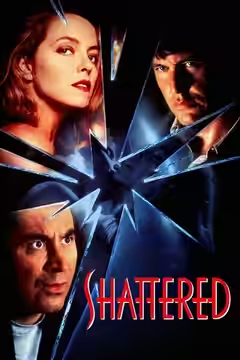
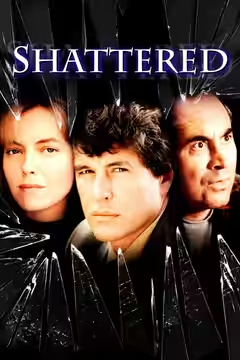
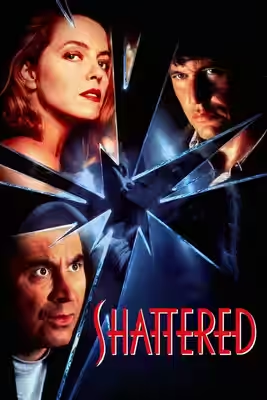
Wolfgang Petersen’s amnesia thriller is handsomely shot, briskly cut and lifted by Bob Hoskins every time he walks in. But it spends ninety minutes building towards a twist we did not believe for a second, and a good deal of what came before falls over with it.
Ten years after Das Boot (1981), Wolfgang Petersen makes an American thriller out of a Richard Neely novel, writing the screenplay himself. A man goes over a cliff, comes back with a new face and no memory, and spends 98 minutes finding out who he was and whether anyone around him is telling the truth. It is well made and well acted for most of its length, and it is undone by where it decides to arrive. Up to that point it is a decent evening. After it we were laughing, and not where the film wanted us to.
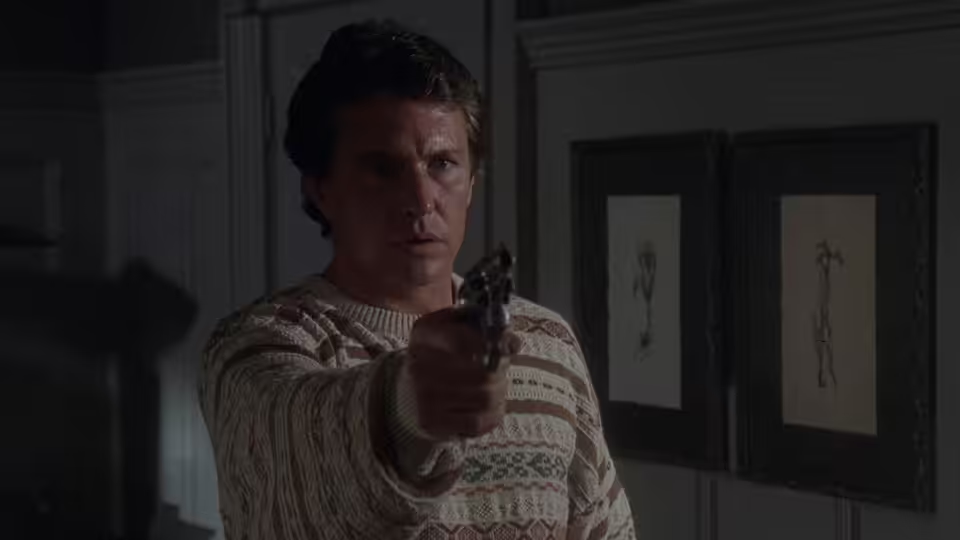
László Kovács shoots the crash at night, the car turning over in its own headlights before the drop, and then shoots the rest of the film in a soft grey, fog in the windows, white light in the hospital. Berenger plays the first stretch behind bandages and does his acting with his eyes, which turns out to be the right way to play a man who does not recognise his own reflection. Gregg Fonseca’s house for the Merricks is all pale surfaces and hard edges, a place a stranger would be nervous to sit down in, which is the point. Erica Edell Phillips puts Scacchi in cream and silk, so that Judith looks like something Dan has been given rather than someone he married.
Alan Silvestri’s score is a low synthesiser pulse under nearly everything, with strings that rise whenever a secret is about to be found, whether or not one is. Glenn Farr and Hannes Nikel cut the film tight; scenes end a line early, which keeps it moving and also keeps us from looking too hard at any of them. For an hour that pace works. The clues come on schedule, a photograph, a stranger who greets Dan by his old name, a wife whose patience is a little too complete, and we were leaning forward.
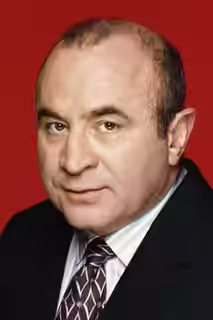
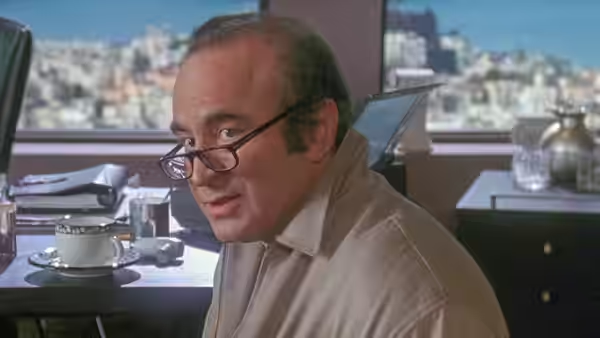
Then Hoskins arrives and the film gets better and worse at once. Gus Klein is a private detective, and Hoskins plays him as a cheerful man in a cheap jacket who has seen all this before and finds it mildly funny. Every scene he is in has air in it. We perked up each time he came through a door, and we noticed how badly the film needed him, because without him it is two handsome people being tense in a nice house.
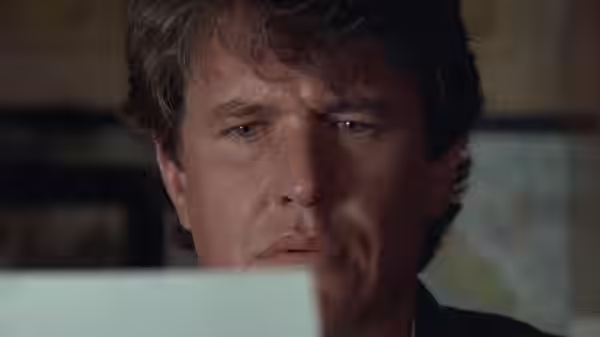
Scacchi has the harder job and does it well: Judith’s every kindness has to read two ways, and she manages it without winking. Whalley is given almost nothing beyond looking as if she knows something, and does that. Bernsen plays Jeb as a man who slaps backs for a living. Berenger holds the centre, bewildered and increasingly frightened, though the script gives Dan no quality beyond his confusion, so there is no one in particular for us to want restored.
The second half takes a turn we will not describe. We can say that Petersen plays fair with his clues, which is to his credit, and that fair is not the same as believable. The reveal needs several people to have behaved for months in ways no one would, and once it lands, the scenes we had admired look like a set of mirrors arranged for one trick. We sat up for it, as the film intended, and then we laughed out loud, which it did not, and the laugh was at the mechanism rather than with it.
Das Boot shut forty men in a tube and never once let the plot do work that fear and tiredness should have done. In the Line of Fire (1993), two years after this, showed Petersen could run a Hollywood thriller on character and still deliver the set pieces. Shattered sits between them and shows the join. It is better looking than most films of its kind and it trusts its gimmick far more than its people.
Watch it on a wet afternoon with someone who enjoys groaning at endings, and treat the ending as part of the entertainment rather than the payoff. Hoskins alone justifies the first hour. The last ten minutes are easier to forgive for anyone who enjoys being had.