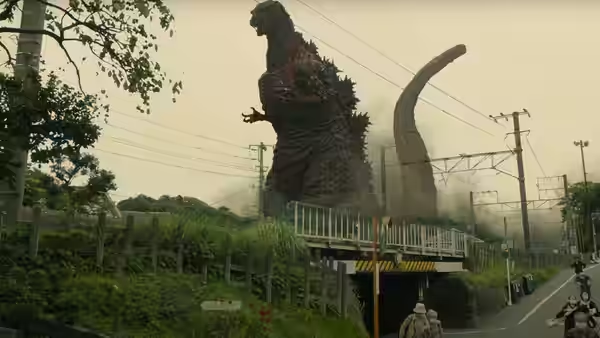
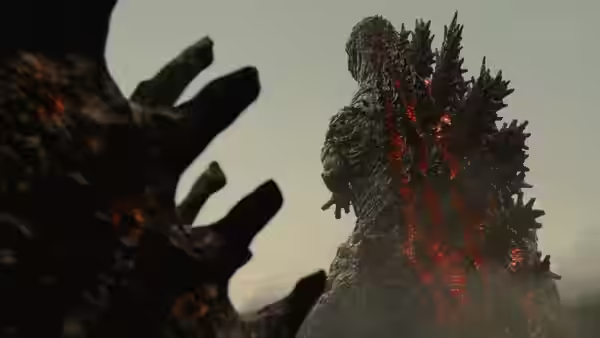
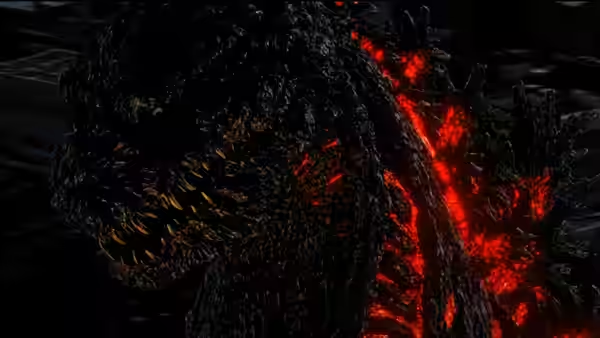
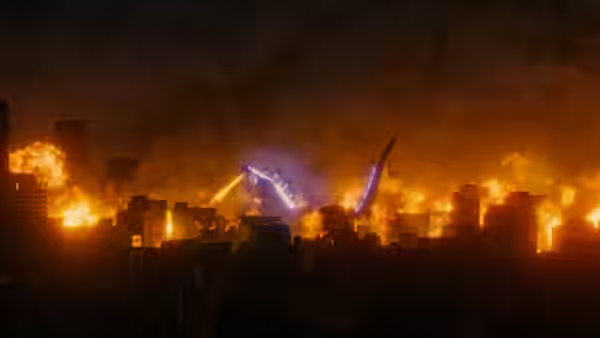
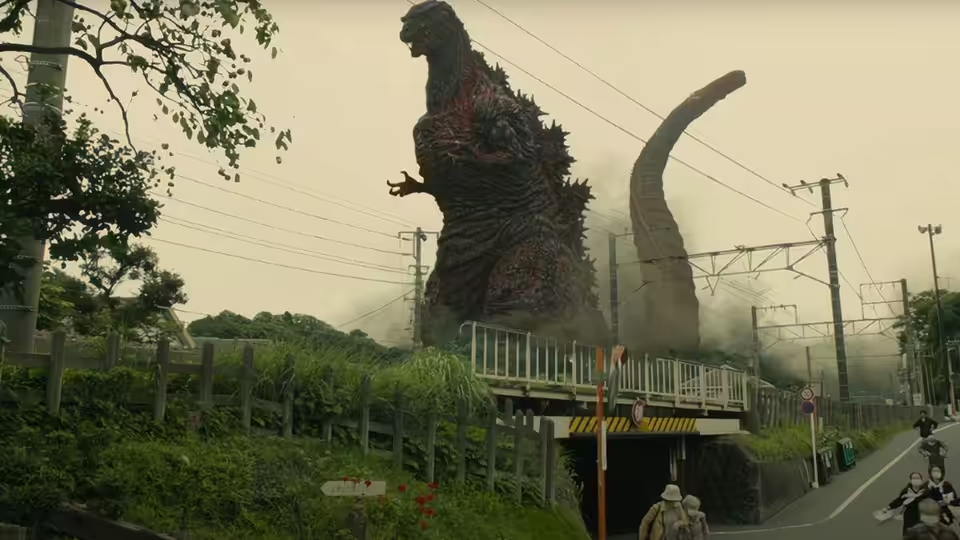
Godzilla rises beside a railway overpass as pedestrians flee along the road
Film review

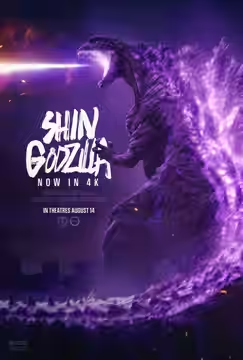
Shin Godzilla

2016 · Directed by Shinji Higuchi, Hideaki Anno · 2h 00m

In a sentenceGodzilla flattens a suburb and the cabinet’s first response is to move to a bigger room

Steam erupts from the water off the coast and a road tunnel beneath the bay floods. The cabinet of Prime Minister Seiji Ookouchi (Ren Osugi) gathers and argues over whether the cause is volcanic; Deputy Chief Cabinet Secretary Rando Yaguchi (Hiroki Hasegawa) says it is a living creature and is told to sit down. Then something with gills and fixed, staring eyes hauls itself up a river into a crowded district of the city, pushing boats and cars ahead of it. Yaguchi is handed a task force of officials nobody else wants, among them Hiromi Ogashira (Mikako Ichikawa) from the environment ministry and the biologist Kunio Hazama (Shinya Tsukamoto), while the smooth adviser Hideki Akasaka (Yutaka Takenouchi) manages the prime minister and an American envoy, Kayoko Ann Patterson (Satomi Ishihara), arrives with her own government’s demands.

Plays from YouTube when you press play; nothing loads from them until then.

Fi1m review

Hideaki Anno and Shinji Higuchi remake Godzilla as a disaster-response procedural, and the procedure is the point. It is talky, odd and sometimes clumsy, and its creature, when it appears, is the strangest and most frightening the series has produced.

Hideaki Anno and Shinji Higuchi have made a Godzilla film in which the monster is on screen for perhaps a third of its 120 minutes and the rest is meetings. That is not a complaint. Shin Godzilla is about what a modern state does when something impossible comes out of the sea, and its answer, delivered with a straight face and at speed, is that it convenes. We found it funnier and more frightening than we expected, and also tiring, which seems to be intended.

The first act moves fast. Steam rises from the bay, a tunnel floods, and the cabinet debates whether it is looking at a volcanic vent. Rando Yaguchi (Hiroki Hasegawa), a junior man who says the word creature out loud, is told to be quiet. Then the thing comes up a river into the streets on its belly, head lolling, gills leaking, eyes like painted plates, and shoves boats and cars through the streets ahead of it like a wave. We laughed when we first saw it. Ten seconds later we were horrified, and the two feelings never quite separated for the rest of the film.

Anno, who also wrote the script, edits with Atsuki Sato and cuts the meetings as if they were the action. Every official who speaks gets a caption with rank and department; every helicopter gets its designation. Kosuke Yamada shoots the rooms flat and wide under fluorescent light, faces low in the frame, sometimes from a camera set on the table among the water glasses. Eri Sakushima and Yuji Hayashida design a government of folding tables, whiteboards and name placards, and the joke, repeated until it stops being funny and then becomes funny again, is that the placards keep being carried into another room. Prime Minister Ookouchi (Ren Osugi) asks whether he is allowed to authorise a shot and is told a form is missing.

Shirō Sagisu, Anno’s composer since Neon Genesis Evangelion, supplies the choral and percussive cues that make a spreadsheet scene feel like a countdown. Alongside him the film uses Akira Ifukube’s marches from the earlier Godzilla films, and when the tanks roll out to that music we were moved more than we can quite account for. It is old music for old machines, and the film knows both are about to be found wanting.

Nobody here has a home life. Hasegawa’s Yaguchi is a decent man who is good in meetings; Takenouchi’s Akasaka is the adviser who always knows which way the wind is blowing; Ichikawa’s Ogashira says one flat sentence per scene and is right every time; Tsukamoto, the director of Tetsuo, plays the biologist Hazama with an unseemly delight. They are job titles with faces, and the film is content with that, so the two or three moments when a voice cracks land harder than they would in a warmer film. The exception is Ishihara’s Kayoko Ann Patterson, an American envoy who announces her intention to be president, speaks English that wobbles, and is written as a sketch in a film that has decided not to draw people. Most critics have picked on her, and they are right.

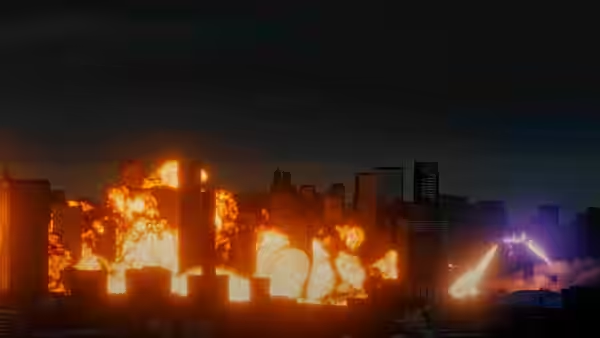
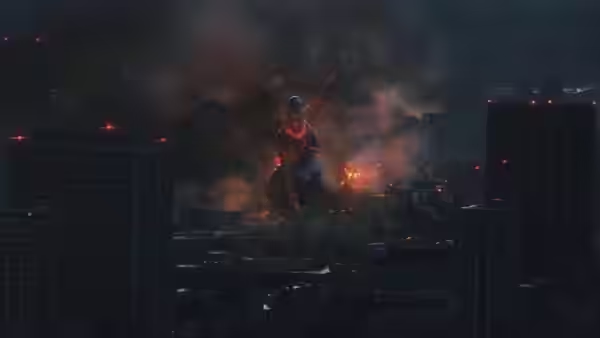
There is a sequence at about the hour mark, at night, over the city, that we will not describe. We watched it with a hand over our mouth. Higuchi and Anno stage it slowly, almost quietly, and it is the point at which the film stops being a comedy about paperwork and becomes something that is plainly about a real disaster, still recent when the film was made: press conferences, evacuation maps and men in blue jumpsuits. The film is angry at that memory and also proud of the people who worked through it, and it does not always manage to hold both moods in the same scene.

After that the creature goes quiet for a long stretch and the film becomes a plan: chemists, pumps, cranes, phone calls to foreign capitals. Several critics have complained that the monster vanishes for much of the second half, and the complaint is fair. The ending is a procedure carried out, and it goes more or less as planned, which is not what a monster film usually gives you. We were gripped anyway, mostly by the faces of people doing sums under a deadline.

Watch it with subtitles and be prepared to read; the captions arrive faster than anyone can say them. It runs 120 minutes and carries a 12, which is fair for the violence and slightly generous for the dread.

Critical consensus AI synthesised

65
Positive
8
Mixed
7
Negative
1

Most critics come away favourable, though the mixed verdicts are almost as numerous as the positive ones. The praise gathers in two places. The first is the political satire: the scenes of Japanese officials bickering in committee rooms while Tokyo comes apart are widely called shrewd, pointed and funny. The second is the creature itself. Reviewers admire the unsettling redesign, the awe-inspiring scale and the destruction sequences, and several note that the effects grow more convincing as Godzilla mutates.

The reservations gather around the talk. Many find the dialogue-heavy stretches slow the film, and a few say it runs too long. Empire complains that Godzilla disappears for much of the second half, and Time Out finds too little horror in the monster’s return. HeyUGuys, the lone outright dissenter, calls the film cold and monotonous, with thin characters. The spread is wide: from four stars to a shrug, with most reviews settling somewhere between entertained and unconvinced.

Radio Times
★★★★ · Jamie Healy
80

The critic finds the reboot unconventional and distinctive. They praise its shift from bureaucratic satire into a chilling nuclear-threat thriller.

Read the full review →
The i Paper
10 August 2017 · ★★★★ · Matthew Turner
80

Turner finds the film an effective blend of monster movie and political satire. He especially praises its impressive effects and sharply written treatment of political dithering.

Read the full review →
The AV Club
13 October 2016 · B · Katie Rife
77

Rife finds the film a charming, smashing return to form despite its dialogue-heavy stretches and anticlimactic ending. She praises the creature effects and the spectacular battle sequence, while noting the film’s pointed bureaucratic satire.

Read the full review →
Variety
29 September 2016 · festival review · Joe Leydon
75*

Leydon finds the reboot largely satisfying and surprisingly clever. He praises its political satire and increasingly persuasive effects as Godzilla mutates.

Read the full review →
The New York Times
11 October 2016
65*

The URL identifies this as a review of the matching film. The page returned only an access error, so the critic’s verdict and specific praise or complaint are unavailable.

Read the full review →
The Guardian
11 August 2017 · ★★★ · Peter Bradshaw
60

Bradshaw finds the film watchable entertainment, though its first glimpse of the monster and an American character disappoint. He praises the shrewd, amusing scenes of Japan’s bickering bureaucracy.

Read the full review →

Straight answers AI written, from our review

Is Shin Godzilla worth watching?
Shin Godzilla is worth watching if you can sit through a monster film that is mostly meetings, and we scored it 74. Hideaki Anno and Shinji Higuchi treat a government's response as the drama, and the creature, when it appears, is the strangest and most frightening in the series. It is talky and tiring by design, so those who want two hours of destruction should look elsewhere.
How long is Shin Godzilla, and what is it rated?
Shin Godzilla runs 2h 00m. It is an action and science fiction film.
Where can I watch Shin Godzilla in Croatia?
Shin Godzilla is not on any streaming or rental service in Croatia at the moment. It is available in 18 other countries; change your country at the top of the page to see where. Availability is checked daily.
How does Shin Godzilla compare to Godzilla?
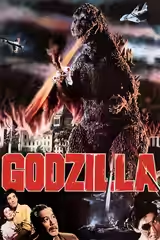
Shin Godzilla remakes Ishirō Honda's Godzilla as a fast, dry procedural about officials, whiteboards and paperwork, where the original is slow, sombre and openly grieving. Honda's film is the tighter and more affecting of the two; Anno and Higuchi's is odder, funnier and more frightening in its creature. Watch the original first, because Anno borrows Akira Ifukube's music from it to real effect.
What should I watch after Shin Godzilla?
After Shin Godzilla, try Godzilla (1954, Fi1m 88): Ishirō Honda’s original: slow, sombre and still frightening, with Ifukube’s music first heard here. Then Dr. Strangelove (1964, Fi1m 93): The end of the world managed by committee, played entirely for laughs; and Threads (1984, Fi1m 92): British nuclear catastrophe told through council memos and shopping lists; do not watch alone.

Cast

Awards

Blue Ribbon Awards for Best Film, 2017

Won
Blue Ribbon Awards for Best Film

Japan Academy Prize for Best Film Editing, 2017

Won
Japan Academy Prize for Best Film Editing

Japan Academy Prize for Director of the Year, 2017

Won
Japan Academy Prize for Director of the Year

Japan Academy Prize for Picture of the Year, 2017

Won
Japan Academy Prize for Picture of the Year

Japan Media Arts Festival Entertainment Division Grand Prize, 2017

Won
Japan Media Arts Festival Entertainment Division Grand Prize

Kinema Junpo Award for Best Screenplay, 2017

Won
Kinema Junpo Award for Best Screenplay

Mainichi Film Award for Best Film, 2017

Won
Mainichi Film Award for Best Film

Nikkan Sports Film Award, 2017

Won
Nikkan Sports Film Award

Nikkan Sports Film Award for Best Film, 2017

Won
Nikkan Sports Film Award for Best Film

Seiun Award - Best Media, 2017

Won
Seiun Award - Best Media

Japan SF Award Special Award, 2016

Won
Japan SF Award Special Award

If you liked this, try…

  1. Godzilla (1954, Fi1m 88)Ishirō Honda’s original: slow, sombre and still frightening, with Ifukube’s music first heard here.

  2. The Host (2006) · not on Fi1m yetBong Joon-ho’s river monster film, where the government is as dangerous as the creature.

  3. Dr. Strangelove (1964, Fi1m 93)The end of the world managed by committee, played entirely for laughs.

  4. Threads (1984, Fi1m 92)British nuclear catastrophe told through council memos and shopping lists; do not watch alone.

  5. Contagion (2011, Fi1m 78)Soderbergh’s pandemic as briefings, spreadsheets and cold rooms; the paperwork is again the point.