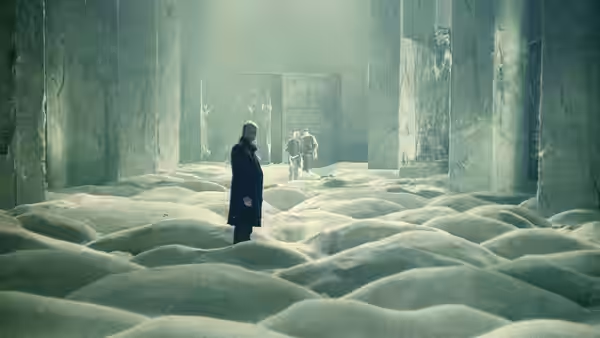
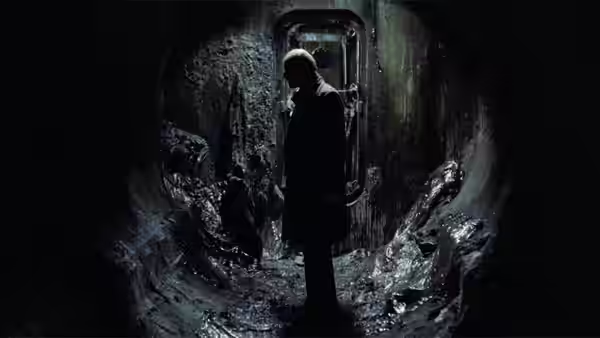
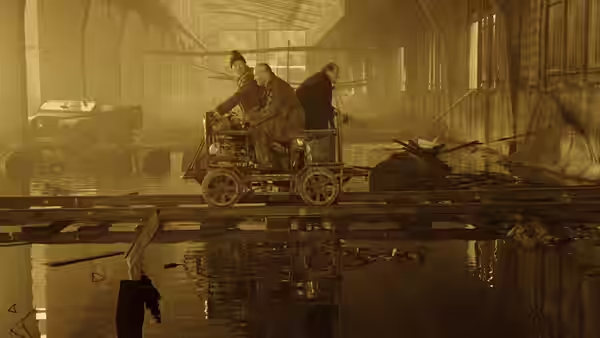
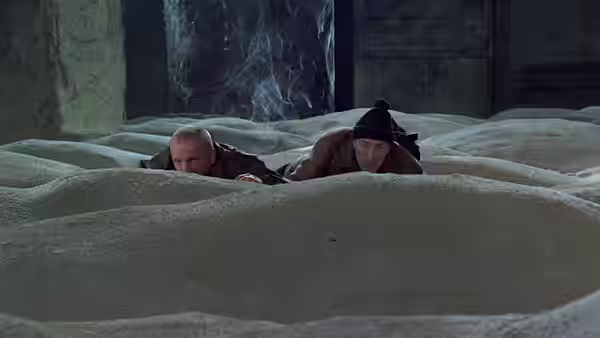
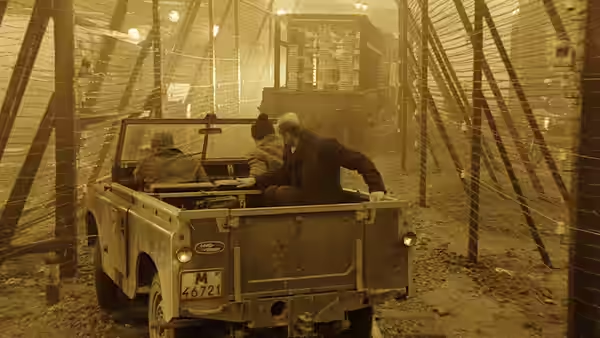
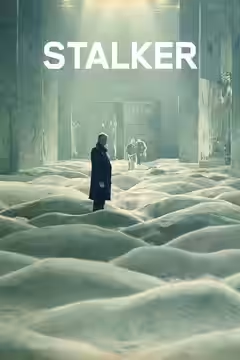
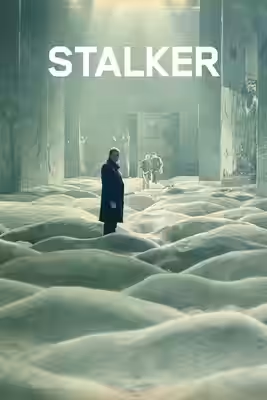
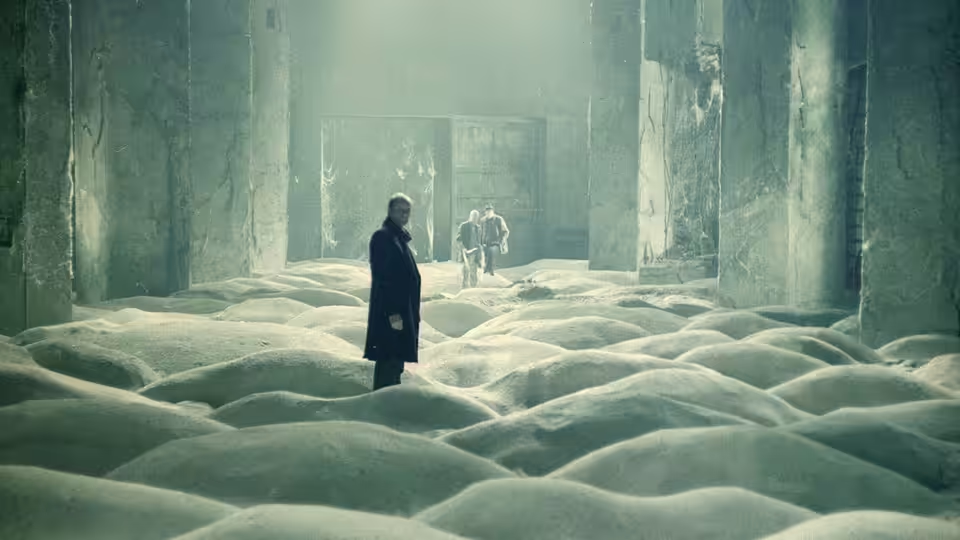
A man in a dark coat stands amid rippled dunes in a ruined hall
Film review

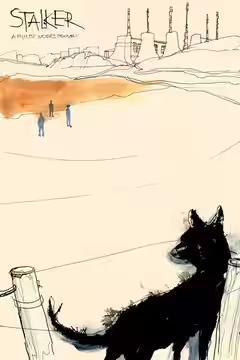
Stalker

1979 · Directed by Andrei Tarkovsky · 2h 42m

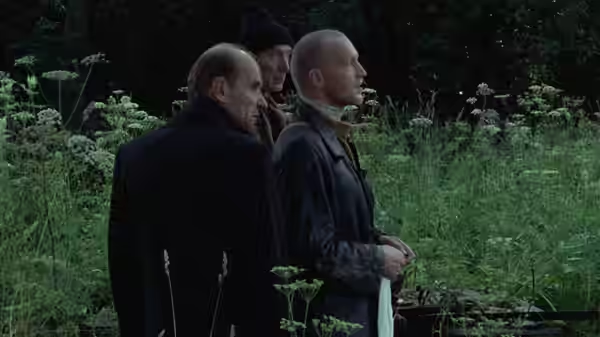
In a sentenceThree men go walking, and somehow the greenery makes everything worse

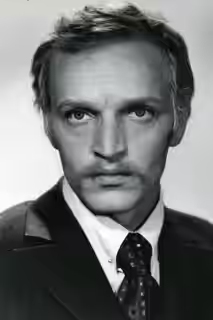
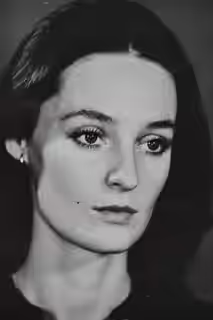
Stalker (Alexander Kaidanovsky) earns his living leading people into the Zone, a mysterious place beyond an ashen world. Stalker’s Wife (Alisa Freindlich) objects to the work that takes him there. His companions are Writer (Anatoly Solonitsyn) and Professor (Mykola Hrynko). Inside the Zone, green growth replaces the bleak surroundings outside. As the men travel, their conversation turns to belief, purpose and human desire. Stalker must guide them through unfamiliar surroundings while questions about what they want, and what they believe, complicate the business of getting from one place to another.

Plays from YouTube when you press play; nothing loads from them until then.

Fi1m review

Andrei Tarkovsky’s Stalker is a slow, unsettling science-fiction film that rewards close attention. The philosophical talk sometimes grows heavy, but the faces, music and green Zone make this a journey we warmly recommend.

Andrei Tarkovsky’s Stalker is demanding, unsettling science fiction, and we warmly recommend it to anyone prepared to let a film take its time. The starting point is a guide who earns his living taking people into the Zone, despite his wife’s objections. Tarkovsky makes that work carry questions about faith, purpose and the difficulty of understanding our own desires. At 162 minutes, the film gives those questions room to become uncomfortable.

The contrast between the ashen world outside and the green Zone initially looks easy enough to read. In the cinematography credited to Leonid Kalashnikov and Aleksandr Knyazhinsky, however, greenery offers surprisingly little comfort. The colour invites closer attention, which makes the place more troubling as we search it for something that might explain its hold on the people. Andrei Tarkovsky’s production design gives the landscape enough prominence to make that searching an important part of watching.

The close-ups have a similar effect, allowing us ample time to inspect faces without making the people easy to know. We were unsettled by that prolonged looking, particularly at Alexander Kaidanovsky’s Stalker. Kaidanovsky makes the guide’s seriousness seem vulnerable, and the camera stays with him long enough for us to question his confidence. The performance matters because faith would be a dry subject here without somebody who appears to need it.

Anatoly Solonitsyn’s Writer and Mykola Hrynko’s Professor have the harder task of keeping the philosophical debate human. The writing sometimes gives them a subject to discuss without enough sense of why this particular person needs to discuss it. Some exchanges keep pressing a point after we have understood it, and our attention begins to drift. Alisa Freindlich’s Stalker’s Wife helps through her objection to the guide’s work. She gives us a plain reason to question his commitment, without requiring another discussion of what belief means.

Lyudmila Feiginova’s editing is crucial to the film’s slow pace, giving the close-ups and landscapes time to occupy us. There is a risk of staring dutifully and waiting for the next piece of information. Eduard Artemyev’s music helps prevent that, making the Zone feel strange even when we think we have begun to understand what we are seeing. It is worth listening closely: the score contributes to the unease without making the place any easier to explain.

We like science fiction that lets an unfamiliar place remain difficult to understand. Here, the faces, changes in colour and music keep suggesting more than the men can explain. There is something troubling about watching people carry their convictions into surroundings that offer so little reassurance. Tarkovsky keeps bringing us back to the people doing the wondering, and their need to believe that their questions have answers.

This is a film to watch without worrying about having the correct interpretation ready for the credits. We would happily sit through its slower stretches again for the unease of those close-ups and the music. Give it an evening when neither of you is waiting for things to speed up.

Critical consensus AI synthesised

85
Positive
10
Mixed
0
Negative
0

The reviews are unanimously positive, with most critics finding Stalker absorbing precisely because it leaves so much unexplained. Praise centres on Tarkovsky’s imagery and atmosphere: the Zone’s unsettling landscapes, concentrated close-ups and carefully detailed sound give its questions about faith, identity and desire a physical presence. Critics repeatedly describe a film whose sparse science-fiction premise supports complex spiritual and philosophical enquiry, while several find its mystery compelling enough to sustain the slow pace.

The differences concern interpretation and degree of enthusiasm rather than any outright rejection. Some reviews emphasise spiritual uncertainty and human longing; others find a more concrete political allegory. Sight and Sound offers the clearest reservation, finding the philosophical debate less persuasive than the imagery and the evidence of Soviet life within it. The spread is modest, with even the more qualified responses recognising the film’s visual force.

Empire
1 January 2000 · David Parkinson
90*

This is a complex, challenging work of rare beauty and power whose elusiveness is part of its fascination. It is a seminal feature from the master of atmosphere and multi-functional allegory.

Read the full review →
Little White Lies
23 May 2016 · David Jenkins
90*

Jenkins hails Stalker as Tarkovsky's existential masterpiece exploring what it all means, with intricate detail and complexity that builds on its parable of faith and mystery. He singles out the staggering final shot that undermines everything preceding it.

Read the full review →
RogerEbert.com
25 July 2017 · Brian Tallerico
90*

Tarkovsky’s epic masterpiece remains riveting decades later for its timeless themes of identity and purpose, delivered through a mesmerizing visual language. The recent digital restoration makes it feel like experiencing the film anew.

Read the full review →
Slant Magazine
12 July 2017 · Nick Schager
90*

The critic praises Tarkovsky’s transfixing spiritual thriller as a dense, complex allegory about faith, consciousness, and human desire, highlighting its masterful close-ups and oblique philosophical ruminations. The review singles out the Criterion Blu-ray’s revelatory 2K restoration for finally rendering the Zone’s foreboding beauty and sonic details as originally intended.

Read the full review →
Los Angeles Times
18 May 2017 · Mark Olsen
85*

The rerelease of Stalker provides a fresh opportunity to appreciate its hypnotic, enigmatic adventure and hypnotic pull as a revelation among Tarkovsky’s works. Its enveloping, philosophical sci-fi world and distinctive score stand out as particularly compelling on the big screen.

Read the full review →
The New Yorker
8 February 2021 · Alex Ross
75*

Stalker has become Tarkovsky’s most celebrated work, a cryptic yet influential slow-cinema landmark that contrasts an ashen world with the verdant Zone and has inspired pop-culture phenomena. Its hyper-abstract thriller elements and reaffirmation of certain philosophical ideas are singled out amid broader discussion of the director’s legacy.

Read the full review →

Straight answers AI written, from our review

Is Stalker worth watching?
Stalker is worth watching for anyone prepared to give a slow, unsettling science-fiction film 162 minutes and their full attention, and we scored it 86. The philosophical talk sometimes presses on after the point is made, but the faces, Eduard Artemyev's music and the strange green Zone keep suggesting more than the men can explain.
How long is Stalker, and what is it rated?
Stalker runs 2h 42m. It is a science fiction and drama film.
Where can I watch Stalker in Poland?
Stalker is not on any streaming or rental service in Poland at the moment. It is available in 3 other countries; change your country at the top of the page to see where. Availability is checked daily.
How does Stalker compare to The Spirit of the Beehive?
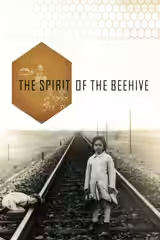
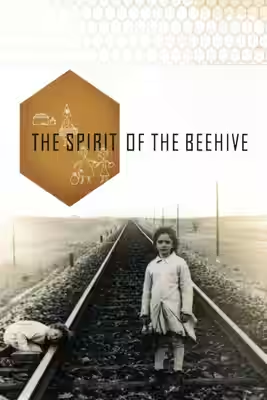
Stalker and The Spirit of the Beehive both let quiet images make ordinary places unsettling, but they work at different scales. Tarkovsky's film is longer and heavier with talk about belief, while Víctor Erice's is shorter, gentler and carried by a child's curiosity and Ana Torrent's performance. We recommend both; the Erice is the more affecting, the Tarkovsky the stranger.
Is Stalker based on a true story or a book?
Stalker is based on a novel by Arkady and Boris Strugatsky, not on a true story. Our review does not measure how closely Tarkovsky follows the book, and knowing it is not required: the film asks you to watch without an interpretation ready, and the source will not supply one.
What should I watch after Stalker?
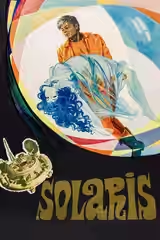
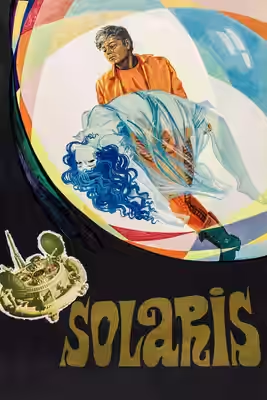
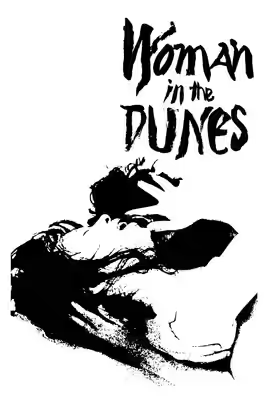
After Stalker, try Solaris (1972, Fi1m 87): Tarkovsky makes another uncertain journey feel painfully close to home. Then Woman in the Dunes (1964, Fi1m 88): Sand, confinement and stubborn desire turn a small setting into sustained unease; and The Spirit of the Beehive (1973, Fi1m 87): Quiet images and a child’s curiosity give ordinary places an unsettling charge.

Cast

If you liked this, try…

  1. Solaris (1972, Fi1m 87)Tarkovsky makes another uncertain journey feel painfully close to home.

  2. Woman in the Dunes (1964, Fi1m 88)Sand, confinement and stubborn desire turn a small setting into sustained unease.

  3. The Spirit of the Beehive (1973, Fi1m 87)Quiet images and a child’s curiosity give ordinary places an unsettling charge.

  4. Picnic at Hanging Rock (1975, Fi1m 88)A landscape becomes frightening through patient looking and explanations that never settle.

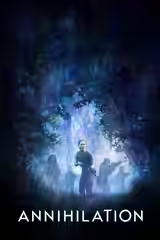
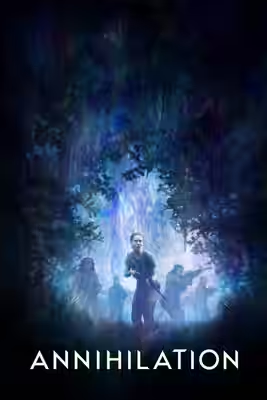
  5. Annihilation (2018, Fi1m 82)Another expedition into altered nature, with more visible threats and fewer speeches.

Free account

Know what to watch tonight

Two lists that know where things are streaming, collections you can share, your own score beside ours, and Discover that remembers what you have seen.

  • Want to see, sorted by what is streaming now
  • Seen, with your score out of ten
  • No adverts, ever