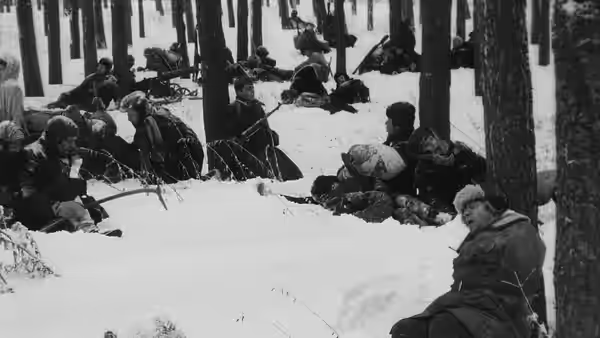
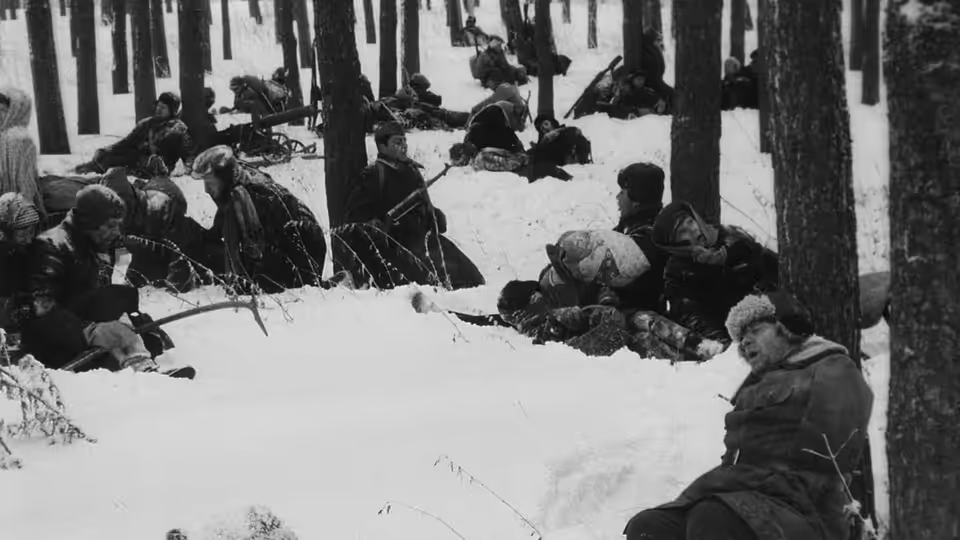
Armed partisans lie and crouch among snow-covered trees in a forest
Film review

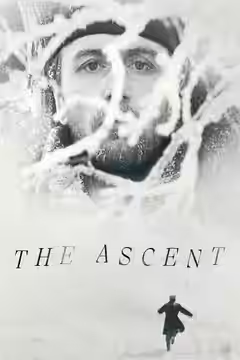
The Ascent

1977 · Directed by Larisa Shepitko · 1h 50m

In a sentenceTwo partisans, one stolen sheep, a lot of snow, and the only warm room in the film belongs to the interrogator

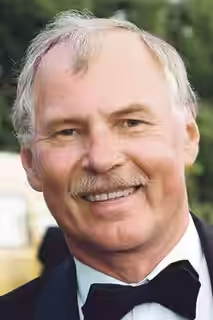
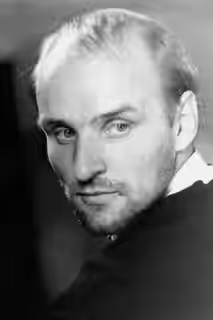
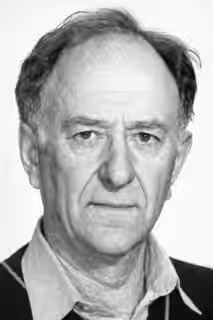
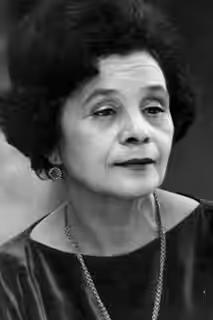
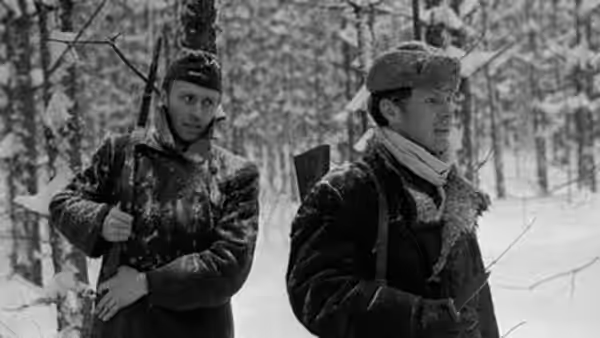
Belarus, winter 1942. A partisan unit hides in the forest with nothing left to eat, and its commander (Leonid Yukhin) sends two men out for food. Sotnikov (Boris Plotnikov), a former schoolteacher, is already sick, coughing and feverish, with no hat in the cold. Rybak (Vladimir Gostyukhin) is strong, practical and knows the villages. They find the farm they were counting on burned to the ground, take a sheep from the house of the village elder Petr Sych (Sergei Yakovlev), and run into a German patrol on the way back. Sotnikov is shot in the leg. The two shelter in the hut of Avginya Demchikha (Lyudmila Polyakova), a mother with children, and are found there. In town they are brought before Portnov (Anatoly Solonitsyn), a local man who now interrogates for the Germans.

Fi1m review

Larisa Shepitko’s film follows two partisans across the snow and into a collaborator’s interrogation room, and it is as severe and exact about conscience as anything we have seen. Gruelling, plainly shot, hard to shake; not for a tired evening.

Larisa Shepitko’s film, from Vasil Bykaŭ’s novel, is a war film in which the war has almost finished happening. The Germans hold the villages, the partisans hold the forest, and the forest has run out of food. Two men are sent to find some. Sotnikov (Boris Plotnikov) is ill before they set off, coughing into his sleeve and wearing a thin cap in the worst of the cold. Rybak (Vladimir Gostyukhin) is fit and practical, knows the farms and knows how to talk to the people in them. What follows over 110 minutes is one exchange of fire, a hut, a cellar and an interrogation room, and Shepitko is interested in nothing but what the two men do in them.

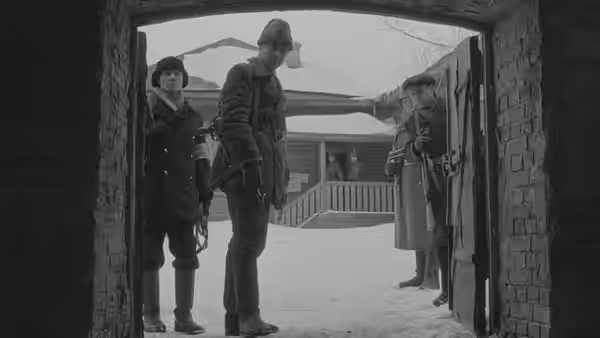
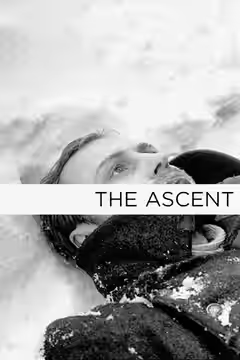
Vladimir Chukhnov shoots the snow in black and white as a white sheet with black marks on it, and the marks are the men. When they walk, the camera stays close at shoulder height, so we hear the breathing and see the fields only when they look up. When a German patrol appears it is three shapes at the far edge of the frame, and the rifle shots are small, dry and late. We were frightened by that sequence far beyond what three figures in a field ought to manage, and it is because Chukhnov never cuts to the enemy’s side. We know exactly as much as Sotnikov does, lying in the snow with a bullet in his leg.

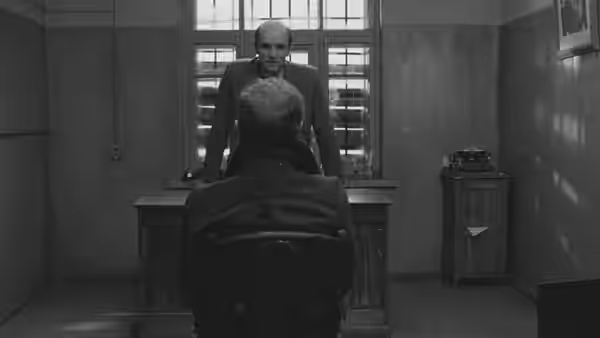
Plotnikov has a thin, feverish face and Shepitko holds on it for longer than most directors would dare. He says little; the cough does most of his talking in the first hour. Gostyukhin is the better soldier and the film lets him be, dragging his friend across country, finding the sheep, doing the deals, and he is likeable in a way that makes what comes later harder. Anatoly Solonitsyn, the actor Tarkovsky used in Andrei Rublev, plays Portnov, a local man who now asks questions for the Germans. He sits, he speaks quietly, he offers reason. It is the most alarming performance in the film because he never once raises his voice.

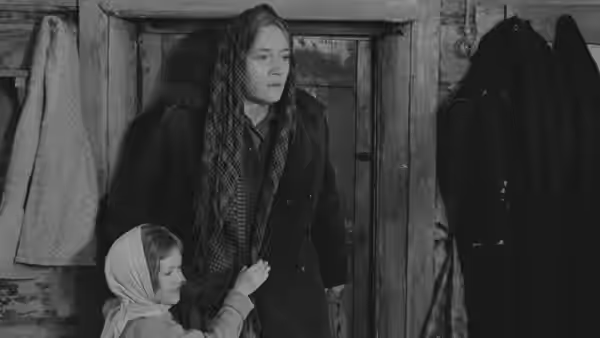
Yuri Raksha builds the interrogation room around a stove, so that the only warmth in the picture belongs to the man doing the questioning, and the cellar beneath it as bare planks and a single grille of light. Alina Budnikova puts everyone in padded coats and sheepskin until the prisoners are stripped of theirs, and the cold becomes visible on their shirts. Valeriya Belova cuts the cellar scenes slowly, from face to face, and lets the silences run: Avginya Demchikha (Lyudmila Polyakova), a mother whose children are elsewhere; Basya (Viktoriya Goldentul), a girl the police found hiding; the village elder Petr Sych (Sergei Yakovlev), who did what he could. Nobody makes a speech.

Alfred Schnittke’s score is the one element that does. For most of the film it is a low held tone under the snow, barely music, and it works. In the last act it swells into something choral and insists on the meaning of what we are seeing, and we felt pushed, once or twice, in a film that otherwise trusts us. Shepitko also lights Plotnikov in the closing stretch so that Sotnikov becomes a figure from an icon rather than a man with a fever, and the title tells you where she is going. It is a fair criticism and it does not much matter in the moment, because by then the film has us.

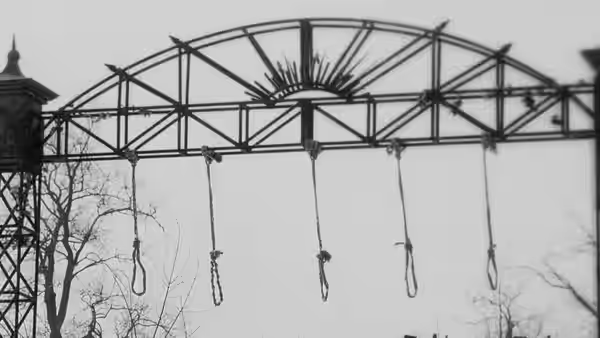
The second half takes a turn we will not describe. We can say that the last half hour is a procession, nearly wordless, taken at walking pace, and that we watched it without moving and did not speak for some time after the lights came up. It is not what happens that does it. It is that Shepitko refuses to look away or to hurry, and makes us keep pace with Rybak, who would give anything to be anywhere else.

Soviet war films of the period mostly honoured a victory. This one asks what it costs one person to stay who they are when nothing will be gained by it. It is not for a tired evening, and it is not company for a takeaway. Clear the night, turn the lights off, and do not plan anything for afterwards.
Critical consensus AI synthesised

73
Positive
2
Mixed
2
Negative
0
Slant Magazine
16 February 2021 · ★★★★½ · Derek Smith
90

The review praises the Criterion release as the most impressive home-video presentation of Shepitko’s work. It singles out the film’s visually powerful treatment of moral and spiritual conflict, alongside the release’s improved image and sound.

Read the full review →
Time Out
· SJo
70*

The review describes the film as an extraordinary, gruelling account of the partisans’ fight against the Nazis. It singles out its depiction of that wartime struggle as its strength.

Read the full review →
RogerEbert.com
67*

The headline frames the article as an appreciative critical discussion of the film. The blocked page prevents confirming the critic’s verdict or what they single out for praise.

Read the full review →
The New York Times
22 December 1978
64*

The available page does not reveal the critic’s verdict or what the review singles out. Its article text is inaccessible, so those details cannot be verified.

Read the full review →

Straight answers AI written, from our review

Is The Ascent worth watching?
The Ascent is worth watching for anyone prepared for a slow, severe film about conscience, and we scored it 88. Larisa Shepitko follows two Soviet partisans across the snow and into a collaborator's interrogation room, and refuses to hurry or look away. It is not for a tired evening or a distracted one; clear the night and plan nothing afterwards.
How long is The Ascent, and what is it rated?
The Ascent runs 1h 50m. It is a drama and war film.
Where can I watch The Ascent in Türkiye?
The Ascent is not on any streaming or rental service in Türkiye at the moment. It is available in 2 other countries; change your country at the top of the page to see where. Availability is checked daily.
How violent or frightening is The Ascent, and is it suitable for children?
The Ascent carries no UK or US certificate, and its violence is sparse but its cruelty is sustained. There is one exchange of gunfire, a wounding, prisoners stripped of their coats in the cold and a long, quiet interrogation, with a final half hour that is hard to sit through. We would not show it to children, and teenagers should know it is bleak throughout.
How does The Ascent compare to Come and See?
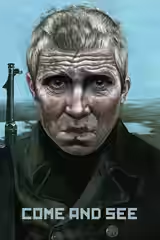
The Ascent and Come and See cover the same war in the same country, but Shepitko's film is the quieter and more exact of the two. Klimov shows the occupation through a terrified boy and punishing sound, and is even harder to endure, while occasionally pressing for effects his actor has already earned. Start with The Ascent if you want restraint; go to Come and See if you can take more.
Is The Ascent based on a true story or a book?
The Ascent is based on a novel by the Belarusian writer Vasil Bykaŭ, not on a documented true story. Shepitko keeps the novel's wartime setting of Belarus in the winter of 1942 and its two partisans sent to find food. You do not need to have read the book; the film explains everything it wants you to know.
What should I watch after The Ascent?
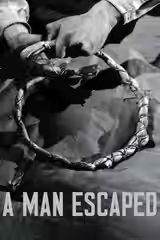
After The Ascent, try Come and See (1985, Fi1m 92): Belarus again, the same war, seen through a boy; even harder to sit through. Then A Man Escaped (1956, Fi1m 90): Bresson in a Lyon prison cell; patience, hands, and a spoon as the whole plot.

Cast

Awards

International Submission to the Academy Awards, 1978

Nominated
International Submission to the Academy Awards

Berlin International Film Festival, 1977

Won
Golden Bear

If you liked this, try…

  1. Come and See (1985, Fi1m 92)Belarus again, the same war, seen through a boy; even harder to sit through.

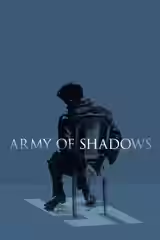
  2. Army of Shadows (1969) · not on Fi1m yetMelville’s French Resistance film: grey, quiet, and unsentimental about what resistance costs.

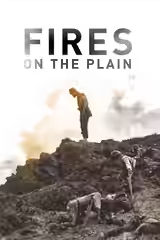
  3. Fires on the Plain (1959) · not on Fi1m yetJapanese soldiers starving in the Philippines; Ichikawa strips war down to hunger and choice.

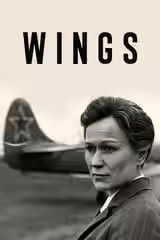
  4. Wings (1966) · not on Fi1m yetShepitko’s earlier film, a former fighter pilot adrift in peacetime; smaller, drier, just as exact.

  5. A Man Escaped (1956, Fi1m 90)Bresson in a Lyon prison cell; patience, hands, and a spoon as the whole plot.