Film review

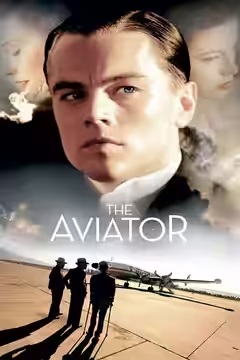
The Aviator

2004 · Directed by Martin Scorsese · 2h 50m · MPA PG-13

In a sentenceThree hours of a man who can build anything except a door handle he can bring himself to touch

Drama

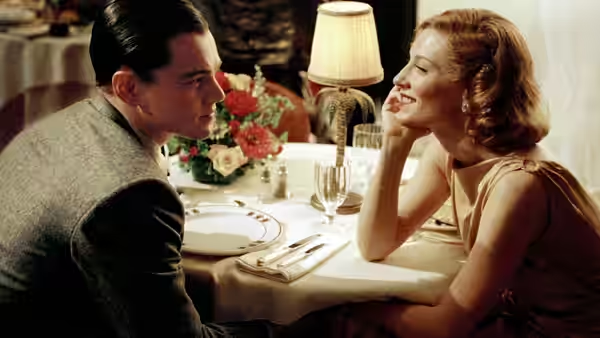
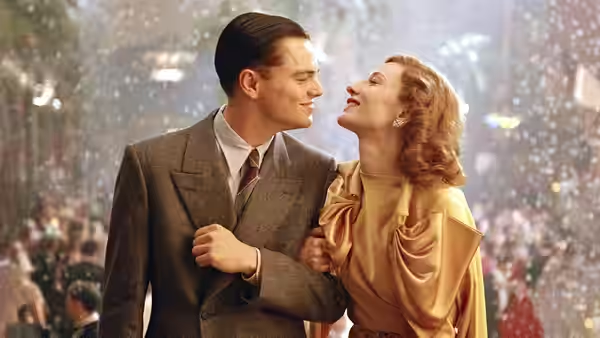
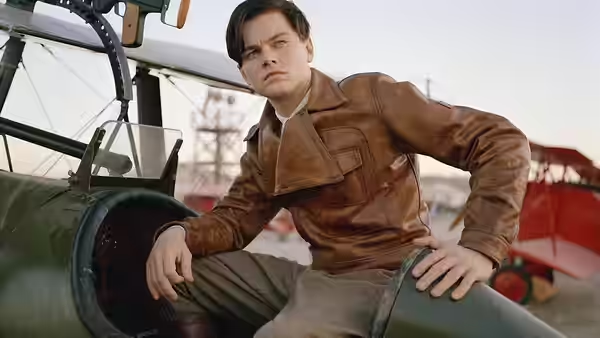
Hollywood, the late 1920s. Howard Hughes (Leonardo DiCaprio), heir to a Houston tool fortune, is spending it on Hell’s Angels, a war film with real aeroplanes and real pilots. He wants more cameras, he wants clouds, and he has hired the meteorologist Professor Fitz (Ian Holm) to find some, while his accountant Noah Dietrich (John C. Reilly) tries to keep the company solvent. The film opens with Hughes’s mother bathing him as a boy and spelling out the word “quarantine”; the grown man washes his hands with his own soap and lines up the peas on his plate. Once the picture is finished he moves on to faster planes, to buying an airline, and to Katharine Hepburn (Cate Blanchett), whom he meets on a golf course and cannot keep up with.

Plays from YouTube when you press play; nothing loads from them until then.

Fi1m review

Scorsese’s Howard Hughes film is big, fast and beautifully dressed, with a Cate Blanchett who steals every scene she is in. It explains its subject in one childhood scene and then keeps pointing at it, and at 170 minutes the last hour drags.

Martin Scorsese and the writer John Logan take Howard Hughes from the shooting of Hell’s Angels in the late 1920s and stop well short of the bearded recluse of legend. Hughes (Leonardo DiCaprio) has his father’s tool company in Houston to pay for whatever he wants, and what he wants, in order, is a war film with real aeroplanes, the fastest plane in the world, an airline and Katharine Hepburn. The film says the appetite that built the planes is the one that left him unable to touch a door handle. It is a good film, worth an evening, and not the great one people hoped for from this director. At 170 minutes it is about an hour longer than its best material.

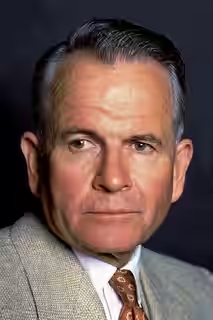
The first stretch is the best. Hughes has spent a fortune on his dogfight picture, is waiting for clouds, and has hired a meteorologist, Professor Fitz (Ian Holm), to find him some. John C. Reilly, as the accountant Noah Dietrich, walks a pace behind with the face of a man who has already read the bank statements. Thelma Schoonmaker cuts the aerial footage and Hughes’s pacing together so that the money and the mania look like the same thing.

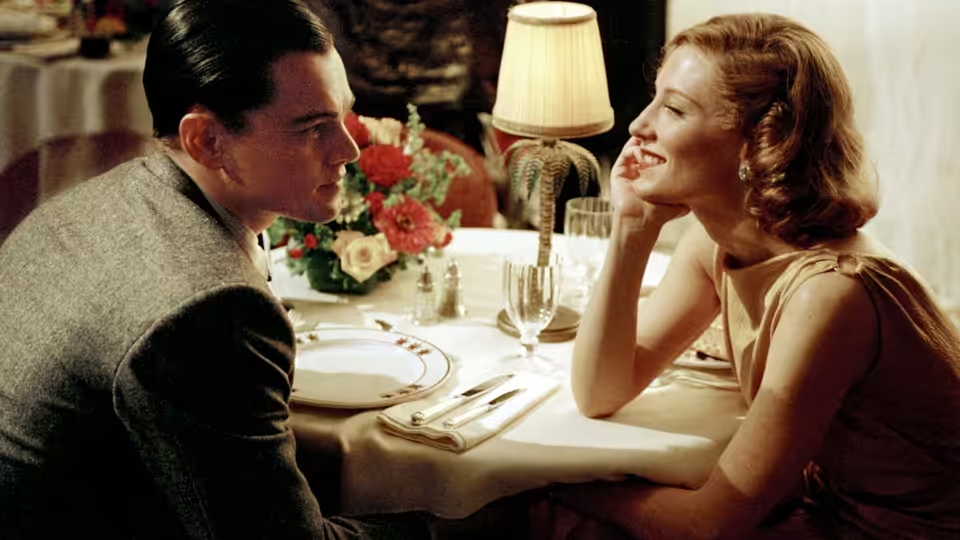
Then Cate Blanchett arrives as Hepburn, on a golf course, talking faster than Hughes can think, and the film goes up a gear. She has the voice and the stride, but what makes it a performance rather than an impression is that she lets us see the work: Hepburn keeping up with being Hepburn. Lunch with her family in Connecticut, where everyone talks over everyone about politics and nobody will admit to caring about money, is the funniest scene in the film. We laughed, then noticed Hughes was not laughing.

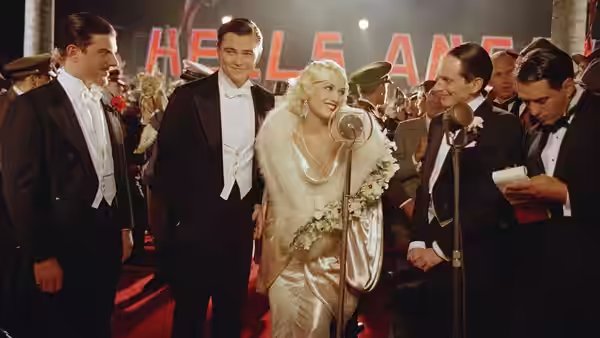
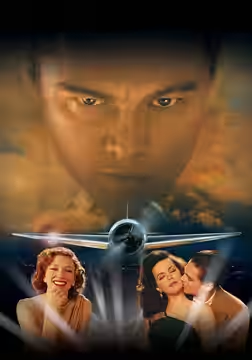
Robert Richardson shoots the first hour in the colours of early Technicolor, so greens come out blue: the golf course, the peas on Hughes’s plate. Later the full palette arrives and the reds get louder. Dante Ferretti builds the Cocoanut Grove with paper palms and a dance floor big enough to land on, and Sandy Powell puts Hepburn in trousers and Ava Gardner (Kate Beckinsale) in the strongest colour in any room she enters. Howard Shore keeps his own music low and lets the bands carry the nightclubs. None of it is only decoration: Hughes lines those peas up by size, and stops eating when Errol Flynn (Jude Law) takes one off his plate.

The moment we will keep is in a men’s lavatory. Hughes has washed his hands until they bleed, and he cannot touch the door handle, so he stands and waits for someone else to come in and open it. DiCaprio does almost nothing, and we were more frightened by that door than by anything the film puts in the air, because we understood, as he did, that he would rather stay in there all night than touch it. The flying sequences are there so this scene can land: the man who can fly anything, beaten by a brass knob.

DiCaprio is good as the young Hughes, all appetite and impatience. He is less good later, when the film gives him a moustache and a lower voice and his face declines to go along with it. He plays a man of forty like a boy who has been told to, and the film needs that older Hughes to carry weight.

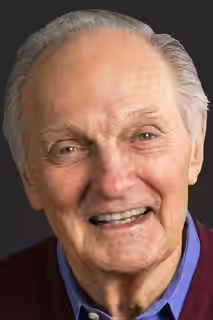
The larger problem is Logan’s script. It opens with Hughes’s mother washing him and spelling out “quarantine”, and it treats that scene as a receipt for everything after: each tic has a cause, each cause gets a flashback. Once Hughes leaves the aeroplanes for boardrooms and committee rooms, opposite Alec Baldwin’s Juan Trippe and Alan Alda’s Senator Brewster, the film slows to the pace of a hearing, and we felt every remaining minute. Baldwin and Alda are fine. Their scenes are about airline routes.

Scorsese has made a better film about a man taking himself apart, in black and white, and he was not fond of Jake LaMotta the way he is fond of Hughes. Fondness makes him generous with time. Watch this on the largest screen you have, in one sitting, and expect the first two hours to be better than the third. The 12A is honest; the length is the only thing in it a child would struggle with.

Critical consensus AI synthesised

74
Positive
17
Mixed
2
Negative
1

Most critics like The Aviator, and the praise gathers in the same places. DiCaprio’s Hughes is the performance nearly everyone singles out, for its shrewdness, petulance and the slow slide into obsession. Behind him, the reviews admire the scale: the recreation of old Hollywood, the flight sequences and the colour design, with Scorsese credited with a pace and energy several see as a return to form after a slack patch.

The reservations gather too. A run of critics find the film keeps Hughes at a distance, sumptuous to look at but not much interested in what drove him, and several say plainly that it is not among Scorsese’s best. The spread is wide: RogerEbert.com gives full marks, The New York Times finds it hollow once the character begins to decline, and The Independent, the one negative voice, thinks DiCaprio miscast and the whole reverential and unengaging. Most reviews sit in the middle, impressed and a little unsatisfied.

RogerEbert.com
23 December 2004 · ★★★★/4 · Roger Ebert
100

The critic praises Scorsese's focus on Hughes's glory years and the director's ability to capture both the excitement and the encroaching madness. DiCaprio's performance and the recreation of period glamor are singled out as highlights.

Read the full review →
The AV Club
14 December 2004
90*

Calls it a sprawling, larger-than-life American epic with never-better DiCaprio and strong supporting turns, praising its complexity in balancing celebration and critique of individualism alongside vivid portrayal of mental illness.

Read the full review →
The Times
23 December 2004 · James Christopher
90*

One of the most fascinating and revealing pictures of Scorsese’s career, The Aviator is the story of Howard Hughes and a masterclass in how to chisel a hero out of a legendary 20th-century monster. The pressure that Scorsese inflicts on Hughes is spookily revealing about the director’s moral uncertainty, but you can’t but kiss and admire the craft of the film.

Read the full review →
The New Yorker
13 December 2004 · David Denby
85*

Scorsese's entertaining film is celebrated as a rehabilitation and fantasia of Hughes as a studly capitalist prince who soared on golden wings. The aerial sequences and abundant humor with obvious sympathy are highlighted as strengths.

Read the full review →
Evening Standard
11 April 2012 · Sheila Johnston
80*

The review praises the film's spectacular scale, visual flair and barnstorming energy as a glittering return to form for Scorsese, with DiCaprio persuasive as the eccentric Hughes. It highlights dazzling set-pieces and technical brilliance while noting it falls short of the director's greatest works.

Read the full review →
Time Out
25 January 2012 · GA
80*

The review calls it Scorsese’s best film since The Age of Innocence, praising DiCaprio’s nuanced portrayal of Hughes and the director’s shift into expressionist style in the later sections, while noting some ordinariness in the opening.

Read the full review →

Cast

Awards

Academy Awards, 2005

Nominated
Best Actor
Nominated
Best Director
Nominated
Best Picture
Nominated
Best Sound
Nominated
Best Supporting Actor
Nominated
Best Writing, Original Screenplay
Won
Best Cinematography
Won
Best Costume Design
Won
Best Film Editing
Won
Best Production Design
Won
Best Supporting Actress

If you liked this, try…