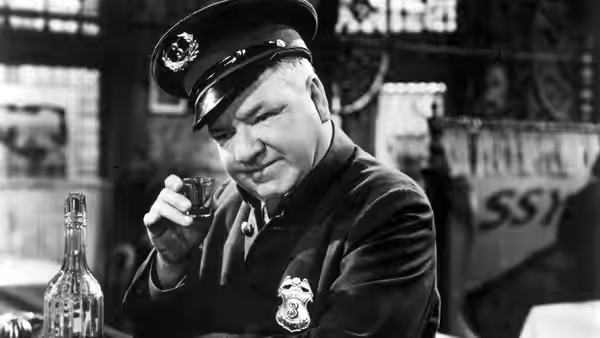
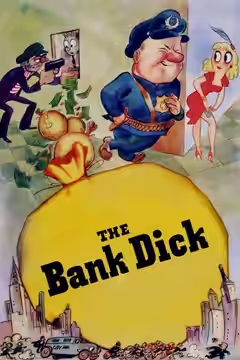
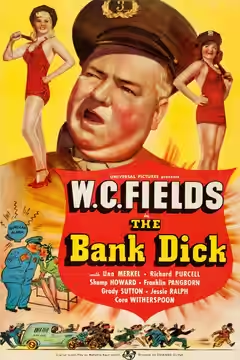
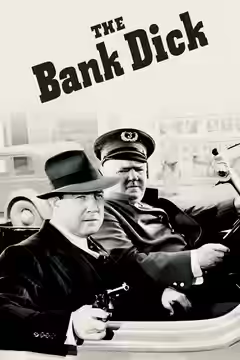
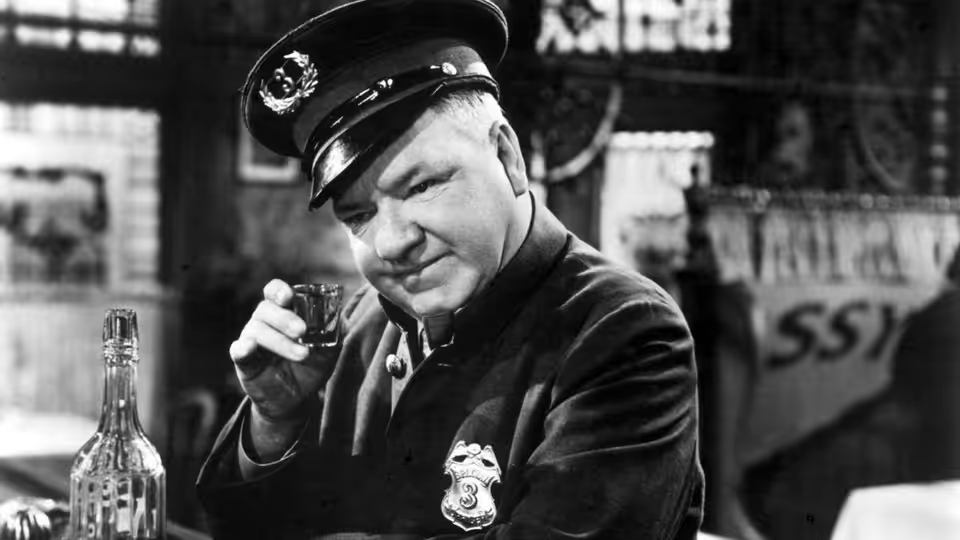
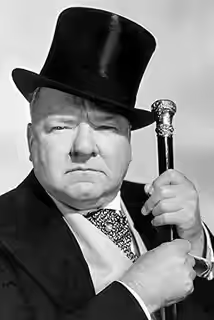
Egbert Sousé (W.C. Fields) in a police uniform holds a glass beside a bar counter
Film review

The Bank Dick

1940 · Directed by Edward F. Cline · 1h 12m

In a sentenceEgbert Sousé accepts good luck with the air of a man still waiting for an apology

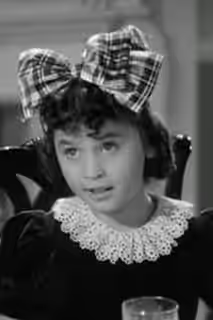
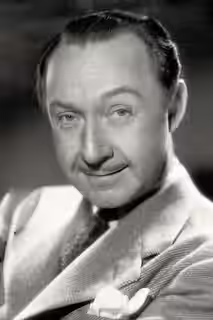
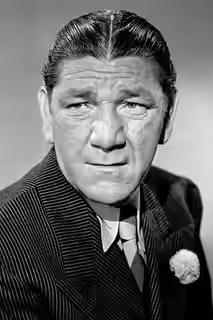
Egbert Sousé (W.C. Fields) encounters improbable good fortune and takes it with little sign of surprise. The other characters include Agatha Sousé (Cora Witherspoon), Myrtle Sousé (Una Merkel) and Mrs. Hermisillo Brunch (Jessie Ralph), alongside J. Pinkerton Snoopington (Franklin Pangborn) and Og Oggilby (Grady Sutton). Egbert’s talk and a succession of comic routines lead the story, which gives him room to be sour, expansive and unconcerned with making himself agreeable. Edward F. Cline directs this 72-minute comedy from a screenplay by W.C. Fields.

Fi1m review

W.C. Fields makes The Bank Dick a pleasure, despite plotting that barely connects its routines. The supporting cast earns its share of the laughs, though some old jokes need more help than they get.

The Bank Dick is a funny, cheerfully untidy comedy whose chief pleasure is the sound of W.C. Fields talking. Edward F. Cline gives his leading man room, and the screenplay is his too: individual routines matter more than a story that connects them. We recommend it for the performance, with fair warning that the plot often seems to exist merely to introduce the next routine. At 72 minutes, it can afford a little wandering.

As Egbert Sousé, W.C. Fields sounds entitled to whatever good fortune happens to come his way. We laughed at how calmly he accepts it; anything less seems likely to strike him as a personal insult. He does not ask us to approve of Egbert, which is a relief. The performance lets us enjoy the man’s sourness without requiring the usual reassurance that he is secretly delightful.

The dialogue is the main reason to stay. W.C. Fields makes exaggeration sound conversational, so that an outrageous assertion can pass almost unnoticed until we have considered what he actually said. His derisive talk is funny because he gives it the patience of a man explaining something obvious. There is an unpleasantness here that remains enjoyable, partly because he makes no effort to excuse it.

Cora Witherspoon, Una Merkel and Jessie Ralph are worth listening to as well. Playing Agatha Sousé, Myrtle Sousé and Mrs. Hermisillo Brunch respectively, they make the supporting company a substantial part of the pleasure. The film belongs to its leading man, but it is better whenever we are conscious of someone besides him. A little more room for these performers would have been welcome, particularly when an individual routine begins to run short of invention.

Milton Krasner’s cinematography is less memorable than the faces it records. Arthur Hilton’s editing does more for the individual routines than for their connections, allowing the comedy to remain conspicuously episodic. Charles Previn’s music makes less of an impression than the speaking voice at the centre of the film, whose delivery supplies plenty of rhythm already. Edward F. Cline’s direction makes a sensible choice in leaving the actor room, although it offers few other attractions when a joke falls flat.

Some of those jokes are tired. W.C. Fields can improve familiar material by sounding aggrieved that anyone might question it, but even he cannot make every routine feel newly invented. The screenplay’s casual connections are usually easy to forgive; occasionally they leave us waiting for another subject rather than enjoying the one at hand. A firmer decision to move on would have helped in those stretches.

As a comedian’s vehicle, though, The Bank Dick does its main job well. It gives a distinctive performer material that suits him, makes good use of its supporting players and does not insist that an abrasive personality must be softened before we can enjoy his company. The range is narrow, and we are happy to stay within it for most of the running time. Give it an evening when nobody needs the people on screen to be likeable.
Critical consensus AI synthesised

82
Positive
8
Mixed
0
Negative
0

The consensus is strongly favourable, with praise centred on W.C. Fields’s performance and the freedom the film gives his comedy. Critics repeatedly single out his expansive delivery, derisive patter and unruffled response to improbable good fortune; the loose storytelling is generally treated as permission for the routines to flourish. Though Fields dominates the notices, Radio Times also praises the supporting cast, particularly Cora Witherspoon, Una Merkel and Jessie Ralph.

The differences are chiefly matters of enthusiasm rather than outright dissent: all eight reviews are classified as positive, though the available summaries offer uneven detail. Variety finds some of the gags old-fashioned but considers the fresh material sufficient to keep them working. Time Out notes Fields’s limited versatility while admiring how effectively he uses his sour persona. Most critics place greater weight on the precision and pleasure of his comic routines than on those limitations.

The AV Club
29 March 2002 · Keith Phipps
95*

Phipps calls the film pure gold from start to finish. He singles out Fields’s comic performance and the script’s freedom from concern with coherence.

Read the full review →
Slant Magazine
15 November 2021 · Derek Smith
90*

The critic praises The Bank Dick as a high point in W.C. Fields’s comic formula. Its understated humor and Egbert’s cool indifference amid improbable good fortune receive particular praise.

Read the full review →
The New Yorker
90*

The review calls the film a classic and Fields’s funniest vehicle. It singles out his lewd, derisive, hyperbolic patter as what makes the film work.

Read the full review →
The New York Times
13 December 1940 · Bosley Crowther
85*

Crowther recommends the film as great fun. He especially praises Fields’s expansive comic performance and the way the picture belongs to him.

Read the full review →
Radio Times
★★★★ · David Parkinson
80

Parkinson calls it one of W.C. Fields’s finest comedies, praising his inspired routines. He also singles out the supporting cast, especially Cora Witherspoon, Una Merkel and Jessie Ralph.

Read the full review →
Variety
31 December 1939 · Variety Staff
78*

The review finds the comedy routine-driven but refreshed by enough new material to overcome its antique gags. It especially praises the climax’s refurbished downhill car chase as a thrilling comic set piece.

Read the full review →

Straight answers AI written, from our review

Is The Bank Dick worth watching?
The Bank Dick is worth watching for W.C. Fields’s dry, sour delivery and a supporting cast that earns its laughs; we score it 80 out of 100. We recommend it to anyone who enjoys verbal comedy and cheerfully abrasive characters, though the plot barely connects the routines and some familiar jokes outstay their welcome.
How long is The Bank Dick, and what is it rated?
The Bank Dick runs 1h 12m. It is a comedy film.
Where can I watch The Bank Dick in Brazil?
The Bank Dick is not on any streaming or rental service in Brazil at the moment. It is available in 1 other country; change your country at the top of the page to see where. Availability is checked daily.
How does The Bank Dick compare to Duck Soup?
The Bank Dick is a looser showcase for one comedian’s sour conversational manner than Duck Soup, which we recommend as the brisker, more consistently funny choice. Both thrive on verbal insolence, but Duck Soup directs its rudeness at political vanity and orderly public life; Fields’s film suits an evening when we are happy to let the story wander.
What should I watch after The Bank Dick?
After The Bank Dick, try Duck Soup (1933, Fi1m 88): Verbal insolence takes charge, with even less respect for orderly public life. Then Kind Hearts and Coronets (1949, Fi1m 91): For equally dry delivery and considerably more careful attention to the plotting.

Cast

If you liked this, try…

  1. Duck Soup (1933, Fi1m 88)Verbal insolence takes charge, with even less respect for orderly public life.

  2. Kind Hearts and Coronets (1949, Fi1m 91)For equally dry delivery and considerably more careful attention to the plotting.

  3. A New Leaf (1971) · not on Fi1m yetAnother comedy that trusts us to enjoy a thoroughly disagreeable central character.

  4. Tampopo (1985) · not on Fi1m yetA more generous comedy, equally happy to interrupt its story for a joke.

  5. The Dinner Game (1998) · not on Fi1m yetVanity and elaborate excuses receive stricter comic punishment in a tightly organised farce.

The Bank Dick (1940) review: funny, loose and carried by its star (Brazil) | Fi1m