Frank Capra’s romantic drama is worth considering for Barbara Stanwyck and Joseph Walker’s cinematography. Its treatment of desire has force, but patronising characterisation makes the central relationship harder to believe.
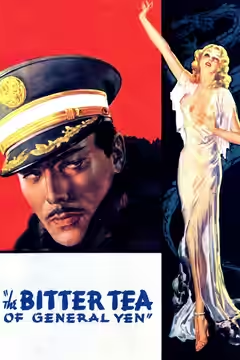
Frank Capra’s The Bitter Tea of General Yen is a romance worth approaching with reservations. It takes attraction seriously enough to make us curious about people who do not understand one another, then too often settles for simple explanations of them. The relationship between an American woman and a Chinese warlord gives it plenty to examine. The trouble is that its treatment of Chinese characters can be patronising even when it appears to be asking for sympathy.
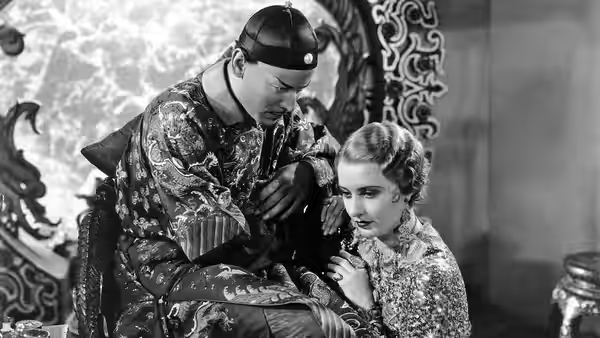
Barbara Stanwyck gives Megan Davis enough emotional seriousness to keep the love story from becoming merely an illustration of a difficult subject. Her performance encourages us to look for competing feelings, even where the characterisation is too simple to reward much looking. We were drawn in by her sense of uncertainty about the attraction. It is the strongest reason to stay with a romance whose development does not always convince.
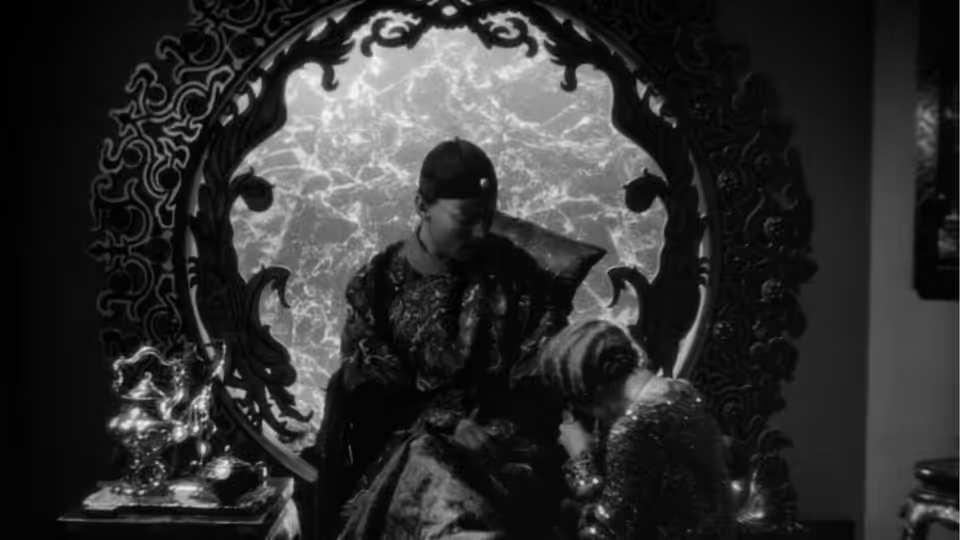
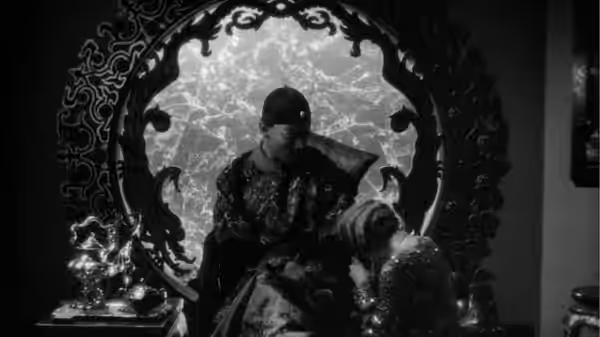
Joseph Walker’s cinematography is the other substantial pleasure. The opulence gives the romance room to indulge its feelings, and the stylisation suits a story in which desire unsettles people’s understanding of themselves. We would not want this material photographed with dutiful restraint. Yet the visual richness makes the thin characterisation harder to overlook. Some of the people within these carefully made images remain disappointingly simple.
Edward E. Paramore Jr.’s screenplay, from a story by Grace Zaring Stone, is least persuasive when it asks broad ideas about cultural difference to do the work of character. The Chinese characters need the same freedom to be difficult, inconsistent people that the central romance requires. Too often the treatment feels condescending. That weakens the drama: it becomes difficult to believe in an attraction when one of the people involved is being treated as a lesson for the other.
Nils Asther gives General Yen sufficient presence to prevent that weakness from swallowing the film. The performance holds our attention even when the conception of the character feels naive. The attraction has to carry a great deal of the drama, however, and its later development asks for more conviction than the writing earns. Both leading performances deserve credit for keeping us interested through those difficulties.
Edward Curtiss’s editing takes us through the story in 87 minutes, but the short running time does not prevent the romance from losing force. The first half feels more assured than what follows. W. Franke Harling’s music helps sustain the romantic mood, though it cannot supply the missing reasons to believe in the relationship. Our chief reservation remains with how the lovers are written. A brisker cut would not necessarily repair that.
As romantic melodrama, this asks for a degree of surrender that becomes difficult when the people seem arranged to prove a point. We can accept heightened emotion and still need convincing reasons for it. Frank Capra gets close enough to make the shortcomings irritating rather than fatal. See it for Barbara Stanwyck and Joseph Walker, with some patience for the screenplay.