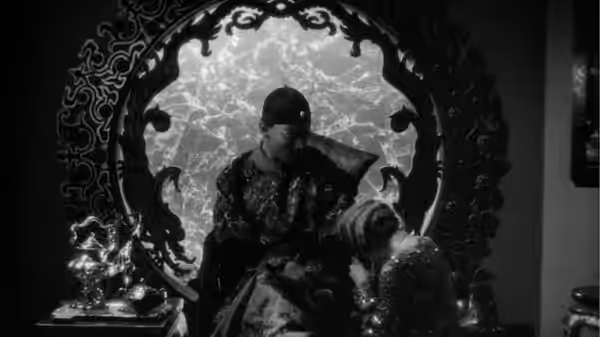
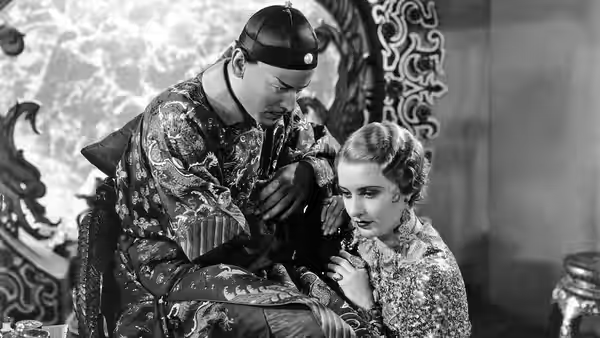
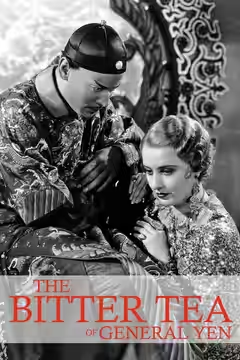
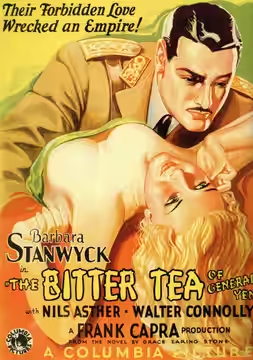
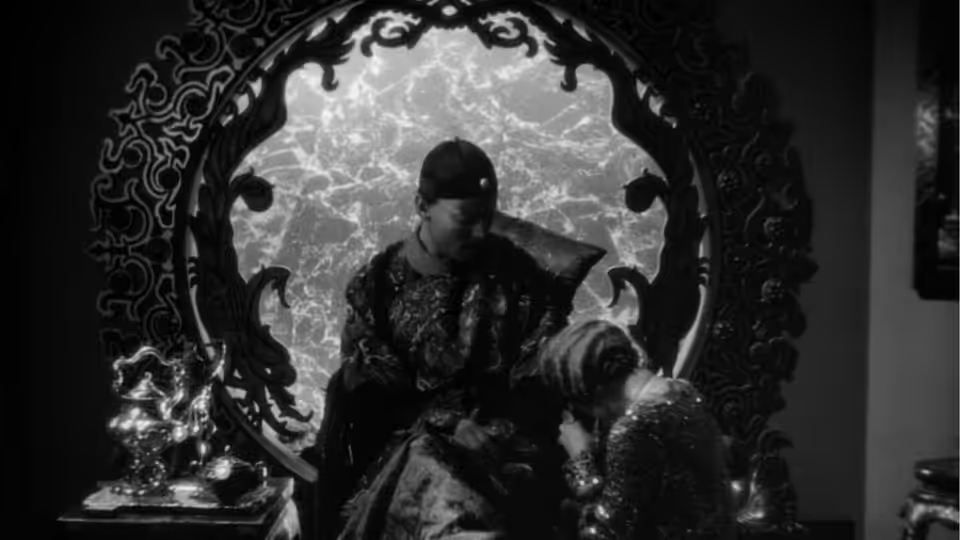
A man in an embroidered robe sits behind an ornate screen as a woman faces him
Film review

The Bitter Tea of General Yen

1932 · Directed by Frank Capra · 1h 27m

In a sentenceBarbara Stanwyck has to do rather a lot of the screenplay’s thinking

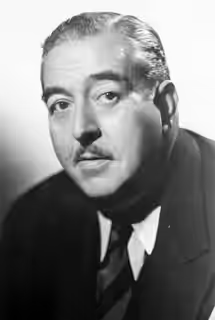
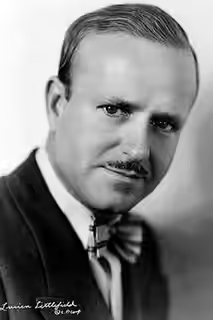
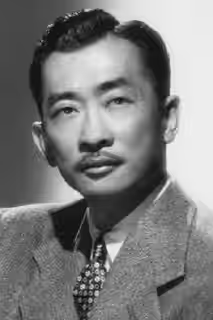
Megan Davis (Barbara Stanwyck), an American woman, becomes involved with General Yen (Nils Asther), a Chinese warlord. Their attraction draws them into a romance complicated by their different assumptions about one another and by the distance between their lives. Among the other figures in the drama are Mah-Li (Toshia Mori) and Jones (Walter Connolly). The relationship between Megan Davis and General Yen raises the possibility of a love that neither can easily accommodate within an existing understanding of the other.

Fi1m review

Frank Capra’s romantic drama is worth considering for Barbara Stanwyck and Joseph Walker’s cinematography. Its treatment of desire has force, but patronising characterisation makes the central relationship harder to believe.

Frank Capra’s The Bitter Tea of General Yen is a romance worth approaching with reservations. It takes attraction seriously enough to make us curious about people who do not understand one another, then too often settles for simple explanations of them. The relationship between an American woman and a Chinese warlord gives it plenty to examine. The trouble is that its treatment of Chinese characters can be patronising even when it appears to be asking for sympathy.

Barbara Stanwyck gives Megan Davis enough emotional seriousness to keep the love story from becoming merely an illustration of a difficult subject. Her performance encourages us to look for competing feelings, even where the characterisation is too simple to reward much looking. We were drawn in by her sense of uncertainty about the attraction. It is the strongest reason to stay with a romance whose development does not always convince.

Joseph Walker’s cinematography is the other substantial pleasure. The opulence gives the romance room to indulge its feelings, and the stylisation suits a story in which desire unsettles people’s understanding of themselves. We would not want this material photographed with dutiful restraint. Yet the visual richness makes the thin characterisation harder to overlook. Some of the people within these carefully made images remain disappointingly simple.

Edward E. Paramore Jr.’s screenplay, from a story by Grace Zaring Stone, is least persuasive when it asks broad ideas about cultural difference to do the work of character. The Chinese characters need the same freedom to be difficult, inconsistent people that the central romance requires. Too often the treatment feels condescending. That weakens the drama: it becomes difficult to believe in an attraction when one of the people involved is being treated as a lesson for the other.

Nils Asther gives General Yen sufficient presence to prevent that weakness from swallowing the film. The performance holds our attention even when the conception of the character feels naive. The attraction has to carry a great deal of the drama, however, and its later development asks for more conviction than the writing earns. Both leading performances deserve credit for keeping us interested through those difficulties.

Edward Curtiss’s editing takes us through the story in 87 minutes, but the short running time does not prevent the romance from losing force. The first half feels more assured than what follows. W. Franke Harling’s music helps sustain the romantic mood, though it cannot supply the missing reasons to believe in the relationship. Our chief reservation remains with how the lovers are written. A brisker cut would not necessarily repair that.

As romantic melodrama, this asks for a degree of surrender that becomes difficult when the people seem arranged to prove a point. We can accept heightened emotion and still need convincing reasons for it. Frank Capra gets close enough to make the shortcomings irritating rather than fatal. See it for Barbara Stanwyck and Joseph Walker, with some patience for the screenplay.

Critical consensus AI synthesised

65
Positive
3
Mixed
1
Negative
1
The Guardian
18 January 2001 · Derek Malcolm
85*

Malcolm calls the film an extraordinary, superbly crafted work and regrets that Capra later turned toward patriotic Americana. He singles out the cinematography, Stanwyck’s performance, and the film’s erotic, psychologically intelligent treatment.

Read the full review →
Radio Times
★★★★ · Tony Sloman
80

Sloman gives the film a strongly positive assessment. He praises the performances of Barbara Stanwyck and Nils Asther and Frank Capra’s direction.

Read the full review →
Time Out
29 January 2013
70*

The review calls Capra’s film an excellent early sound work, though somewhat dated. It singles out the relationship between an American woman and a Chinese warlord.

Read the full review →
Empire
30 March 2006 · David Parkinson
60*

Parkinson finds the adaptation decent and visually distinctive, though its characterisation is naive and patronising. He praises its surprising opulence and stylisation, while noting the film’s troubling attitudes toward its Chinese characters.

Read the full review →
Variety
31 December 1932 · Variety Staff
30*

The critic finds the film disappointing after its first half. They fault the romance’s later development and say Barbara Stanwyck does not fit her role.

Read the full review →

Straight answers AI written, from our review

Is The Bitter Tea of General Yen worth watching?
The Bitter Tea of General Yen is worth considering for admirers of romantic melodrama, Barbara Stanwyck’s performance and Joseph Walker’s cinematography; we score it 65 out of 100. The attraction has force, but patronising treatment of the Chinese characters and an increasingly unconvincing relationship make this a qualified recommendation.
How long is The Bitter Tea of General Yen, and what is it rated?
The Bitter Tea of General Yen runs 1h 27m. It is a drama and romance film.
Where can I watch The Bitter Tea of General Yen in the Netherlands?
The Bitter Tea of General Yen is not on any streaming or rental service in the Netherlands at the moment. It is available in 3 other countries; change your country at the top of the page to see where. Availability is checked daily.
How does The Bitter Tea of General Yen compare to Shanghai Express?
The Bitter Tea of General Yen is the less satisfying of these two stylised romances; we recommend Shanghai Express more readily for its visual pleasures, pace and fun. Both bring attraction up against suspicion and unequal power, but Stanwyck’s emotional seriousness cannot compensate for thin characterisation as effectively as the other film’s lighting and momentum overcome its pulp plotting.
What should I watch after The Bitter Tea of General Yen?
After The Bitter Tea of General Yen, try Shanghai Express (1932, Fi1m 80): Another stylised romance in which attraction meets suspicion and unequal power. Then Black Narcissus (1947, Fi1m 88): For desire, religious certainty and lavish images that make restraint look difficult; and Letter from an Unknown Woman (1948, Fi1m 86): A more piercing account of longing sustained by unequal understanding.

Cast

If you liked this, try…

  1. Shanghai Express (1932, Fi1m 80)Another stylised romance in which attraction meets suspicion and unequal power.

  2. Black Narcissus (1947, Fi1m 88)For desire, religious certainty and lavish images that make restraint look difficult.

  3. Letter from an Unknown Woman (1948, Fi1m 86)A more piercing account of longing sustained by unequal understanding.

  4. In the Mood for Love (2000, Fi1m 91)Restrained performances and precise images give unspoken attraction its full weight.

  5. The Piano (1993, Fi1m 88)A more searching treatment of desire complicated by power and cultural difference.

The Bitter Tea of General Yen (1932) review: Fine acting, but the roma (the Netherlands) | Fi1m