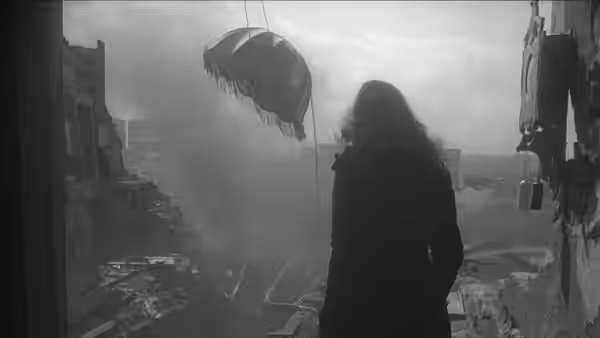
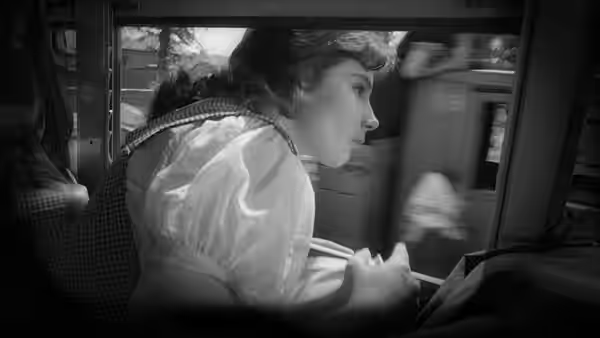
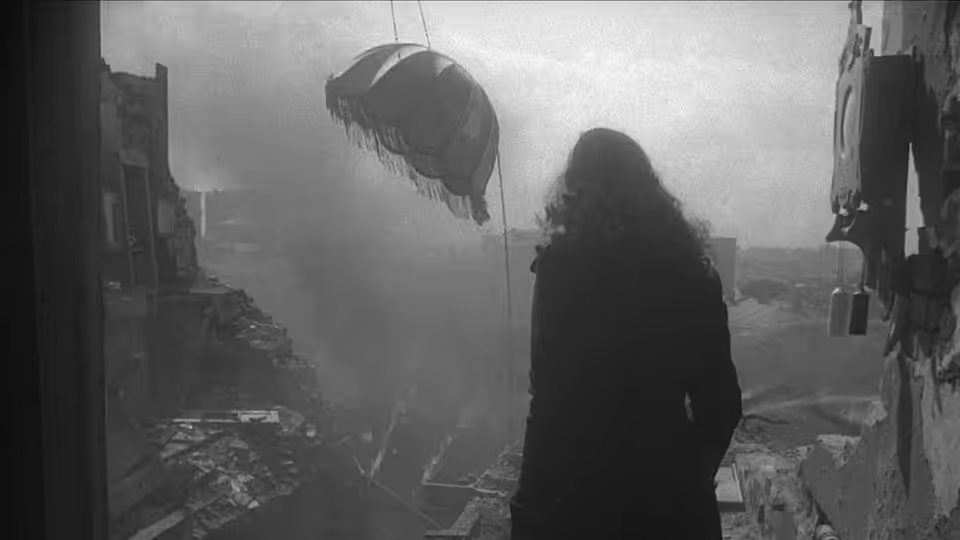
A woman stands silhouetted at a window overlooking a city
Film review

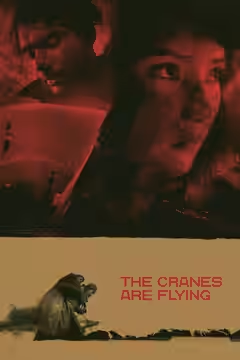
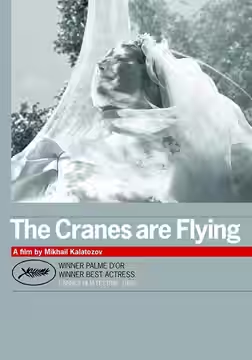
The Cranes Are Flying

1957 · Directed by Mikhail Kalatozov · 1h 37m

In a sentenceA camera that cannot keep still, and a face we cannot stop watching

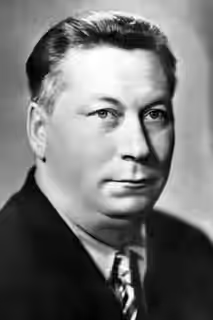
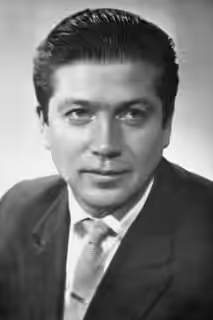
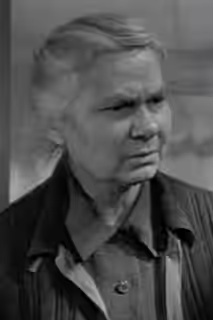
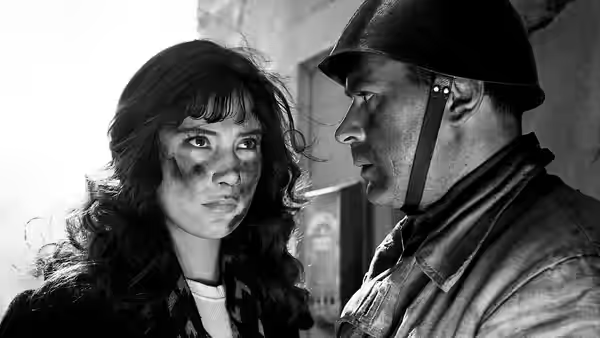
Veronika (Tatyana Samoylova) searches for happiness as war shapes the lives of those around her. Boris (Aleksey Batalov), Fyodor Ivanovich (Vasili Merkuryev), Mark (Aleksandr Shvorin) and Irina (Svetlana Kharitonova) are the other central figures in this romance. The story follows Veronika’s experience of wartime life, with love and the possibility of happiness at its centre. Her private hopes belong to a life disrupted by conflict, and her search continues under that pressure. The emphasis stays on how she experiences the war and what it means for the life she wants.

Fi1m review

The Cranes Are Flying is a moving war romance, carried by Tatyana Samoylova and Sergey Urusevsky’s expressive photography. The symbolism sometimes presses too hard, but the attention to Veronika’s unhappiness makes the excess worth accepting.

Mikhail Kalatozov’s The Cranes Are Flying is a moving war romance, with a tendency to underline emotions that are already clear. Its great advantage is Tatyana Samoylova, whose Veronika makes that excess forgivable more often than it ought to be. The film asks us to care about one woman’s search for happiness without treating that concern as small beside war. We recommend it for the seriousness with which it takes her unhappiness, and for the restless photography that keeps us close to it.

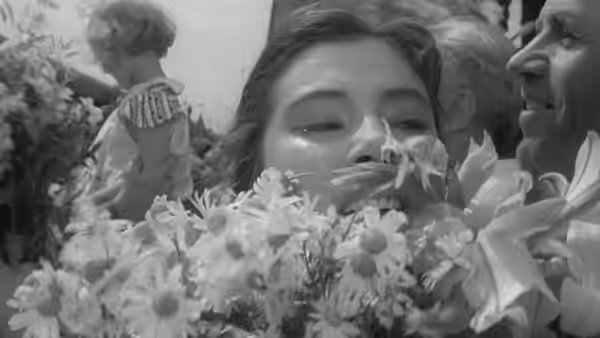
The performance gives us someone to worry about before we begin admiring how the film is made. We were moved by the strain in Veronika’s face, by the sense that feeling has become something she must work to contain. There is sensitivity here without the suggestion that unhappiness makes a person simple or easy to understand. That matters in a romance this emphatic: we need someone to believe in when the filmmaking begins insisting on what we should feel.

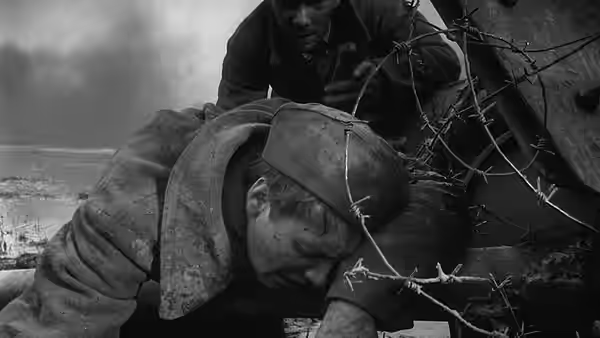
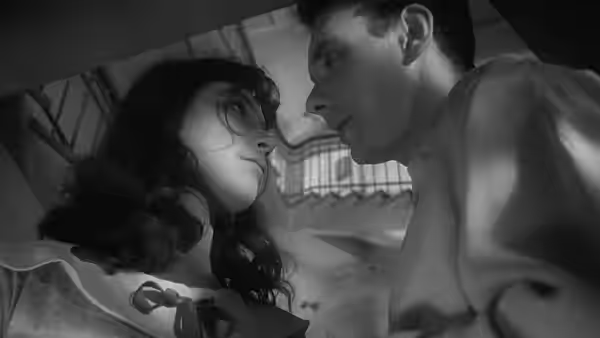
Sergey Urusevsky’s cinematography takes its lead from that distress. The camera’s movement makes Veronika’s troubled experience harder to observe calmly; the images seem affected by what she is enduring. We are conscious of how much the camera is doing, yet rarely feel it has wandered away from her. The approach can be florid, but making wartime distress look orderly would be the less convincing choice.

Mariya Timofeyeva’s editing gives this restless photography enough shape for us to remain involved in Veronika’s unhappiness. Across its 97 minutes, the film feels concentrated, though we sometimes wanted an emotion to settle before it was pressed again. We would welcome a little less insistence, particularly when the symbolism becomes conspicuous. There are moments when trusting the performance would have been enough.

Mieczysław Weinberg’s music is effective, although we would put it behind the photography in explaining why the film moves us. Much the same applies to Yevgeni Svidetelev’s production design: the surroundings make less of an impression than the people. Neither contribution distracts us from the performance, which counts for something in a film with so much expressive energy. Our attention keeps returning to Veronika, even when there is plenty of filmmaking asking to be noticed.

A war romance needs to make its private suffering matter, and this one gives that task proper attention. We do not need Veronika to represent everyone before her distress counts. The romantic intensity can make the symbols seem heavier than they need to be, but it also gives the film an emotional directness that we would not wish to lose. Tatyana Samoylova makes us care about the difficulty of living through war without requiring us to admire unhappiness itself.

The caveat is for those who prefer their romances dry-eyed. This one makes little provision for that preference, and its occasional overstatement is part of the bargain. Give it an evening without interruptions.

Critical consensus AI synthesised

79
Positive
5
Mixed
2
Negative
0
Empire
8 December 2006 · Jo Berry
90*

Berry considers the film a masterpiece and praises its tender, delicate filmmaking. She notes that its sometimes overt symbolism is easy to forgive amid its cinematic poetry.

Read the full review →
Slant Magazine
7 June 2020 · ★★★★½ · Jake Cole
90

Cole presents the film as a Soviet-era masterpiece, praising its spellbinding visual style and Criterion’s restoration. He singles out the expressive cinematography for how it reflects Veronika’s increasingly distorted experience of wartime life.

Read the full review →
The AV Club
6 May 2002 · Scott Tobias
85*

Tobias gives the film a strongly positive verdict, calling it a key postwar work. He singles out Kalatozov’s inventive camera movements and expressive visual storytelling for praise.

Read the full review →
Radio Times
★★★★ · Ronald Bergan
80

Bergan presents the film as an unpretentious, poetic love story about war. He praises its majestic camerawork and Tatyana Samoilova’s sensitive performance.

Read the full review →
The Guardian
28 January 2007 · Philip French
75*

French praises the film as a highly romantic work with superb lyrical photography. He especially singles out Tatyana Samojlova’s heartbreaking performance.

Read the full review →
Time Out
· WH
66*

The page is a review of Kalatozov’s war film, but the critic’s verdict is unavailable. The visible metadata notes its adaptation from Viktor Rozov’s play and its Cannes Palme d’Or win, but offers no specific praise or complaint.

Read the full review →

Straight answers AI written, from our review

Is The Cranes Are Flying worth watching?
The Cranes Are Flying is worth watching for its moving wartime romance, Tatyana Samoylova’s performance and expressive photography; we score it 87. We recommend it especially for those who like emotionally direct drama, with the caveat that its conspicuous symbolism sometimes insists on feelings Samoylova has already made clear.
How long is The Cranes Are Flying, and what is it rated?
The Cranes Are Flying runs 1h 37m. It is a drama and romance film.
Where can I watch The Cranes Are Flying in India?
The Cranes Are Flying is not on any streaming or rental service in India at the moment. It is available in 2 other countries; change your country at the top of the page to see where. Availability is checked daily.
How violent or frightening is The Cranes Are Flying, and is it suitable for children?
The Cranes Are Flying carries a UK PG certificate, which indicates general viewing with parental guidance rather than suitability for every child. Its wartime setting and emphasis on Veronika’s unhappiness make emotional distress the concern we can identify, rather than any specific level of violence. Parents considering it for younger or sensitive children should take that distinction into account.
How does The Cranes Are Flying compare to Brief Encounter?
The Cranes Are Flying is the more visibly expressive romance beside Brief Encounter, using restless photography to bring us close to its heroine’s unhappiness. We give Brief Encounter the edge for making love feel ordinary and frightening, though Alec is less fully drawn. Choose The Cranes Are Flying for wartime intensity and a lead performance that holds its emphatic filmmaking together.
What should I watch after The Cranes Are Flying?
After The Cranes Are Flying, try Brief Encounter (1945, Fi1m 90): For another lead performance that makes romantic unhappiness painfully specific. Then Hiroshima mon amour (1959, Fi1m 87): Love and wartime memory, with images that resist easy consolation; and In the Mood for Love (2000, Fi1m 91): For restrained performances surrounded by filmmaking that gives longing its full weight.

Cast

Awards

Cannes Film Festival, 1958

Won
Palme d'Or

If you liked this, try…

  1. Brief Encounter (1945, Fi1m 90)For another lead performance that makes romantic unhappiness painfully specific.

  2. Hiroshima mon amour (1959, Fi1m 87)Love and wartime memory, with images that resist easy consolation.

  3. The Ascent (1977) · not on Fi1m yetWar stripped of reassurance, with faces carrying much of the burden.

  4. In the Mood for Love (2000, Fi1m 91)For restrained performances surrounded by filmmaking that gives longing its full weight.

  5. Phoenix (2014, Fi1m 68)Another woman rebuilding her life after war, with less outward display.