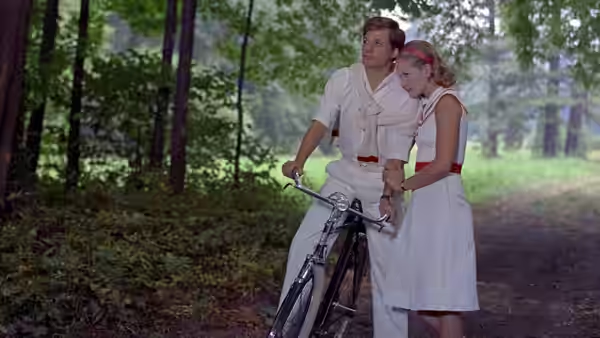
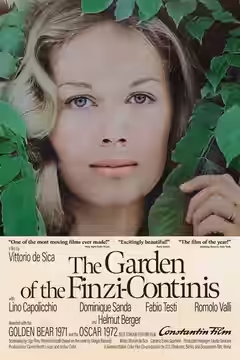
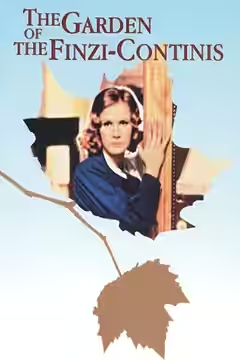
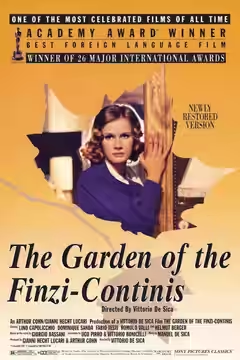
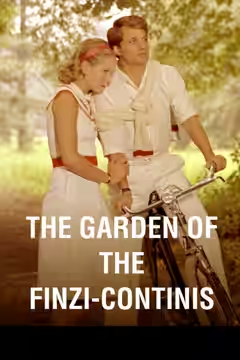
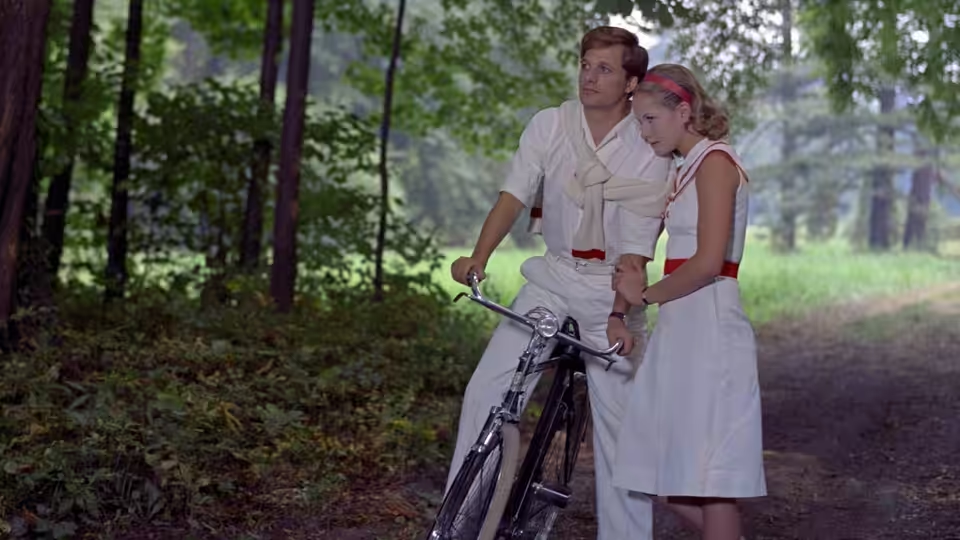
A young couple pause with a bicycle beside the garden’s glass doors
Film review

The Garden of the Finzi-Continis

1970 · Directed by Vittorio De Sica · 1h 35m

In a sentenceThe lighting is doing a suspiciously good job of making denial look comfortable

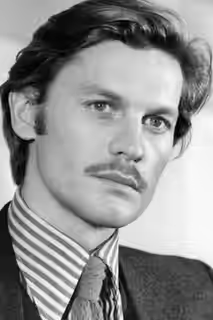
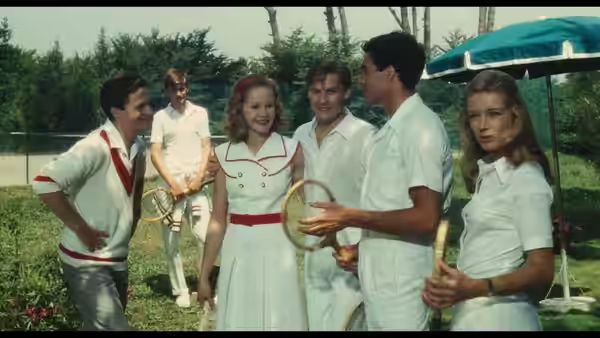
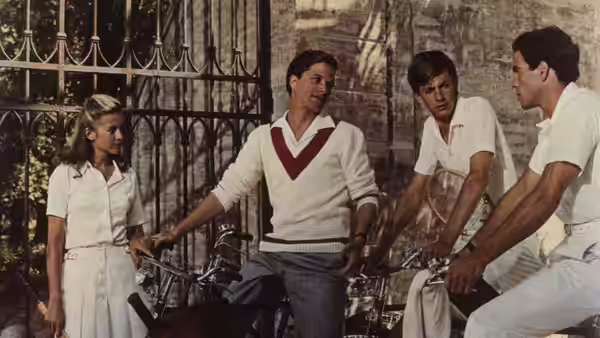
Giorgio (Lino Capolicchio), Micól (Dominique Sanda) and Alberto (Helmut Berger) inhabit a social world where wealth and position appear to offer protection from persecution. Family life brings Giorgio’s father (Romolo Valli) and Micól’s father (Camillo Cesarei) into the story. Familiar comforts encourage the belief that the threat can be kept at a distance. As private concerns compete with the need to respond, the people within this sheltered society struggle to recognise what their status can, and cannot, secure.

Fi1m review

Vittorio De Sica makes an affecting drama about people who mistake social standing for safety. The images and performances hold us, though the writing is less convincing about why these people cannot act.

The Garden of the Finzi-Continis is a good, troubling drama whose people are slow to understand how little their position will protect them. Vittorio De Sica takes their attachment to a comfortable life seriously, allowing us to understand their reluctance to acknowledge danger. That sympathy matters: we are not being invited to congratulate ourselves on knowing better. Yet the film sometimes leaves us waiting for an understanding of these people that its careful attention has led us to expect.

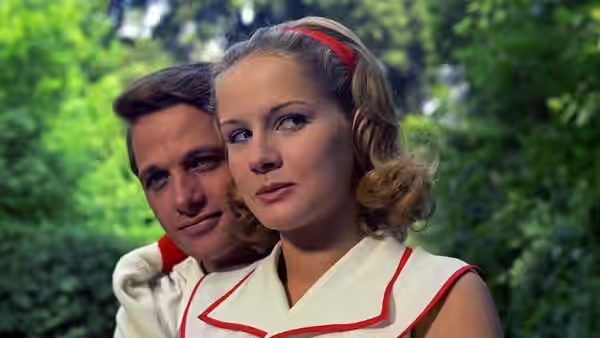
Dominique Sanda’s Micól gives the film much of its fascination. Her composure does not make her easy to read, and the distance she maintains can be attractive and frustrating within the same scene. Lino Capolicchio’s Giorgio gives us a more immediate point of entry, while Helmut Berger’s Alberto belongs convincingly to this protected company. The performances suit the restraint of the telling, although their remoteness sometimes makes it difficult to distinguish what the characters conceal from what the screenplay has left unwritten.

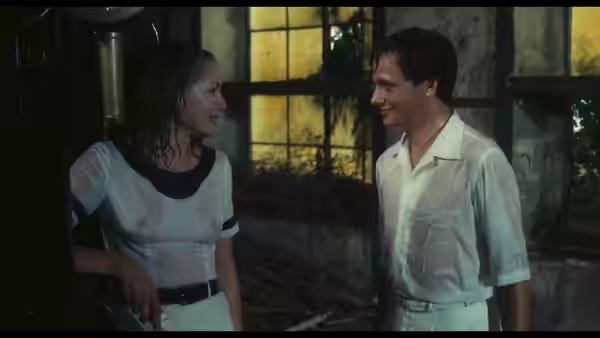
Ennio Guarnieri’s cinematography gives us something firmer to follow. The change from warm images to harder ones is the film’s most persuasive account of what is happening to these lives. We were moved by that loss of visual comfort: the growing harshness makes their exposure to persecution felt without requiring an explanatory speech. The photography earns a response that the more guarded performances sometimes struggle to invite.

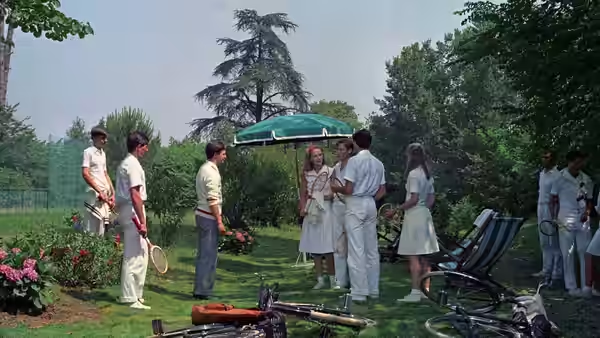
Giancarlo Bartolini Salimbeni’s production and costume design make the characters’ attachment to their circumstances credible. The comfort is persuasive enough that we understand why its occupants might confuse being well provided for with being secure. Manuel De Sica’s music contributes to the sadness without making the people easier to understand. We found the changing appearance of their world more affecting than the musical encouragement to feel for them.

The screenplay by Vittorio Bonicelli and Ugo Pirro, from Giorgio Bassani’s novel, is certain about the failure of privilege but less curious about the people who rely on it. Showing characters unable to respond adequately to persecution is reasonable; leaving that inability so sparsely examined is frustrating. Some of the symbolism also presses a point we have already understood, making the writing seem less patient than the direction. We wanted another revealing exchange, another small inconsistency in someone’s behaviour, rather than further confirmation that money offers no guarantee of safety.

Adriana Novelli’s editing keeps the measured pace from becoming a trial, and the film remains absorbing despite those omissions. At 95 minutes, it does not ask length to do the work of seriousness. Historical dramas often struggle to make private concerns feel important beside public danger, and Vittorio De Sica handles that difficulty well by taking his characters’ confusion seriously. We remain interested in them even when we wish the screenplay would enquire a little further.

There is a worthwhile evening here for anyone willing to spend time with people who do not fully understand themselves. The beauty helps draw us towards them, and we do not think the film is wrong to let that attraction work. Watch it for the performances and photography, accepting that some questions about the people will remain unanswered.

Critical consensus AI synthesised

73
Positive
4
Mixed
2
Negative
0

Most critics respond warmly to The Garden of the Finzi-Continis, with four positive assessments and two mixed ones, and no outright rejection. Praise centres on its affecting tragedy and cinematography, though some reviews offer little detail beyond general approval. The more detailed accounts value the graceful atmosphere and the way the images grow harsher as the characters’ sheltered lives unravel. Empire also praises the clear-eyed portrayal of wealth and social standing failing to protect them from persecution.

The differences concern how fully the film explains its characters and how plainly it signals its themes. The New Yorker admires the style and performances but finds the restraint frustrating, leaving the characters’ paralysis insufficiently explored. The Los Angeles Times finds some symbolism too obvious, despite being moved by the tragedy. Enthusiasm therefore ranges from strong admiration to qualified appreciation, with the reservations focused on storytelling rather than visual craft.

The AV Club
29 March 2002 · Keith Phipps
90*

Phipps calls the film one of the world’s great films and praises its emotionally crushing storytelling. He especially singles out the restored cinematography as a reason to see it.

Read the full review →
The New York Times
2 January 1972 · Vincent Canby
80*

The headline signals an enthusiastic verdict on De Sica’s film. The accessible material gives no specific element the critic praises.

Read the full review →
Empire
5 April 2006 · David Parkinson
70*

Parkinson offers a humane, largely positive assessment of De Sica’s adaptation. He singles out its clear-eyed portrayal of how wealth and social status fail to shield the characters from persecution.

Read the full review →
Time Out
· TM
70*

The critic describes it as De Sica’s most watchable film in years, indicating a positive verdict. The available text praises its watchability but offers no further detail about what stands out.

Read the full review →
Los Angeles Times
25 August 1994 · MARK CHALON SMITH
65*

The critic finds the film quietly absorbing and its tragedy affecting, though some of its symbolism is too obvious. They praise the honeyed cinematography and its shift to harsher imagery as the characters’ sheltered world collapses.

Read the full review →
The New Yorker
10 December 1971 · Pauline Kael
65*

Kael sees the film as a beautiful return to De Sica’s earlier, limpid style, though its novelistic restraint leaves parts of the story unsatisfying. She praises the graceful atmosphere and remote, dazzling performances, while faulting the film for withholding insights into its characters’ paralysis.

Read the full review →

Straight answers AI written, from our review

Is The Garden of the Finzi-Continis worth watching?
The Garden of the Finzi-Continis is worth watching for its performances and affecting photography, particularly if we enjoy patient historical dramas; we score it 78 out of 100. Its study of people mistaking privilege for safety holds our attention, though the screenplay leaves their inability to act frustratingly underexplored.
How long is The Garden of the Finzi-Continis, and what is it rated?
The Garden of the Finzi-Continis runs 1h 35m. It is a drama and history film.
Where can I watch The Garden of the Finzi-Continis in Bulgaria?
The Garden of the Finzi-Continis is not on any streaming or rental service in Bulgaria at the moment. It is available in 3 other countries; change your country at the top of the page to see where. Availability is checked daily.
How violent or frightening is The Garden of the Finzi-Continis, and is it suitable for children?
The Garden of the Finzi-Continis has a US R certificate and no UK certificate supplied here, so we would not recommend it as a children's choice. The threat of persecution makes it troubling, but we cannot give a specific warning about violence or frightening imagery from the certificate alone.
How does The Garden of the Finzi-Continis compare to The Leopard?
The Garden of the Finzi-Continis is the shorter choice beside The Leopard, though we recommend the latter more strongly for Burt Lancaster’s central performance. Both patiently examine privilege struggling to recognise changed circumstances; the 95-minute Garden suits an evening when three hours feels too much, but leaves more questions about its characters unanswered.
Is The Garden of the Finzi-Continis based on a true story or a book?
The Garden of the Finzi-Continis is adapted from Giorgio Bassani’s novel, with a screenplay by Vittorio Bonicelli and Ugo Pirro. We find it absorbing as a film in its own right, without requiring knowledge of the book, though that does not establish how faithfully it follows the novel or whether particular events have a factual basis.
What should I watch after The Garden of the Finzi-Continis?
After The Garden of the Finzi-Continis, try The Leopard (1963, Fi1m 88): For another patient study of privilege struggling to recognise that circumstances have changed. Then The Remains of the Day (1993, Fi1m 88): For restrained performances that make the cost of refusing to act painfully clear; and The Last Metro (1980, Fi1m 75): For private attachments and professional routines maintained under the pressure of persecution.

Cast

Awards

Academy Awards, 1972

Nominated
Best Writing, Adapted Screenplay
Won
Best International Feature Film

International Submission to the Academy Awards, 1972

Nominated
International Submission to the Academy Awards

Berlin International Film Festival, 1971

Won
Golden Bear

If you liked this, try…

  1. The Leopard (1963, Fi1m 88)For another patient study of privilege struggling to recognise that circumstances have changed.

  2. The Remains of the Day (1993, Fi1m 88)For restrained performances that make the cost of refusing to act painfully clear.

  3. The Last Metro (1980, Fi1m 75)For private attachments and professional routines maintained under the pressure of persecution.

  4. The Go-Between (1971) · not on Fi1m yetFor an enclosed society whose careful manners make its cruelties harder to challenge.

  5. A Summer at Grandpa's (1984) · not on Fi1m yetFor a gentler rural summer in which adult troubles disturb childhood’s apparent safety.