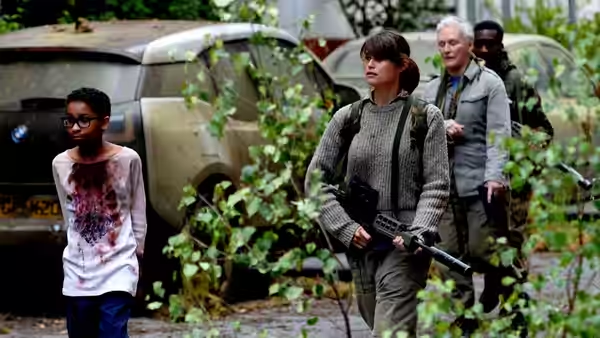
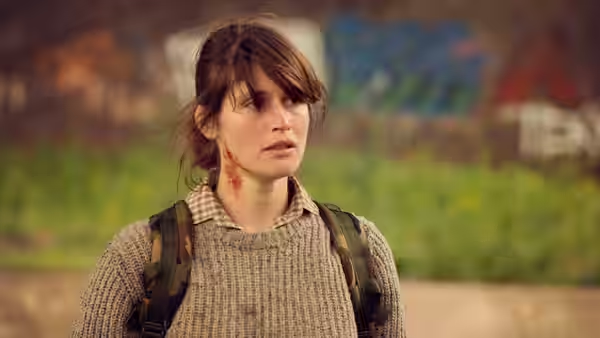
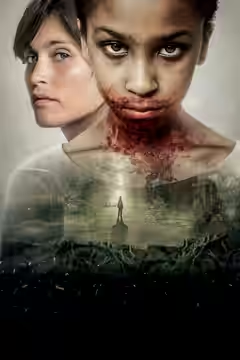
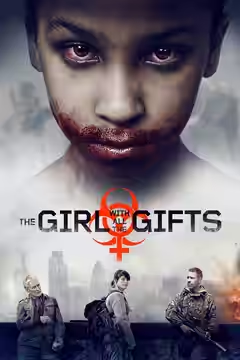
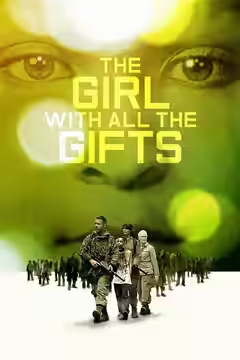
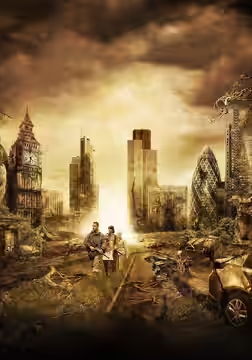
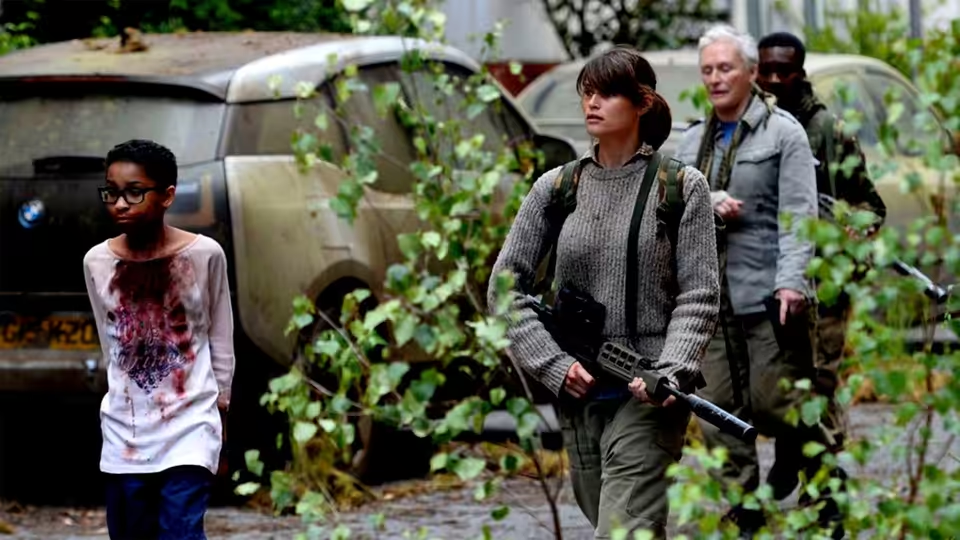
Melanie walks through overgrown streets as Helen carries a rifle nearby
Film review

The Girl with All the Gifts

2016 · Directed by Colm McCarthy · 1h 51m

In a sentenceA small girl, a room full of rifles, and she is the only one with the manners to say good morning

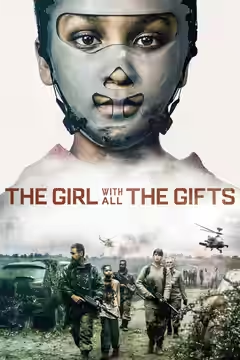
England, years after a fungal infection has turned most of the population into ‘hungries’. Melanie (Sennia Nanua), a small, polite child, lives in a cell on an army base. Each morning soldiers strap her into a wheelchair at gunpoint and wheel her to a classroom, where she and the other children are taught by Helen Justineau (Gemma Arterton), whom Melanie adores. Sergeant Eddie Parks (Paddy Considine) treats the children as weapons that happen to talk; Dr Caroline Caldwell (Glenn Close) treats them as specimens and is working through them, one by one, towards a vaccine. Melanie wants to please Miss Justineau and to understand what she is. Then the fence comes down, the base is overrun, and a handful of survivors take the muzzled girl with them on the road towards London.

Plays from YouTube when you press play; nothing loads from them until then.

Fi1m review

Colm McCarthy’s zombie film finds a new angle on an exhausted genre: tell it from the monster’s side, and give the monster a conscience. Sennia Nanua and Glenn Close make it worth your evening; the long middle on the road does not.

Colm McCarthy’s film, written by Mike Carey from his own novel, takes the most worn-out setup in horror and turns it round, so that we are looking out from inside the monster. Melanie (Sennia Nanua) is one of a classroom of infected children who still think, talk and say thank you. The adults cannot agree whether she is a girl or a weapon, and the film’s plain, good idea is that she is both. It holds that idea steady for most of its 111 minutes; where it wobbles is in the middle, when everyone is walking.

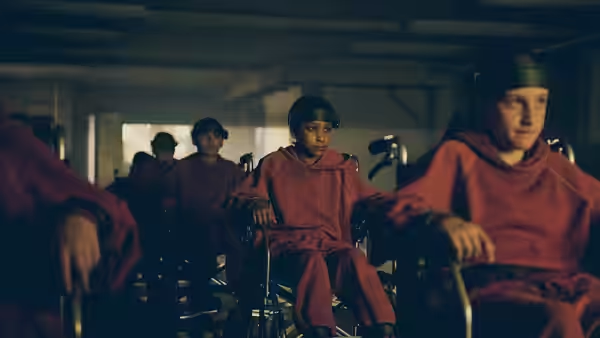
The first half hour is the best of it. Kristian Milsted’s base is bare concrete, strip lights and cell doors, and Simon Dennis lights it so that every face comes out slightly grey. Each morning two soldiers strap Melanie into a wheelchair at gunpoint, and she thanks them. In the classroom Helen Justineau (Gemma Arterton) reads the children Greek myths, and Melanie’s face when the story reaches Pandora tells you what the film is about: a child in love with a tale about a girl who opens the box. Then Sergeant Eddie Parks (Paddy Considine) walks in, bares his forearm, holds it near the front row, and the children’s jaws begin to snap.

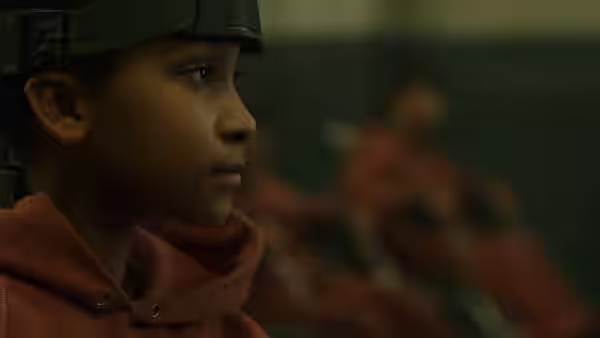
We were horrified by that, and then ashamed of being horrified at a child, which is exactly what McCarthy wants. Nanua is why it works. She plays Melanie’s politeness as real rather than as a mask; she wants to be good and does not understand why the soldiers fear her, and when the hunger comes her eyes go flat and her whole body changes. Afterwards she apologises. It is a performance without a false note from a newcomer, and the film puts its whole weight on her and she carries it.

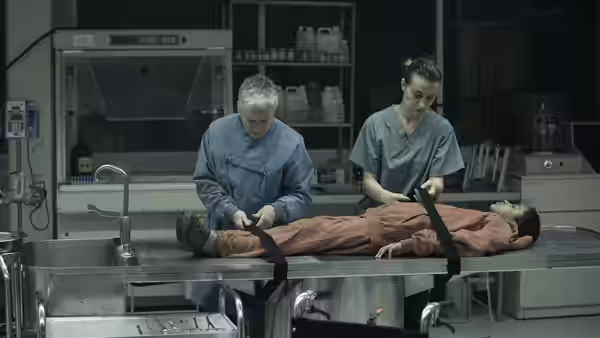
Glenn Close plays Dr Caroline Caldwell as a scientist who has done the sum and found it simple: one child’s brain against a vaccine for whoever is left. She never raises her voice and never says sorry, and Close gives her a dry, tired intelligence that makes her the most reasonable person on screen and the most frightening. When the fence comes down, Matthew Cannings cuts the escape fast and close, so that we are as lost as the soldiers, and the film ends up with a teacher, a sergeant, a scientist, a young soldier (Fisayo Akinade’s Kieran Gallagher) and a muzzled girl in one vehicle, heading for London.

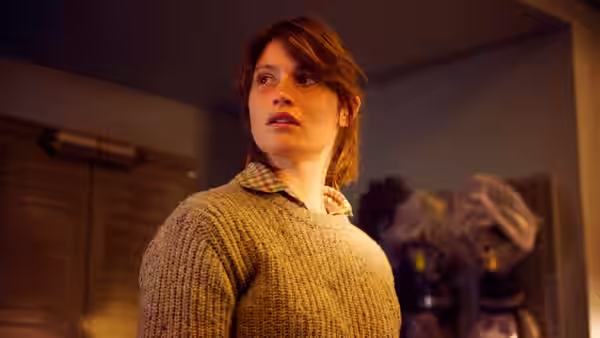
That is where it slows. The road section is a familiar one: a dead town, a hospital, a stop for supplies, an argument about whether to shoot the girl. Carey’s script gives Parks a thaw we can see coming from his first scene, and Considine does it well but cannot make it surprise us. Arterton’s Justineau is kind and that is nearly all she is given; the film needs her to be Melanie’s conscience and never asks what else she might want. Around the hour mark we drifted, and the film took a while to notice.

What pulls us back is the world. McCarthy’s hungries do not shamble; they stand where they stopped, in doorways and on the pavement, twitching, until a noise or a smell wakes them, and the scene in which the party tiptoes through a crowd of them is the film’s best scare. Dennis shoots the city in flat grey daylight with grass through the tarmac, and Milsted has built something in the middle of London that we will leave you to find. Cristóbal Tapia de Veer’s score is treated voices, breaths and chirrups, as if the infection itself were humming; some critics have found it repetitive, and we found it the thing that kept the walking from being dull.

28 Days Later (2002) emptied London and made the infected run. McCarthy’s dead stand still in the streets, and that turns out to be worse. Carey’s smartest decision is to let three adults answer the question of what Melanie is for in three different ways, and to make none of them wholly wrong. The last stretch takes a turn we will not describe, and it is where the idea finally pays off.

See it for Nanua and Close, and for that first half hour, which is as good a stretch of British horror as we have seen in some time. Watch it at home with the lights off; the base loses nothing on a small screen, and a street full of standing dead is better when you can hear yourself breathe. It carries a 15, and earns it in the classroom before anyone has died.

Critical consensus AI synthesised

71
Positive
13
Mixed
2
Negative
3

Most critics come away won over, and the praise lands in the same place: Sennia Nanua as Melanie. Review after review calls her performance the film’s chief asset, a child who is recognisably a child and unnerving at the same time. Beyond her, the reviews credit the film with putting fresh thought into a tired genre, with a moral seriousness about its warring characters, and with a melancholy atmosphere that several find moving. Glenn Close draws repeated mention for scene-stealing work, and the score and production design are singled out by The Guardian.

The spread is wide. Even admirers note predictable beats, a slack middle stretch and a repetitive soundtrack. The firm dissent comes from the festival trade reviews: The Hollywood Reporter finds it dreary and dramatically inert, Variety calls it overlong and tired, though Variety still likes Nanua. The Los Angeles Times finds it competent but routine, with direction and performances that rarely stand out.

Little White Lies
21 September 2016 · 4/5/4 · Anton Bitel
100

Bitel praises the film as a morally complex, character-focused take on familiar zombie-horror territory. He singles out Sennia Nanua’s performance and the film’s sympathetic handling of its characters’ conflicting positions.

Read the full review →
Time Out
18 September 2016 · ★★★★★ · Joshua Rothkopf
100

The critic calls it a radical, brilliant zombie film that refreshes a tired genre. They single out its inventive take on the undead as a major strength.

Read the full review →
Empire
19 September 2016 · Helen O'Hara
85*

O'Hara calls it the best zombie-ish apocalypse in years, praising its tense atmosphere and moral complexity. She singles out Sennia Nanua as a major discovery, especially for balancing Melanie's childlike curiosity with her cunning.

Read the full review →
Evening Standard
3 October 2016 · Charlotte O'Sullivan
85*

O'Sullivan finds the film a moving, hopeful end-of-the-world story despite a few missteps. She particularly praises its melancholy atmosphere and the final twists that return focus to Melanie and her teacher.

Read the full review →
Sight and Sound
26 September 2016 · Nikki Baughan
85*

Baughan finds the film a potent, intelligent horror story whose emotional force grows from Melanie’s journey. She particularly praises Sennia Nanua’s nuanced performance and the character’s blend of innocence, terror and purpose.

Read the full review →
Radio Times
★★★★ · Alan Jones
80

The critic calls it a heartfelt, powerful cautionary tale. They praise the adaptation’s visual resonance and Sennia Nanua’s performance.

Read the full review →

Straight answers AI written, from our review

Is The Girl with All the Gifts worth watching?
The Girl with All the Gifts is worth watching for anyone who can take a zombie film told from the monster's side, and we scored it 75. Sennia Nanua and Glenn Close make it, and the first half hour on the army base is as good a stretch of British horror as we have seen in some time. The long middle on the road sags.
How long is The Girl with All the Gifts, and what is it rated?
The Girl with All the Gifts runs 1h 51m. It is an action and horror film.
Where can I watch The Girl with All the Gifts in Israel?
The Girl with All the Gifts is available to rent from Apple TV from ₪16.90. Availability is checked daily; the links above go straight to each service.
How violent or frightening is The Girl with All the Gifts, and is it suitable for children?
The Girl with All the Gifts carries a UK 15 certificate and earns it in the classroom before anyone has died, when infected children's jaws begin to snap at a soldier's bared arm. The frights come from standing, twitching hungries and from a child's hunger rather than from heavy gore, but it is not for young children or the squeamish. Older teenagers should manage.
How does The Girl with All the Gifts compare to 28 Days Later?
The Girl with All the Gifts is quieter and stranger than 28 Days Later, which empties London and makes its infected run; McCarthy's dead stand still in the streets, and that turns out to be worse. Boyle's film is the brisker and more frightening of the two. Choose this one if you want a horror film with a conscience and a child at its centre.
Is The Girl with All the Gifts based on a true story or a book?
The Girl with All the Gifts is based on Mike Carey's novel of the same name, and Carey wrote the screenplay himself, so it is not a true story. Its smartest ideas, three adults answering what Melanie is for in three different ways, come from the book. You do not need to have read it; the film explains itself from its first morning.
What should I watch after The Girl with All the Gifts?
After The Girl with All the Gifts, try 28 Days Later (2002, Fi1m 77): Boyle empties London and makes the infected run; this film’s nearest British relation. Then Let the Right One In (2008, Fi1m 88): A child who is also a monster, and the person who loves her anyway; and Train to Busan (2016, Fi1m 84): The same year, the opposite pace: a Korean zombie film that never stops moving.

Cast

Awards

Sitges Film Festival Best Actress award, 2016

Won
Sitges Film Festival Best Actress award

If you liked this, try…

  1. 28 Days Later (2002, Fi1m 77)Boyle empties London and makes the infected run; this film’s nearest British relation.

  2. Let the Right One In (2008, Fi1m 88)A child who is also a monster, and the person who loves her anyway.

  3. Train to Busan (2016, Fi1m 84)The same year, the opposite pace: a Korean zombie film that never stops moving.

  4. Pontypool (2008) · not reviewed yetA Canadian radio studio, an infection carried by words, and almost no budget at all.

  5. The Last of Us (2023) · not reviewed yetA fungal plague, a hardened escort and a child who matters more than the cure.