Fincher’s version of Stieg Larsson’s thriller is cold, expert and for two hours properly gripping, with Rooney Mara giving it a centre. The mystery is routine and the film runs on for a good twenty-five minutes after solving it.
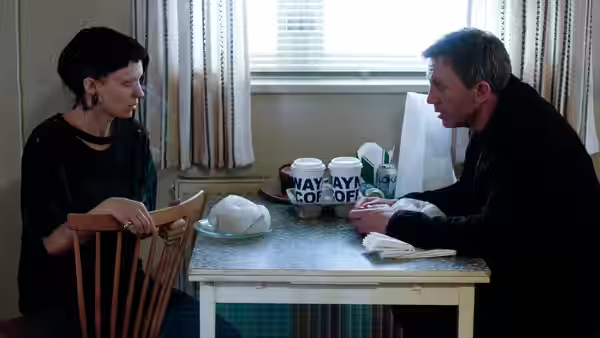
David Fincher’s version of Stieg Larsson’s novel arrives two years after the Swedish one, and the obvious question is why. The answer, for the first two hours, is that Fincher does this better than almost anyone. Mikael Blomkvist (Daniel Craig) loses a libel case, is hired by the old industrialist Henrik Vanger (Christopher Plummer) to find out what happened to a niece who vanished forty years ago, and goes north to a frozen island full of relatives who would rather he had not come. Steven Zaillian’s screenplay strips the book to that spine. What is left is a handsome, cold, mostly gripping 158 minutes with a routine mystery at its centre and an ending that will not sit down.
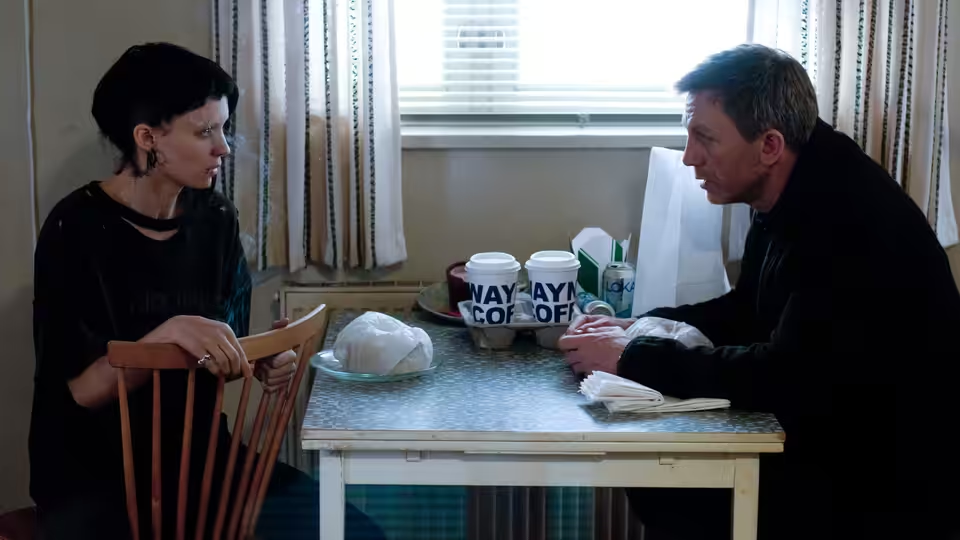
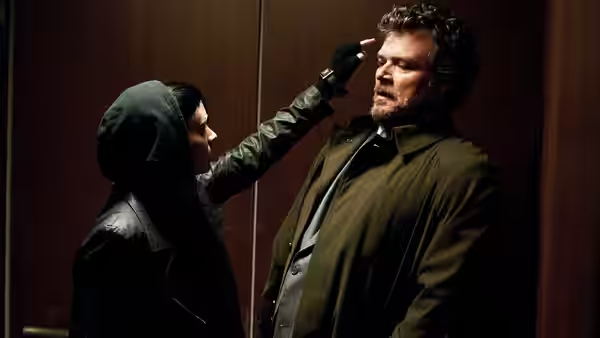
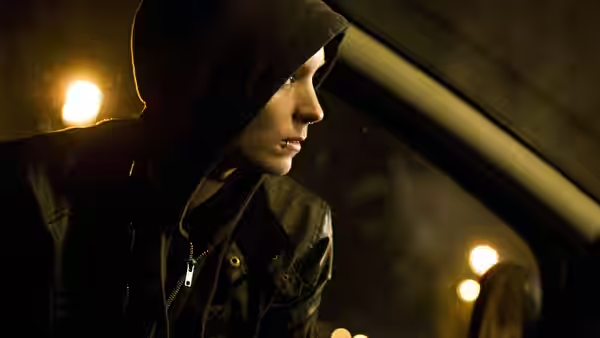
Rooney Mara is the reason to see it. Her Lisbeth Salander has bleached eyebrows, a ring through her lip and hair shaved at the sides, and she speaks as if every word costs her money. She does not look at people; she looks at their screens. Mara plays her as someone who decided long ago that nothing good arrives from other people, and we read a great deal into a face that gives almost nothing away. The scenes with her state-appointed guardian, Nils Bjurman (Yorick van Wageningen), are the hardest in the film. We watched them with our stomach tight, and we were grateful that Fincher stages them as horror and not as spectacle. Van Wageningen plays Bjurman as a dull man in a cardigan, which is worse than a monster.
Jeff Cronenweth shoots Sweden in the blue-grey of a winter afternoon that never quite becomes day. Snow is white only in the distance; up close it is dirty and lit by sodium lamps. Donald Graham Burt puts Blomkvist in a guest cottage where he works in his coat, and puts Martin Vanger (Stellan Skarsgård) in a glass box of a house on the shore, all polished floors and nothing to hide behind. Trish Summerville dresses Salander in hoodies, black leather and a T-shirt with an obscenity on it, and dresses the Vangers in cashmere that has cost more than her flat.
Trent Reznor and Atticus Ross open with a thrash through Led Zeppelin’s “Immigrant Song” over titles of black oil and wires, then spend the rest of the film on drones and pianos that seem to be playing in another room. It works; the whole film hums with unease. Kirk Baxter and Angus Wall cut the two investigations against each other for the first hour, Blomkvist with his photographs and card index, Salander with her laptop, so that when the two finally meet it feels like two halves of one mind. Those stretches, of people reading and thinking, are the best-edited in the film.
The mystery itself is the weak part. It turns on a man enlarging old photographs and a woman searching databases, and each answer arrives on schedule with a small chime of recognition. Craig is fine, tired and decent, but he makes no attempt at an accent while everyone around him does, and the film never accounts for it. Plummer is warm and sly and Skarsgård is courteous. Robin Wright, as Blomkvist’s editor and lover Erika Berger, is given about six lines.
Then there is the ending. The film solves its central puzzle and then continues for something like twenty-five minutes, tying off the Wennerström business from the opening in a sequence of wigs, banks and airports. We looked at our watch, which we had not done once in the preceding two hours, and then we were irritated with the film for making us do it.
Fincher has done this before and done it better. Zodiac (2007) was also about obsessives sifting old paper in bad light, and it was braver, because it admitted the answer might never come. This is still a well-made, unsettling evening, and Mara is worth it on her own; just do not expect the second half to match the first, and be aware the 18 certificate is earned. The story takes a turn we will not describe, but you will guess where it is going a good while before Blomkvist does.