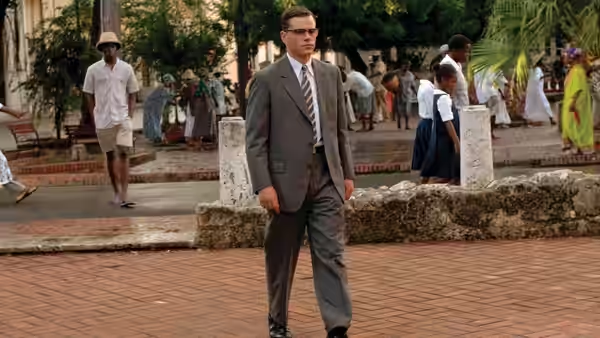
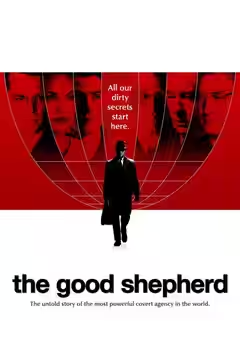
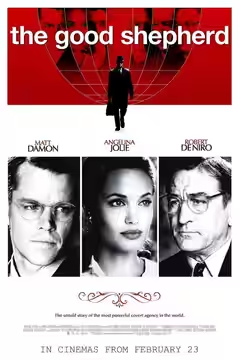
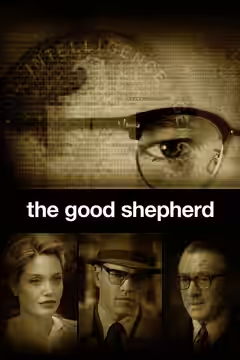
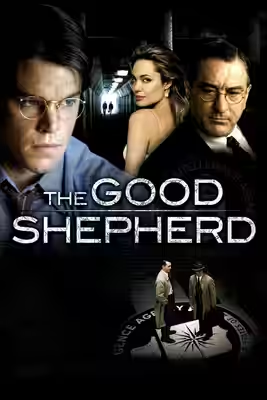
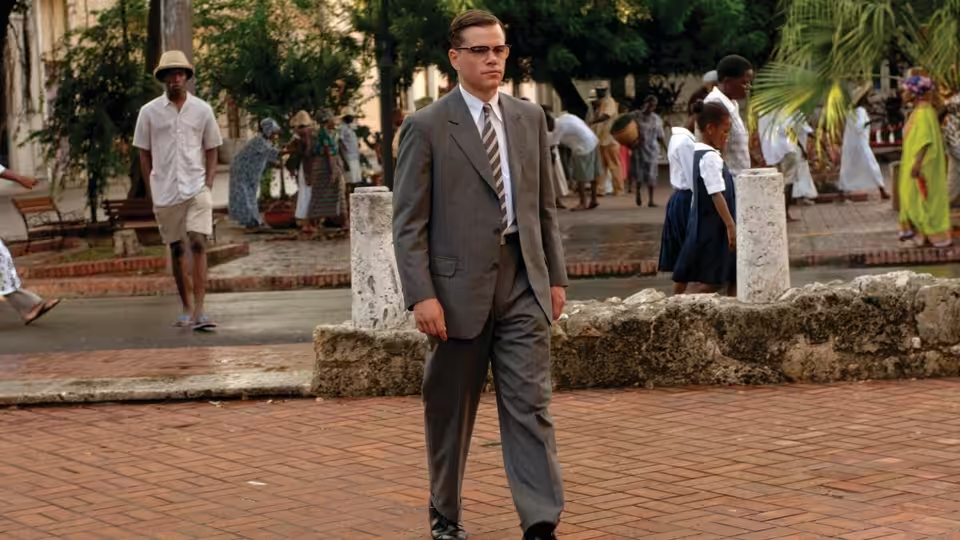
Edward Bell Wilson (Matt Damon) stands in a courtyard among pedestrians
Film review

The Good Shepherd

2006 · Directed by Robert De Niro · 2h 47m

In a sentenceThe whole Cold War conducted in whispers over very good furniture

Washington, 1961. Days after the failed invasion at the Bay of Pigs, senior CIA officer Edward Bell Wilson (Matt Damon) receives an unmarked package: a grainy photograph and a reel of tape that may identify whoever leaked the plan. While his technicians pick the image apart, the film goes back to Yale in 1939, where he is tapped for Skull and Bones, courts a deaf student called Laura (Tammy Blanchard), and is asked by FBI man Sam Murach (Alec Baldwin) to inform on his poetry professor, Dr. Fredericks (Michael Gambon). Then Margaret Ann Russell (Angelina Jolie), a senator’s daughter, takes him upstairs at a society weekend, and Bill Sullivan (Robert De Niro), a general assembling a wartime intelligence service, offers him a job in London.

Plays from YouTube when you press play; nothing loads from them until then.

Fi1m review

Robert De Niro’s second film as director is a long, airless account of how the CIA was built and what it cost one man. Intelligent and well made, over 167 minutes its coldness stops being the subject and becomes the problem.

Robert De Niro’s second film as director, thirteen years after A Bronx Tale, is a history of the Central Intelligence Agency told through one man who never raises his voice. Eric Roth’s script follows Edward Bell Wilson from a Yale quad in 1939 to a Washington office in 1961, and its idea is simple: the agency was built by men like this, educated, discreet and loyal to the institution before anyone in their own house, and the bill was paid at home. It is a serious, handsome, slow film, 167 minutes long, and it is cold on purpose. For about two hours the coldness is interesting. After that it is just cold.

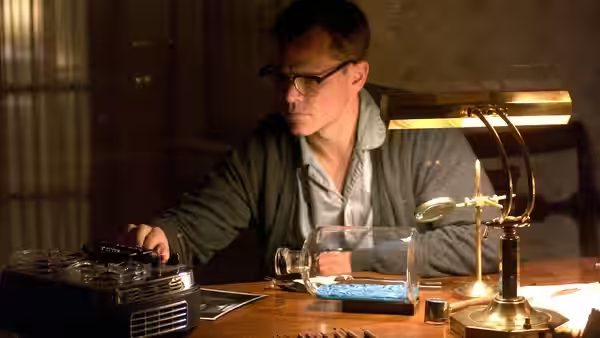
The best stretch is the frame. A package arrives and a room of technicians go to work on the photograph and the tape, enlarging a window, listening for a bell in the background, measuring the light to guess the hour. Nobody chases anyone. Tariq Anwar cuts between this and the past so that the young man’s choices and the old man’s consequences sit side by side, and the film is at its clearest when it does this plainly. We found these scenes gripping, more than any of the violence, because they show what the work actually was: patience, paper and listening.

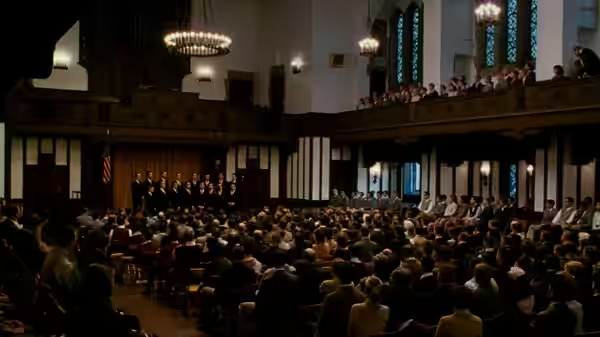
Robert Richardson shoots almost everything indoors, under lamps, in browns and greys with the corners of every room gone, so that a Yale drawing room, a London office and a Washington bungalow look like the same place with the furniture changed. That is the point, and it is well done. Jeannine Oppewall’s rooms are full of good dark wood and nothing personal on the desks. The score by Marcelo Zarvos and Bruce Fowler stays low, mostly strings, and rarely tells us how to feel, which we were grateful for, and which also means that when the film does want us to feel something it has little help.

Damon plays Wilson as a man who decided early that nothing would show on his face, and he holds to it for nearly three hours. It is a disciplined performance and a limiting one; we admired it and were kept outside it, which is the film’s bet and, in the end, its difficulty. The people around him do more with less. Michael Gambon’s Fredericks, the poetry professor, is sly and sad and gone too soon. William Hurt’s Philip Allen runs the agency like a man who has never once been contradicted. Alec Baldwin’s Murach is dry and quick, John Turturro’s Brocco does the ugly jobs with a shrug, and Billy Crudup’s Cummings, the British liaison, is so charming it is a wonder anyone trusts him. Joe Pesci has one scene, as a gangster the government needs a favour from, and does more with it than some people here manage in twenty.

The failure is at home. Margaret Ann Russell, played by Angelina Jolie, is the senator’s daughter who marries Wilson in a hurry and then waits, for years, for a husband who is absent even when he is at home. Jolie gives her real anger, and she is right to; Roth has written the woman as a series of doors slamming, and the film keeps leaving her to go back to the office. The marriage is meant to be the price of everything else, and we never quite believed in the thing being bought, so the price did not add up. Tammy Blanchard’s Laura, the deaf girl from Yale, has fewer scenes and twice the feeling. The one in which Wilson says goodbye to her is the only time in the film we were moved, and it is over in a minute.

Then there is the length. Roth’s script is researched to the hinges and wants all of it in: Yale, London, Berlin, the double agents, the son. Somewhere past the two-hour mark we looked at the time, and then felt slightly unfair for doing it, because the film had not done anything wrong. It had simply done the same thing, well, for a long time, and we had stopped waiting for it to do anything else. Anwar’s cutting is clean; it is the material that keeps coming.

A Bronx Tale was small and warm and knew exactly what it thought. This is large and chilly and has a point to make, and the point takes longer than it needs to. See it if you like your espionage slow and your furniture good, in one sitting, on an evening with nothing planned afterwards. Bring patience. The film has plenty and expects you to match it.

Critical consensus AI synthesised

59
Positive
3
Mixed
11
Negative
1

Most critics find the film ambitious, intelligent and carefully made, and most are also left a little cold by it. The praise clusters around the craft: Eric Roth’s well-researched script, Robert Richardson’s atmospheric photography, the period detail, and the attention to files, paperwork and the slow business of analysing evidence. Matt Damon’s restrained performance is the most frequently singled out, with William Hurt, Michael Gambon and Angelina Jolie also noted.

The reservations are about length, pace and feeling. Eleven of the fifteen reviews land in the middle, calling the film overlong, confusing or emotionally distant, and several say the central character stays underdeveloped. The spread is wide. The New Yorker treats it as an impressive, melancholy espionage story and faults only its reluctance to pursue its Cold War questions, while Variety finds it tedious and without rhythm, and Slant dismisses it as featherweight. Even the warmer notices concede the deliberate pace asks for patience.

The New Yorker
17 December 2006 · David Denby
80*

Denby regards the film as an impressive, melancholy espionage story, though he faults it for not pursuing its ultimate questions about the Cold War. He praises De Niro’s direction, especially its swift, terse handling of the intricate, paranoid narrative.

Read the full review →
Los Angeles Times
22 December 2006 · Kenneth Turan
75*

Turan finds the film a thoughtful, psychologically complex drama whose deliberate pace suits its world of betrayal and mistrust. He particularly praises Matt Damon’s emotionally restrained performance and the detailed sequences showing the agency analyzing evidence.

Read the full review →
Screen Daily
12 December 2006 · Patrick Z McGavin
75*

The critic finds the film frequently absorbing and fascinating, with power rooted in its deliberate contradictions. They praise how it refracts Cold War tensions through the emotionally harsh life of a single spymaster.

Read the full review →
RogerEbert.com
65*

The page content is inaccessible, so the critic’s verdict cannot be verified. No specific praise or complaint is visible in the supplied text.

Read the full review →
Time Out
20 February 2007 · Geoff Andrew
64*

The accessible page does not reveal the critic’s verdict. It provides no specific praise or complaint about the film.

Read the full review →
Radio Times
★★★ · Jamie Russell
60

The review describes an ambitious, restrained spy drama focused on the CIA’s bureaucracy rather than action. It singles out Eric Roth’s well-researched script and the film’s attention to paperwork and files.

Read the full review →

Straight answers AI written, from our review

Is The Good Shepherd worth watching?
The Good Shepherd is worth watching for anyone who likes espionage slow, quiet and conducted indoors, and we scored it 64. Robert De Niro's account of how the CIA was built is intelligent and well made, with a gripping frame story about technicians picking apart a photograph, but at 167 minutes its deliberate coldness becomes the problem. Set aside a whole evening and bring patience.
How long is The Good Shepherd, and what is it rated?
The Good Shepherd runs 2h 47m. It is a drama and thriller film.
Where can I watch The Good Shepherd in the UAE?
The Good Shepherd is not on any streaming or rental service in the UAE at the moment. It is available in 10 other countries; change your country at the top of the page to see where. Availability is checked daily.
How violent or frightening is The Good Shepherd, and is it suitable for children?
The Good Shepherd is a UK 15 and not suitable for children, though the certificate reflects adult themes more than spectacle. There is some violence, but the film is more interested in patience, paper and listening than in chases, and the discomfort comes from betrayal and a marriage going quietly wrong. Teenagers with a taste for history and three hours of concentration could manage it.
What should I watch after The Good Shepherd?
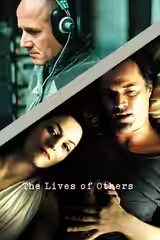
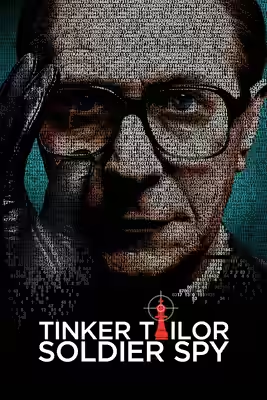
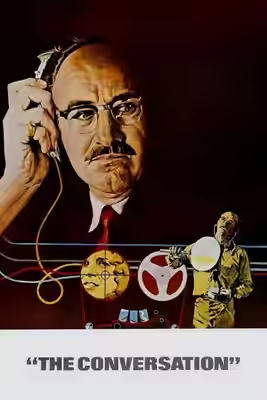
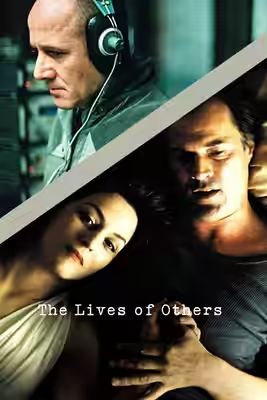
After The Good Shepherd, try Tinker Tailor Soldier Spy (2011, Fi1m 84): The same cold rooms and quiet men, with a plot that actually pays off. Then The Conversation (1974, Fi1m 92): A surveillance man undone by one tape; the evidence scenes here done better and shorter; and The Lives of Others (2006, Fi1m 84): The other side of the wall, and a listener who learns to feel something.

Cast

Awards

Academy Awards, 2007

Nominated
Best Production Design

If you liked this, try…

  1. Tinker Tailor Soldier Spy (2011, Fi1m 84)The same cold rooms and quiet men, with a plot that actually pays off.

  2. The Conversation (1974, Fi1m 92)A surveillance man undone by one tape; the evidence scenes here done better and shorter.

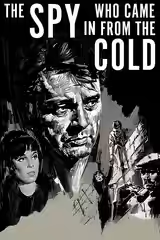
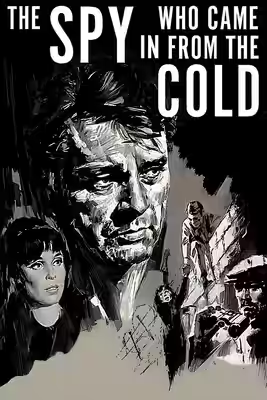
  3. The Spy Who Came in from the Cold (1965) · not reviewed yetRichard Burton proves that a spy with no feelings can still break your heart.

  4. The Lives of Others (2006, Fi1m 84)The other side of the wall, and a listener who learns to feel something.

  5. Army of Shadows (1969) · not reviewed yetMelville’s Resistance film: loyalty, betrayal and executions carried out without a raised voice.

Free account

Know what to watch tonight

Two lists that know where things are streaming, collections you can share, your own score beside ours, and Discover that remembers what you have seen.

  • Want to see, sorted by what is streaming now
  • Seen, with your score out of ten
  • No adverts, ever