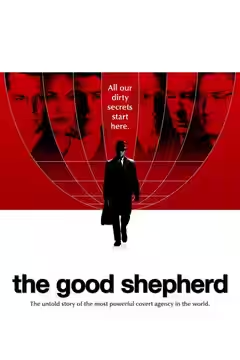
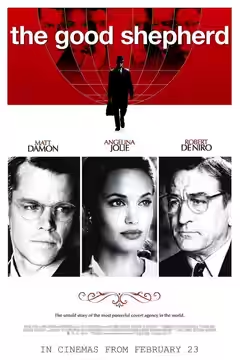
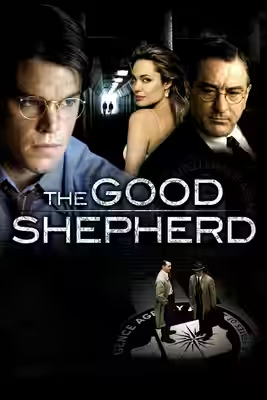
Robert De Niro’s second film as director is a long, airless account of how the CIA was built and what it cost one man. Intelligent and well made, over 167 minutes its coldness stops being the subject and becomes the problem.
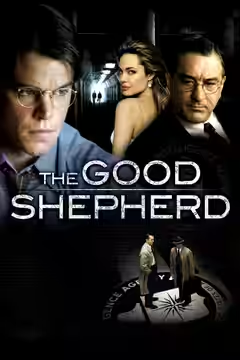
Robert De Niro’s second film as director, thirteen years after A Bronx Tale, is a history of the Central Intelligence Agency told through one man who never raises his voice. Eric Roth’s script follows Edward Bell Wilson from a Yale quad in 1939 to a Washington office in 1961, and its idea is simple: the agency was built by men like this, educated, discreet and loyal to the institution before anyone in their own house, and the bill was paid at home. It is a serious, handsome, slow film, 167 minutes long, and it is cold on purpose. For about two hours the coldness is interesting. After that it is just cold.
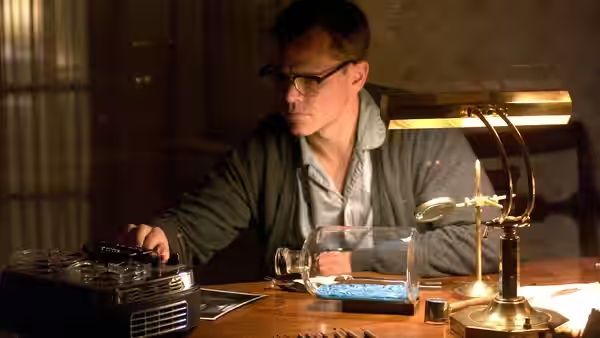
The best stretch is the frame. A package arrives and a room of technicians go to work on the photograph and the tape, enlarging a window, listening for a bell in the background, measuring the light to guess the hour. Nobody chases anyone. Tariq Anwar cuts between this and the past so that the young man’s choices and the old man’s consequences sit side by side, and the film is at its clearest when it does this plainly. We found these scenes gripping, more than any of the violence, because they show what the work actually was: patience, paper and listening.
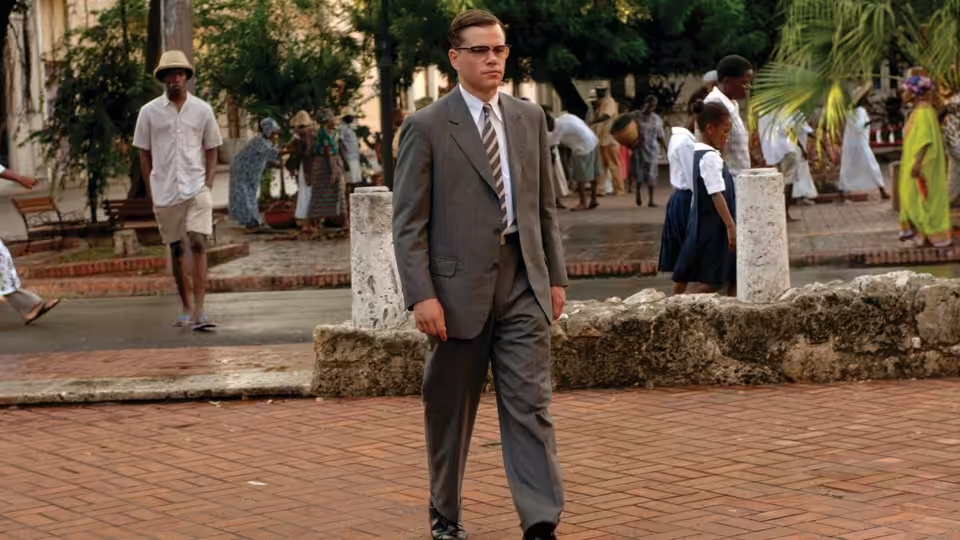
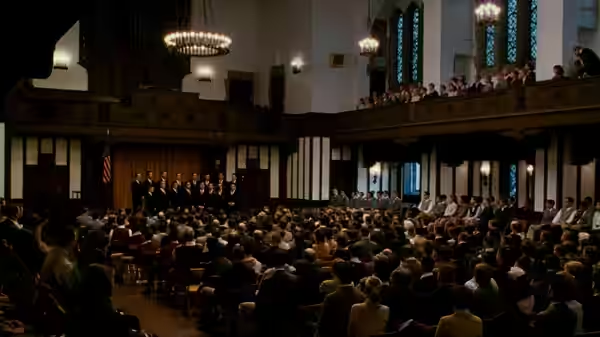
Robert Richardson shoots almost everything indoors, under lamps, in browns and greys with the corners of every room gone, so that a Yale drawing room, a London office and a Washington bungalow look like the same place with the furniture changed. That is the point, and it is well done. Jeannine Oppewall’s rooms are full of good dark wood and nothing personal on the desks. The score by Marcelo Zarvos and Bruce Fowler stays low, mostly strings, and rarely tells us how to feel, which we were grateful for, and which also means that when the film does want us to feel something it has little help.
Damon plays Wilson as a man who decided early that nothing would show on his face, and he holds to it for nearly three hours. It is a disciplined performance and a limiting one; we admired it and were kept outside it, which is the film’s bet and, in the end, its difficulty. The people around him do more with less. Michael Gambon’s Fredericks, the poetry professor, is sly and sad and gone too soon. William Hurt’s Philip Allen runs the agency like a man who has never once been contradicted. Alec Baldwin’s Murach is dry and quick, John Turturro’s Brocco does the ugly jobs with a shrug, and Billy Crudup’s Cummings, the British liaison, is so charming it is a wonder anyone trusts him. Joe Pesci has one scene, as a gangster the government needs a favour from, and does more with it than some people here manage in twenty.
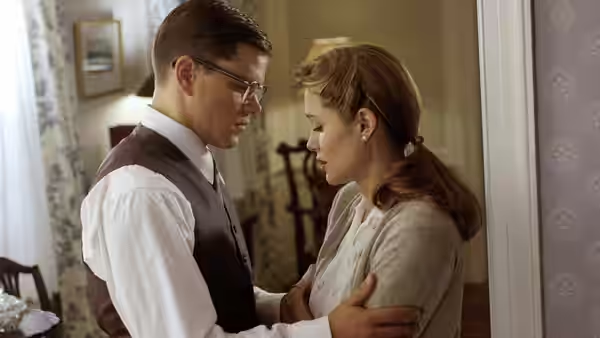
The failure is at home. Margaret Ann Russell, played by Angelina Jolie, is the senator’s daughter who marries Wilson in a hurry and then waits, for years, for a husband who is absent even when he is at home. Jolie gives her real anger, and she is right to; Roth has written the woman as a series of doors slamming, and the film keeps leaving her to go back to the office. The marriage is meant to be the price of everything else, and we never quite believed in the thing being bought, so the price did not add up. Tammy Blanchard’s Laura, the deaf girl from Yale, has fewer scenes and twice the feeling. The one in which Wilson says goodbye to her is the only time in the film we were moved, and it is over in a minute.
Then there is the length. Roth’s script is researched to the hinges and wants all of it in: Yale, London, Berlin, the double agents, the son. Somewhere past the two-hour mark we looked at the time, and then felt slightly unfair for doing it, because the film had not done anything wrong. It had simply done the same thing, well, for a long time, and we had stopped waiting for it to do anything else. Anwar’s cutting is clean; it is the material that keeps coming.
A Bronx Tale was small and warm and knew exactly what it thought. This is large and chilly and has a point to make, and the point takes longer than it needs to. See it if you like your espionage slow and your furniture good, in one sitting, on an evening with nothing planned afterwards. Bring patience. The film has plenty and expects you to match it.