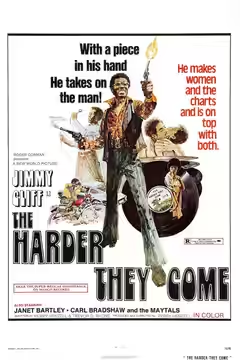
Jimmy Cliff makes Perry Henzell’s reggae crime drama worth seeing even when the storytelling gets ragged. The music is a pleasure, and the film’s anger at the obstacles facing a singer feels earned.
Perry Henzell’s The Harder They Come gives us a good reason to care about a singer before it asks us to follow a crime story. Jimmy Cliff plays Ivanhoe “Ivan” Martin, who comes from the country to Kingston hoping to enter the reggae business. His talent makes the ambition credible, and the difficulty of getting started supplies an anger the film earns. It is well worth seeing, though the storytelling sometimes struggles to keep up with the music.
Cliff is the main reason that combination works. There is an openness to his performance that makes Ivan’s wish to be heard easy to understand, without requiring us to approve of everything about him. We were moved by his singing, because hearing that voice makes the struggle to find a place in the business feel wasteful and unfair. The performance gives Ivan something worth pursuing, so that his frustration means more than a screenplay telling us that an outsider has been badly treated.
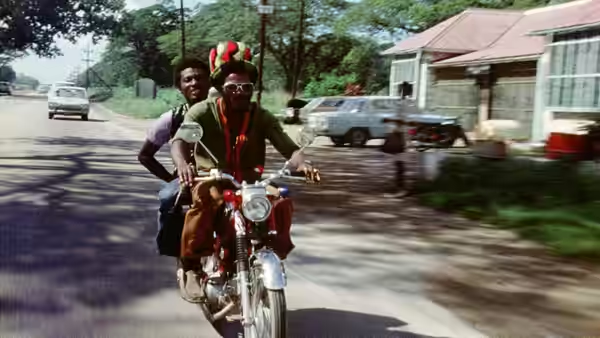
The views of Kingston’s slums hold our attention without the soundtrack doing the work for them. Henzell’s documentary-style approach gives the city a life beyond its usefulness as a setting for Ivan’s troubles. Poverty stays in view, and it makes the hope of earning money from music feel practical and urgent. This is where the film’s social criticism is most convincing: we can understand why a newcomer might believe that talent ought to be enough.
The music credited to Jimmy Cliff, Desmond Dekker and The Slickers is allowed to be enjoyable in its own right. Its rhythms give the film forward movement even when the plotting is uncertain, and Henzell does not need to explain its appeal. That pleasure is important to the film’s account of musical ambition. We hear why someone would want to do this, and the soundtrack allows us to share that pleasure without forgetting the difficulty of making a living.
The editing, credited to Reicland Anderson, John Victor Smith and Richard White, is less consistently persuasive. The film moves briskly, and that briskness suits Ivan’s impatience, but some transitions feel hurried. We can follow its interest in music and its interest in crime without always feeling that the two have been brought together convincingly. A little more time between developments would have helped us understand how one leads to another.
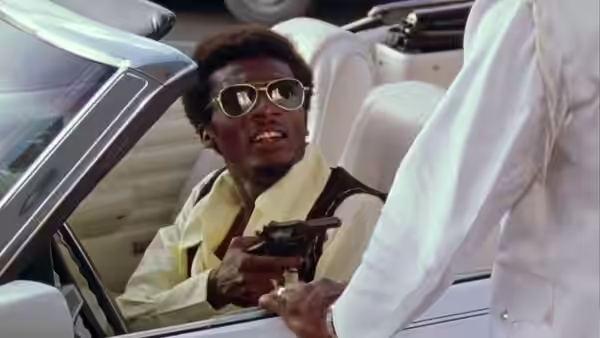
Perry Henzell and co-writer Trevor D. Rhone are strongest when the difficulty of entering the music business carries the drama. As the crime material takes up more space, some of that specificity gives way to familiar excitement. Cliff keeps it involving, but the aspiring singer is a more distinctive figure than the genre’s usual angry outsider. By establishing what Ivan wants so persuasively, the writers have made the passages about getting started in music difficult for the busier plotting to match.
At 103 minutes, there is enough here to justify accepting the rougher passages, especially for anyone interested in how music becomes a livelihood. We would take Cliff’s performance and this close attention to Kingston over a tidier story with less to notice. Come for the singing, and allow some patience for the plot.