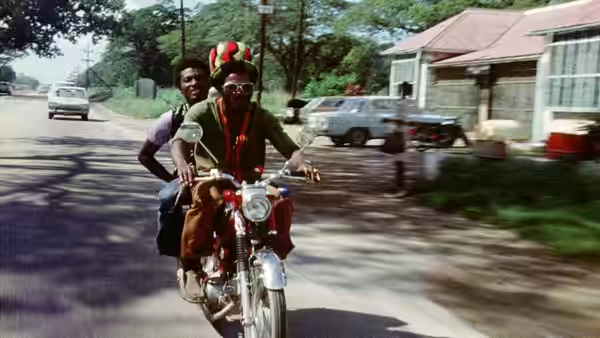
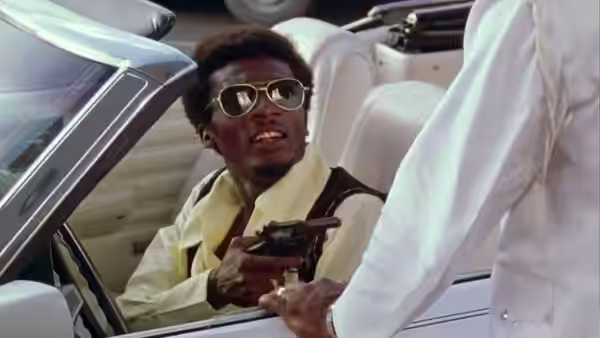
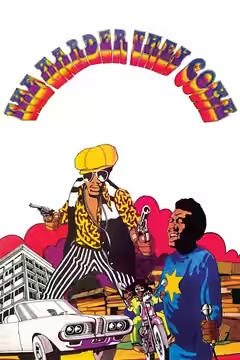
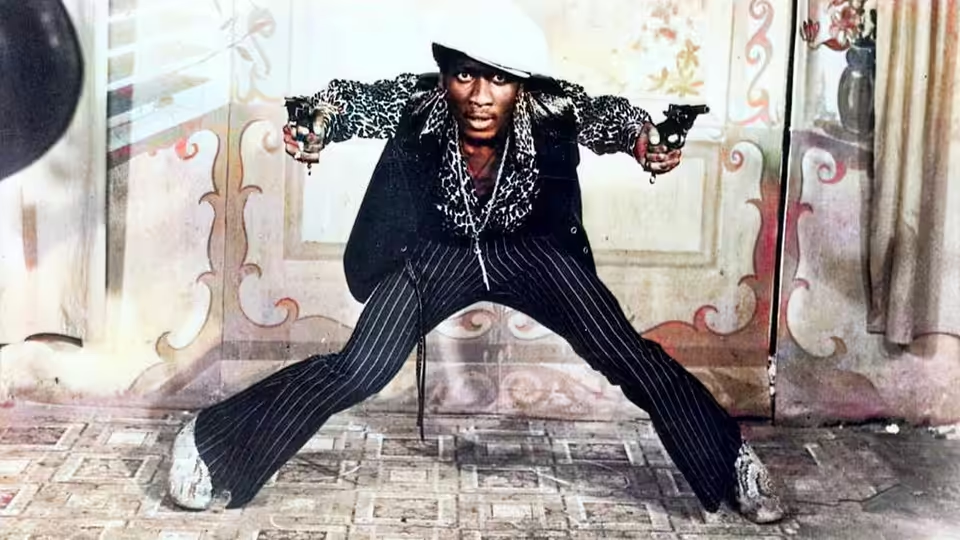
Ivan Martin (Jimmy Cliff) spreads his legs and aims a pistol inside a decorated room
Film review

The Harder They Come

1972 · Directed by Perry Henzell · 1h 43m

In a sentenceJimmy Cliff can sing; persuading the music business to care is another profession

Ivanhoe “Ivan” Martin (Jimmy Cliff) travels from the country to Kingston, hoping to establish himself as a reggae singer. His efforts to enter the music business unfold among the city’s slums, where earning a living from his voice proves difficult. The story also features Elsa (Janet Bartley) and Preacher (Basil Keane). Ivan wants a musical career, but getting heard means finding a way into an industry that is hard for a newcomer to enter. Arriving in the city leaves him with the work of turning ambition into a livelihood.

Plays from YouTube when you press play; nothing loads from them until then.

Fi1m review

Jimmy Cliff makes Perry Henzell’s reggae crime drama worth seeing even when the storytelling gets ragged. The music is a pleasure, and the film’s anger at the obstacles facing a singer feels earned.

Perry Henzell’s The Harder They Come gives us a good reason to care about a singer before it asks us to follow a crime story. Jimmy Cliff plays Ivanhoe “Ivan” Martin, who comes from the country to Kingston hoping to enter the reggae business. His talent makes the ambition credible, and the difficulty of getting started supplies an anger the film earns. It is well worth seeing, though the storytelling sometimes struggles to keep up with the music.

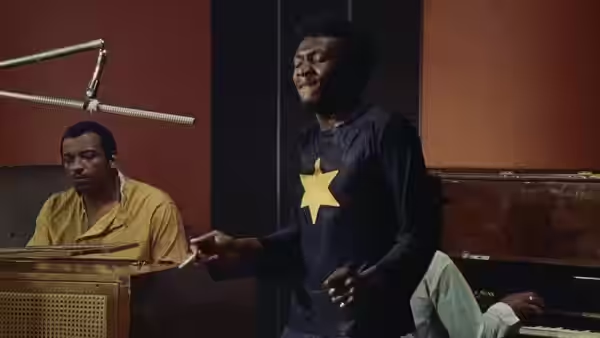
Cliff is the main reason that combination works. There is an openness to his performance that makes Ivan’s wish to be heard easy to understand, without requiring us to approve of everything about him. We were moved by his singing, because hearing that voice makes the struggle to find a place in the business feel wasteful and unfair. The performance gives Ivan something worth pursuing, so that his frustration means more than a screenplay telling us that an outsider has been badly treated.

The views of Kingston’s slums hold our attention without the soundtrack doing the work for them. Henzell’s documentary-style approach gives the city a life beyond its usefulness as a setting for Ivan’s troubles. Poverty stays in view, and it makes the hope of earning money from music feel practical and urgent. This is where the film’s social criticism is most convincing: we can understand why a newcomer might believe that talent ought to be enough.

The music credited to Jimmy Cliff, Desmond Dekker and The Slickers is allowed to be enjoyable in its own right. Its rhythms give the film forward movement even when the plotting is uncertain, and Henzell does not need to explain its appeal. That pleasure is important to the film’s account of musical ambition. We hear why someone would want to do this, and the soundtrack allows us to share that pleasure without forgetting the difficulty of making a living.

The editing, credited to Reicland Anderson, John Victor Smith and Richard White, is less consistently persuasive. The film moves briskly, and that briskness suits Ivan’s impatience, but some transitions feel hurried. We can follow its interest in music and its interest in crime without always feeling that the two have been brought together convincingly. A little more time between developments would have helped us understand how one leads to another.

Perry Henzell and co-writer Trevor D. Rhone are strongest when the difficulty of entering the music business carries the drama. As the crime material takes up more space, some of that specificity gives way to familiar excitement. Cliff keeps it involving, but the aspiring singer is a more distinctive figure than the genre’s usual angry outsider. By establishing what Ivan wants so persuasively, the writers have made the passages about getting started in music difficult for the busier plotting to match.

At 103 minutes, there is enough here to justify accepting the rougher passages, especially for anyone interested in how music becomes a livelihood. We would take Cliff’s performance and this close attention to Kingston over a tidier story with less to notice. Come for the singing, and allow some patience for the plot.

Critical consensus AI synthesised

73
Positive
6
Mixed
2
Negative
1

Most critics respond warmly to The Harder They Come, with the reggae soundtrack drawing the most consistent praise across otherwise differing assessments. The reviews also value its closely observed depiction of Kingston and its anger at social conditions and the music business. Jimmy Cliff’s performance attracts praise even from a sceptical critic. Supporters find energy and political force in a film whose rough edges do not necessarily diminish its impact.

The spread is wide, though the reservations centre chiefly on the storytelling. Radio Times finds the early struggle to enter the music business convincing but argues that the film later slips into banal blaxploitation. The New Yorker is more dismissive of the hurried mixture of musical biography and social protest, while still admiring Cliff and the music. Some enthusiastic retrospective assessments also concern restored editions and supplementary material, rather than the film alone.

Slant Magazine
26 August 2019 · ★★★★★ · Keith Watson
100

Watson praises the Blu-ray package as a definitive presentation of the film and Henzell’s career. He singles out the reggae soundtrack for its stirring impact and the disc’s vivid image and sound.

Read the full review →
Los Angeles Times
15 August 2019 · Kenneth Turan
85*

Turan warmly celebrates the film’s cultural impact and recommends its new collector’s edition. He singles out its role in introducing reggae to a wider audience and praises the restored bonus feature.

Read the full review →
The AV Club
29 March 2002 · Scott Tobias
85*

Tobias finds the film a powerful, politically radical work whose social critique remains forceful. He singles out its reggae soundtrack and documentary-style depiction of Kingston’s slums for praise.

Read the full review →
The Guardian
3 August 2022 · Peter Bradshaw
80*

Bradshaw finds the film raw, energetic and sharply self-aware, with Ivan’s downfall giving it a forceful tragic edge. He particularly praises the throbbing reggae soundtrack and Jimmy Cliff’s performance.

Read the full review →
Empire
1 January 2000 · William Thomas
75*

The critic calls it a Jamaican classic that feels worn around the edges but still has angry momentum. The rollicking reggae soundtrack is singled out as the film’s greatest strength.

Read the full review →
Variety
6 September 1972 · festival review · Variety Staff
75*

Variety gives the film a favorable verdict, praising its taut pacing and visual flair. It also singles out the music’s lively rhythm and the film’s effective use of local color.

Read the full review →

Straight answers AI written, from our review

Is The Harder They Come worth watching?
The Harder They Come is well worth watching for Jimmy Cliff’s singing and its close attention to musical ambition in Kingston; we score it 80 out of 100. We recommend it especially for the music and the frustration of trying to earn a living from talent, though the crime plotting grows ragged.
How long is The Harder They Come, and what is it rated?
The Harder They Come runs 1h 43m. It is a crime and drama film.
Where can I watch The Harder They Come in Chile?
The Harder They Come is not on any streaming or rental service in Chile at the moment. It is available in 4 other countries; change your country at the top of the page to see where. Availability is checked daily.
How violent or frightening is The Harder They Come, and is it suitable for children?
The Harder They Come carries a US R rating, so we would not recommend it for children; no UK certificate is supplied. That rating indicates restricted viewing for younger audiences, but we cannot specify the intensity of violence or frightening material from the classification alone.
How does The Harder They Come compare to The Commitments?
The Harder They Come is our choice for a rougher, angrier account of musical ambition, while The Commitments is the better fit for a warm, funny evening built around a band. We find the crime plotting uneven in the former and a little too much polish in the latter, but both make the songs worth caring about.
What should I watch after The Harder They Come?
After The Harder They Come, try The Commitments (1991, Fi1m 82): Working-class musical ambition, band politics and songs that make the quarrels worthwhile. Then La Haine (1995, Fi1m 90): Street-level anger and charismatic young men whose options keep getting narrower.

Cast

If you liked this, try…

  1. Rockers (1978) · not on Fi1m yetAnother Jamaican musician negotiates crooked dealings, with reggae given plenty of room.

  2. The Commitments (1991, Fi1m 82)Working-class musical ambition, band politics and songs that make the quarrels worthwhile.

  3. Touki Bouki (1973) · not on Fi1m yetYoung Senegalese outsiders dream of escape in a restless, musically charged film.

  4. La Haine (1995, Fi1m 90)Street-level anger and charismatic young men whose options keep getting narrower.

  5. Gully Boy (2019) · not on Fi1m yetAn aspiring Mumbai rapper confronts the distance between talent and opportunity.

The Harder They Come (1972) review: fine songs and a rough story (Chile) | Fi1m