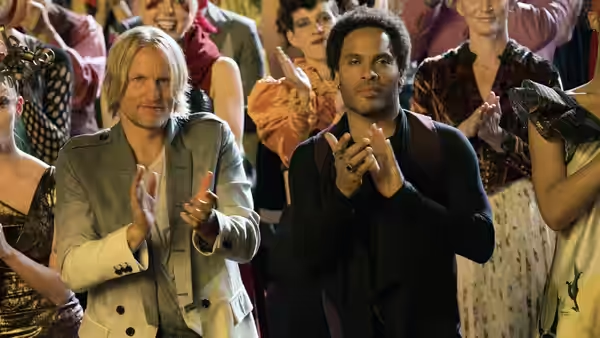
Katniss Everdeen (Jennifer Lawrence) and Peeta Mellark (Josh Hutcherson) crouched in jungle water
Film review

The Hunger Games: Catching Fire

2013 · Directed by Francis Lawrence · 2h 26m

In a sentenceAn oppressive regime with excellent tailoring and a serious Jennifer Lawrence problem

In District 12, Katniss Everdeen (Jennifer Lawrence) is caught between her own loyalties and the public image that keeps her under scrutiny. Her relationships with Peeta Mellark (Josh Hutcherson) and Gale Hawthorne (Liam Hemsworth) are part of that struggle, while President Coriolanus Snow (Donald Sutherland) presides over a society that turns the Hunger Games into entertainment. Katniss wants to survive without letting those in power decide everything she does. As resistance grows, keeping her private feelings separate from her public role becomes harder. Beyond District 12 lies the arena, where the games make political control a physical threat.

Plays from YouTube when you press play; nothing loads from them until then.

Fi1m review

Francis Lawrence makes The Hunger Games: Catching Fire a forceful adventure about political control, with Jennifer Lawrence giving the danger a human cost. The familiar preliminaries run long, but the performances make this a sequel worth staying with.

The Hunger Games: Catching Fire makes its political threats matter as much as its combat. Francis Lawrence makes the struggle over Katniss Everdeen’s public image feel dangerous, and gives Jennifer Lawrence space to show what that attention costs her. We recommend it, with a reservation about how long it spends preparing familiar ground. At 146 minutes, some of the preliminaries could go without making either the politics or the relationships harder to follow.

Jennifer Lawrence is the reason we care about those relationships. Her Katniss is angry, vulnerable and sometimes difficult to read, and the performance lets those qualities remain tangled together. We felt protective of her when the film made her private feelings part of the public entertainment; her anger plainly offered her no escape. The early District 12 passages are particularly effective because Lawrence makes the pressure on Katniss felt before the action has to demonstrate it.

Simon Beaufoy and Michael Arndt’s screenplay makes the love triangle useful by placing it inside a story about social control. Peeta Mellark, played by Josh Hutcherson, and Gale Hawthorne, played by Liam Hemsworth, belong to a private life that cannot stay private. There are stretches when the emotional complications feel rehearsed for our benefit, and the return to familiar business slows the film. Even then, Katniss’s difficulty in separating what she feels from what she must present gives the romance a reason to occupy so much space.

The physical world helps. Philip Messina’s production design gives District 12 a solidity that the broader science fiction needs, while Trish Summerville’s elaborate costumes make extravagant display part of the exercise of power. Jo Willems gives the tropical arena enough visual clarity for the action to have weight: we can follow the danger instead of merely registering commotion. The clothes and the combat belong in the same film because both show how thoroughly this society has organised itself around spectacle.

Francis Lawrence is less successful at making the build-up feel fresh. Alan Edward Bell’s editing keeps the action legible, but the passages leading towards it repeat tensions that the performances have already established. James Newton Howard’s music supplies plenty of urgency, although its emphatic support for the melodrama can feel unnecessary when Jennifer Lawrence is already doing the work. None of this sinks the film, though it does mean the route back to the games feels longer than it needs to.

The supporting cast helps the political scenes hold our attention. Philip Seymour Hoffman, as Plutarch Heavensbee, brings a watchful intelligence to material that could otherwise feel occupied with arranging the next stretch of plot. Donald Sutherland’s President Coriolanus Snow gives the authority above Katniss a recognisable human presence, keeping the threat personal. These are valuable performances in an adventure that wants us to think about who arranges the violence and who benefits from watching it.

For a science-fiction adventure, it is unusually interested in how people behave when they know they are being watched. That gives Jennifer Lawrence more to do than look convincing in danger, and she makes the wider political story matter without turning Katniss into a walking explanation of it. Give it an evening, with a little patience for the repeated preliminaries.


Critical consensus AI synthesised

76
Positive
16
Mixed
2
Negative
1

Most critics welcome Catching Fire as a more confident sequel, with broader political concerns and stronger spectacle than the first film. Praise centres on Jennifer Lawrence: the reviews repeatedly credit her with giving Katniss emotional weight and keeping the larger production grounded. Francis Lawrence’s direction generally earns approval for clearer action and assured handling of the expanded story. The supporting cast also draws favourable notices, while the themes of propaganda, inequality and resistance give critics more to discuss than survival in the arena.

Reservations cluster around repetition, length and the sense that this chapter is preparing another. Critics disagree over pace: some find sustained energy, others a sluggish first half. The spread is mostly positive, but Screen Daily offers a firmer dissent, finding that familiarity drains the urgency despite Lawrence’s performance. Even favourable reviews acknowledge structural weaknesses, though most find enough in the performances and political material to carry them.

Radio Times
★★★★★ · Alan Jones
100

The critic calls it a top-flight escapist adventure that is expertly executed without a dull stretch. They single out the bolder, bigger spectacle, thrilling tropical combat zone, higher designer fashion, and Jennifer Lawrence's terrific performance.

Read the full review →
Total Film
12 November 2013 · Paul Bradshaw
86*

Darker, moodier and better than the first film, it expands the story beyond the arena with brutal truths and strong new characters. Jennifer Lawrence's commanding performance anchors the series.

Read the full review →
Los Angeles Times
20 November 2013 · Kenneth Turan
85*

The film is described as an effective piece of melodramatic popular entertainment that builds on the first movie with increased visual brio while staying faithful to the source. Jennifer Lawrence is praised as the sequel’s biggest asset for creating genuine emotion from pulpy material.

Read the full review →
The Guardian
24 November 2013 · Mark Kermode
80*

The critic praises the film's shift toward political themes of spectacle and resistance over mere survival horror, crediting Jennifer Lawrence's commanding and inspiring performance as Katniss for elevating the material. They note efficient direction by Francis Lawrence but observe some repetition and franchise-driven elements.

Read the full review →
The New York Times
21 November 2013 · Manohla Dargis
80*

The critic finds the sequel largely satisfying as a screen adventure with strong special effects and action, crediting the new director for knowing his way around post-apocalyptic stories. Katniss is singled out as a thrillingly atypical heroine whose strength of character is the heart of the series.

Read the full review →
Time Out
11 November 2013 · ★★★★ · Cath Clarke
80

The critic praises the film as leaner, gutsier and smarter than the first, with non-stop energy over two-and-a-half hours. They single out Jennifer Lawrence's stunning, storm-raging performance and the epic feel that taps into contemporary them-and-us themes.

Read the full review →

Straight answers AI written, from our review

Is The Hunger Games: Catching Fire worth watching?
The Hunger Games: Catching Fire is worth watching for its forceful mix of political control and physical danger, and we score it 80 out of 100. Jennifer Lawrence makes Katniss’s public scrutiny feel painfully personal, though we recommend it with patience for the long, familiar build-up to the games.
How long is The Hunger Games: Catching Fire, and what is it rated?
The Hunger Games: Catching Fire runs 2h 26m. It is an adventure and action film.
Where can I watch The Hunger Games: Catching Fire in Colombia?
The Hunger Games: Catching Fire is streaming on Amazon Prime Video in Colombia, and it is also available to rent from Amazon Prime Video and Apple TV from CO$7900.00. Availability is checked daily; the links above go straight to each service.
How violent or frightening is The Hunger Games: Catching Fire, and is it suitable for children?
The Hunger Games: Catching Fire has a UK 12A certificate and combines arena combat with oppressive political threats, making it better suited to teenagers than younger children. The danger carries emotional weight because Katniss’s private life is also under scrutiny. Under-12s need an accompanying adult at the cinema; the certificate does not mean it suits every child.
How does The Hunger Games: Catching Fire compare to The Hunger Games?
The Hunger Games: Catching Fire is the more convincing action film than The Hunger Games, with clearer combat and political threats that remain personal. We find the earlier film strongest before the arena, where its unsettling social detail has room to register; its shaky fighting weakens the horror. The sequel sustains the danger better, although its familiar preliminaries drag.
Is The Hunger Games: Catching Fire based on a true story or a book?
The Hunger Games: Catching Fire is based on a novel by Suzanne Collins, rather than a true story. We recommend it for the way it makes Katniss’s private feelings part of a struggle over political control, not for fidelity to the book; the performances make those pressures understandable without requiring familiarity with Collins’s writing.
What should I watch after The Hunger Games: Catching Fire?
After The Hunger Games: Catching Fire, try The Truman Show (1998, Fi1m 88): Public entertainment becomes a means of control, with a warmer comic manner. Then Battle Royale (2000, Fi1m 83): Young people face organised violence in a harsher, more abrasive Japanese thriller; and Children of Men (2006, Fi1m 85): An oppressive future feels lived in, and the action keeps human costs visible.

Cast

Awards

Kids' Choice Award for Favorite Movie, 2014

Won
Kids' Choice Award for Favorite Movie

If you liked this, try…

  1. The Truman Show (1998, Fi1m 88)Public entertainment becomes a means of control, with a warmer comic manner.

  2. Battle Royale (2000, Fi1m 83)Young people face organised violence in a harsher, more abrasive Japanese thriller.

  3. Children of Men (2006, Fi1m 85)An oppressive future feels lived in, and the action keeps human costs visible.

  4. Persepolis (2007, Fi1m 87)A young woman resists political control in animation that keeps its wit.

  5. Metropolis (1927, Fi1m 87)Class divisions and extravagant spectacle give an earlier dystopia its enormous scale.