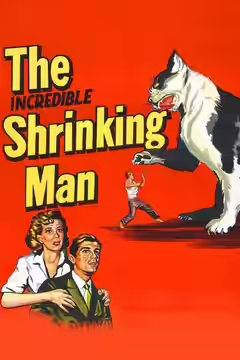
Jack Arnold makes a shrinking man’s predicament frightening and unexpectedly moving, with Grant Williams giving the effects a human purpose. It deserves more room for its awkward questions about masculinity, but we recommend it warmly.
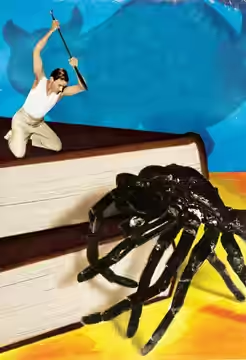
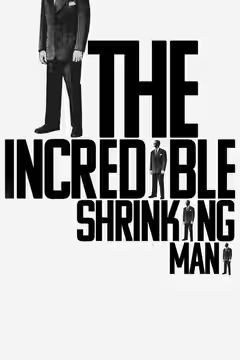
The Incredible Shrinking Man is an unusually affecting science-fiction film, with enough faith in its simple premise to make familiar surroundings frightening. Jack Arnold keeps our attention on Scott Carey, played by Grant Williams, as diminishing size threatens his sense of being somebody. The effects matter because we have to believe in the change before we can take his fears seriously. Across 81 minutes, the film makes that belief surprisingly easy, though the emotional consequences deserve a little more room.
Grant Williams gives Scott enough sensitivity to stop his predicament becoming merely an interesting technical problem. His fear of becoming insignificant is recognisable even when the physical circumstances are not, and the performance makes that fear worth staying with. We are allowed to care about a man who could easily have become an exhibit. That matters in a film whose most immediately striking achievement is making his body look different. Without this sensitivity, we could spend the whole film thinking about how the effects were done.
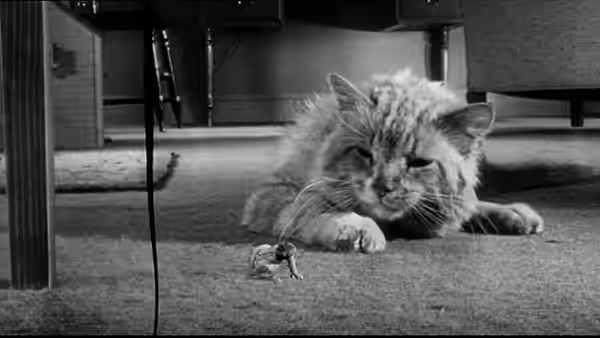
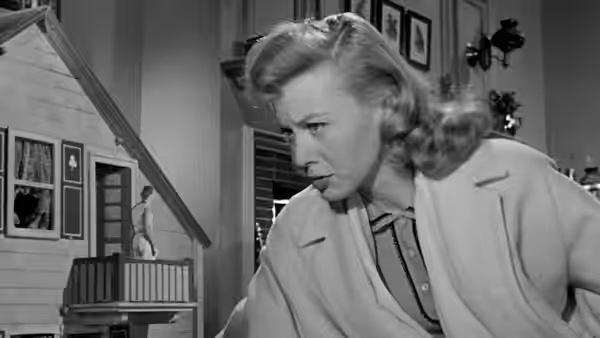
Ellis W. Carter’s cinematography makes the altered viewpoint clear without making the camera itself a distraction. Familiar domestic space becomes threatening because we are asked to consider it from Scott’s height, and Jack Arnold trusts that change to supply the unease. Practical and optical effects make that change of scale convincing enough that we spend little time mentally correcting the image. We felt an unwelcome shiver at the sight of a home becoming somewhere its occupant could no longer feel safe. Nothing needs to look particularly sinister for the effect to work.
The screenplay, credited to Richard Matheson and Richard Alan Simmons, leaves some of its most uncomfortable possibilities underexplored. A man becoming smaller raises awkward questions about authority, dependence and what he thinks makes him a man. We wanted the film to spend longer with those questions, particularly where other people are concerned. It understands Scott’s dread of irrelevance more fully than it examines the assumptions behind it.
Albrecht Joseph’s editing keeps this compact film from wearing out its central idea, without hurrying us past the unease. The music is credited to Hans J. Salter, Earl E. Lawrence, Irving Gertz and Herman Stein, and it supports the suspense without becoming the reason to remember it. We found the altered viewpoint more unsettling than the musical prompting. The running time is an advantage here: the film has room to develop its predicament without requiring an entire evening’s commitment.
Science fiction often asks us to accept a great deal of explanation before it lets us feel anything. This is a useful corrective for anyone who finds the genre’s machinery more tiring than exciting. Give Grant Williams a few minutes before deciding that the title has told you everything.