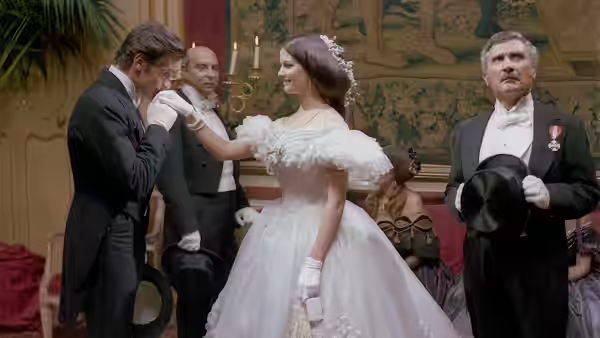
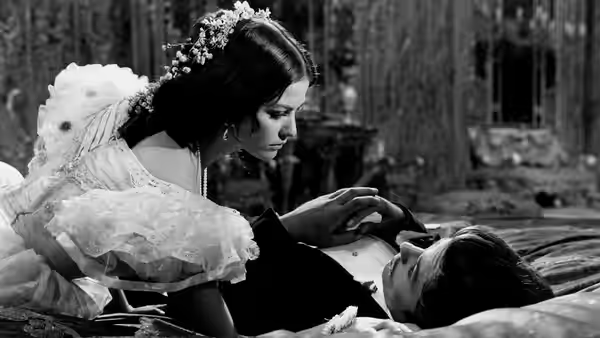
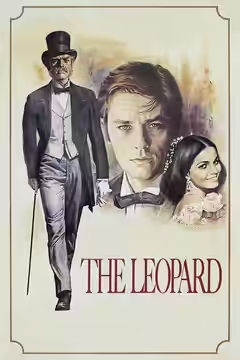
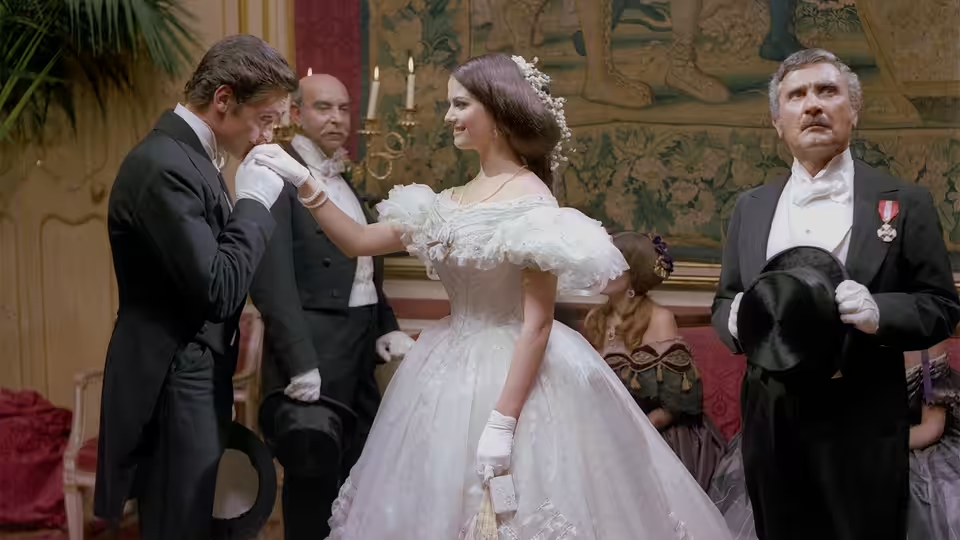
Angelica (Claudia Cardinale) dances in a white gown as Prince Fabrizio (Burt Lancaster) watches
Film review

The Leopard

1963 · Directed by Luchino Visconti · 3h 06m

In a sentenceSicily changes hands, and the Prince changes for dinner

Sicily, spring 1860. Prince Fabrizio Corbera of Salina (Burt Lancaster) is at evening prayers at his villa near Palermo when a servant finds a dead soldier in the garden: Garibaldi has landed. His nephew, Tancredi Falconeri (Alain Delon), rides off to join the rebels, telling his uncle that if they want things to stay as they are, things will have to change. Fabrizio wants his family and his estates to survive the upheaval; the new men in Palermo have other ideas. With his wife, Princess Maria Stella Corbera of Salina (Rina Morelli), and his confessor, Father Pirrone (Romolo Valli), he moves the household across the island to Donnafugata. There the new mayor, Don Calogero Sedara (Paolo Stoppa), has grown rich buying land, and his daughter Angelica Sedara (Claudia Cardinale) arrives late to dinner.

Fi1m review

Visconti’s three-hour film of Lampedusa’s novel is as good as its reputation, and Burt Lancaster’s Prince is the reason. It is slow in stretches that do not earn it and the Palermo fighting is a pageant, but the ball that closes it is worth the wait.

Luchino Visconti’s film of Giuseppe Tomasi Di Lampedusa’s novel opens in Sicily in the spring of 1860, with the household of Prince Fabrizio Corbera of Salina (Burt Lancaster) at their evening prayers while a servant finds a dead soldier in the garden. Garibaldi has landed. The Prince’s nephew Tancredi (Alain Delon) rides off to join the rebels, telling his uncle that if they want things to stay as they are, things will have to change. The Leopard is Visconti’s account of how an aristocracy survived the end of its world by marrying money and calling it patriotism. It is as good as its reputation, and it is long in ways that are not always earned. We recommend it warmly, with a comfortable chair; it runs 186 minutes.

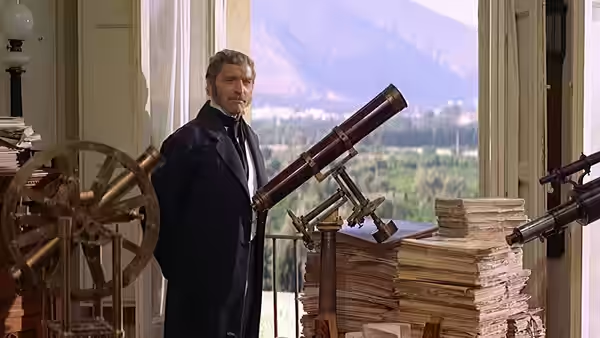
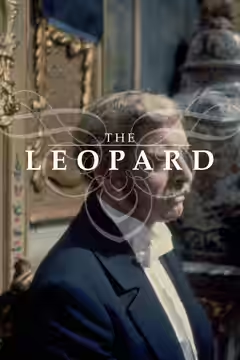
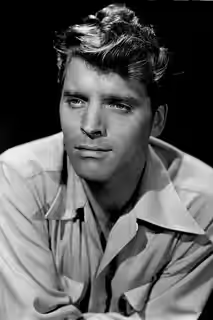
Lancaster is why it works. He was an odd choice on paper for a Sicilian prince, and he plays Fabrizio almost entirely through carriage: the way he fills a doorway, the way he lets a hand rest on a table while a lesser man talks. Watch him shaving while Tancredi talks politics behind him, or listening to Father Pirrone (Romolo Valli) fret about his soul in a carriage on the road to Palermo, where the Prince is going to see his mistress. He is amused, tired, and never in doubt of his own weight.

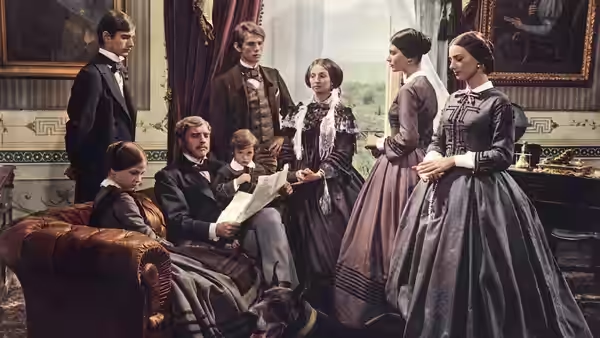
Giuseppe Rotunno shoots the island in widescreen as a country of dust and bleached stone, and he shoots the villa dark, shutters half closed against the heat, so the family seem to live in the gaps between bars of light. Mario Garbuglia’s rooms are full and slightly shabby, with the paint going on the ceilings. The scene that got us came sooner than we expected. The family cross the island to Donnafugata and go straight from the carriages into the church, and they sit in a row grey from head to foot with road dust while the townspeople stare. They look like the effigies on their own tombs. Nobody says so, and Visconti holds the shot long enough that nobody needs to.

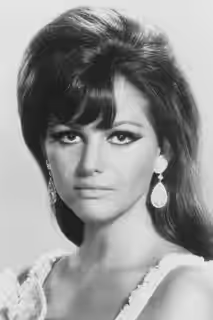
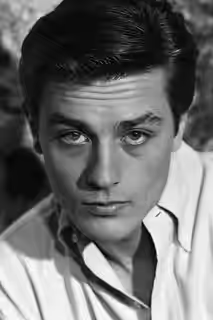
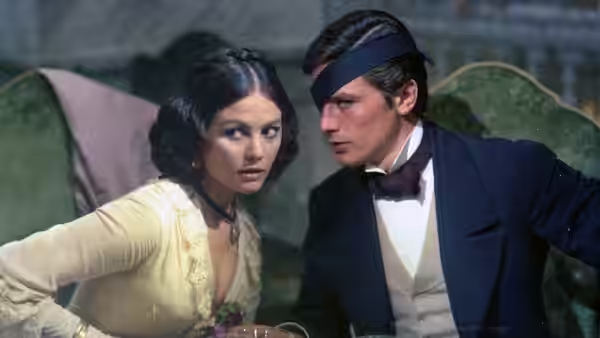
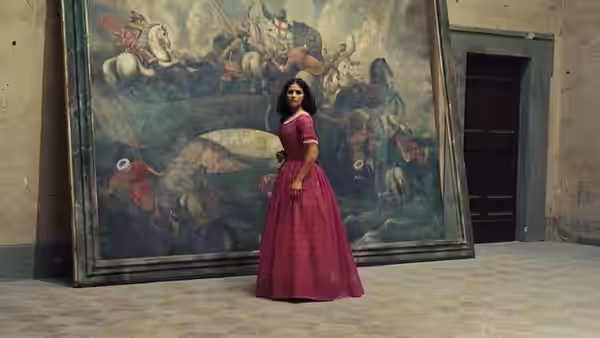
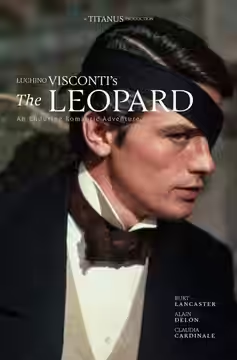
Delon’s Tancredi is charm with nothing behind it, and Delon knows it: the smile arrives a half-second before any feeling would. Claudia Cardinale enters as Angelica in a dress Piero Tosi has cut a little too grand for a country dinner, and she laughs at a coarse story of Tancredi’s with a loud, open laugh that stops the table. Concetta (Lucilla Morlacchi), the Prince’s daughter, who loves Tancredi, watches it happen. Paolo Stoppa is the best of the supporting cast as Don Calogero, who turns up in tails when everyone else is in ordinary dress and cannot understand why the footmen are smiling. He is a small greedy man, and the only person in the film who works.

The last hour is a ball in a Palermo palace, and it is the sequence everyone talks about, rightly. Visconti runs it at the speed of a real party: arrivals, introductions, girls shrieking on a sofa, old men asleep in chairs, the Prince drifting from room to room. Mario Serandrei cuts it slowly and lets Nino Rota’s waltzes play out at full length, and Rotunno lights the gilt so it glows while the faces sweat. We were moved more than we expected by a shot of Lancaster alone in a library, looking at a painting of a deathbed and then at himself in a glass. Nothing has happened to him. He has understood something, and Lancaster lets us watch it arrive.

Not all of it is at that level. The street fighting in Palermo early on is staged like a costume pageant, extras falling in tidy groups while Giuliano Gemma’s general addresses the camera. The middle stretch at Donnafugata, taking in a plebiscite, a hunting trip and a long wait for a letter, is where the length tells, and for twenty minutes we were admiring the wallpaper. Rina Morelli’s Princess is given prayer and tears and little else. Five writers are credited, Visconti among them, and the film sometimes says a thing twice.

Visconti had made angrier films about the poor and would make more morbid ones about the rich. This is the one where his politics and his taste are in the same room and agree, and we think it is his best. Watch it in Italian with subtitles if you can, and in one sitting: the ball only lands on someone who has already been up all night with the Prince.
Critical consensus AI synthesised

79
Positive
9
Mixed
2
Negative
1
Time Out
24 August 2010 · ★★★★★ · Trevor Johnston
100

The review presents Visconti’s saga as an exceptionally beautiful film. It singles out the experience of being immersed in its depiction of Sicilian aristocracy amid mid-century upheaval.

Read the full review →
Total Film
9 August 2010 · ★★★★★ · Philip Kemp
100

Kemp presents the film as an elegiac masterpiece about a society in decline. He praises its opulent widescreen presentation and Burt Lancaster’s patrician performance.

Read the full review →
The Guardian
26 August 2010 · Peter Bradshaw
90*

Bradshaw praises the film as a rich, gorgeous historical epic whose restored version shows it in sumptuous glory. He singles out the magnificent extended ballroom scene as its crowning achievement.

Read the full review →
The Independent
3 May 2003 · Jonathan Romney
90*

Romney praises the film as an ambitious, visually opulent requiem for a vanishing world. He singles out the ball sequence, whose vivid colors and choreography make history’s passing palpable.

Read the full review →
Empire
1 January 2000 · Kim Newman
85*

Newman regards the film as a magnificent, truly special epic, despite its deliberate pace and occasional lack of clarity. He singles out Burt Lancaster’s commanding portrayal of the Don as its heart.

Read the full review →
Los Angeles Times
27 June 2010 · Sam Adams
85*

Adams presents the film as a richly ambivalent portrait of aristocratic decline, delivered with grandeur and emotional force. He especially praises Burt Lancaster’s expressive physical performance and the opulent ball sequence.

Read the full review →

Straight answers AI written, from our review

Is The Leopard worth watching?
The Leopard is worth watching for anyone with a spare evening and a comfortable chair, and we scored it 88. Burt Lancaster's Prince carries all 186 minutes, and the ball that closes the film is worth the wait. The middle stretch at Donnafugata is slow in ways it does not earn, so it is not for the impatient.
How long is The Leopard, and what is it rated?
The Leopard runs 3h 06m. It is a drama film.
Where can I watch The Leopard in Hungary?
The Leopard is not on any streaming or rental service in Hungary at the moment. It is available in 18 other countries; change your country at the top of the page to see where. Availability is checked daily.
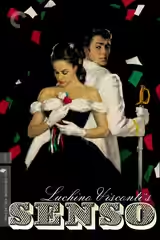
How does The Leopard compare to Senso?
The Leopard is the larger and, we think, the better of Visconti's two Risorgimento films, with Senso the smaller and nastier. Both are beautifully dressed and both are about people who take their own desires too seriously. Senso is the tighter of the two and its central attraction is underexplained; The Leopard has Lancaster, and that decides it for us.
Is The Leopard based on a true story or a book?
The Leopard is based on the novel by Giuseppe Tomasi Di Lampedusa, set against the real events of Garibaldi's landing in Sicily in 1860. The Prince and his household are fiction; the upheaval around them is history. You do not need to have read the book, though five writers are credited and the film sometimes says a thing twice.
What should I watch after The Leopard?
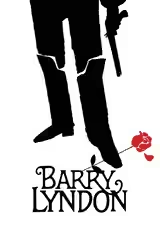
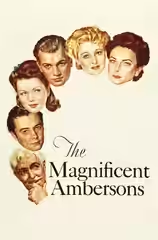
After The Leopard, try Senso (1954, Fi1m 79): Visconti’s earlier Risorgimento story, smaller, nastier and just as beautifully dressed. Then Barry Lyndon (1975, Fi1m 85): Kubrick’s candlelit climb through eighteenth-century society, with the same patience and a colder eye; and The Magnificent Ambersons (1942, Fi1m 89): Welles on an American family that does not notice the town has moved on without them.

Cast

Awards

Academy Awards, 1964

Nominated
Best Costume Design, Color

Cannes Film Festival, 1963

Won
Palme d'Or

If you liked this, try…

  1. Senso (1954, Fi1m 79)Visconti’s earlier Risorgimento story, smaller, nastier and just as beautifully dressed.

  2. Barry Lyndon (1975, Fi1m 85)Kubrick’s candlelit climb through eighteenth-century society, with the same patience and a colder eye.

  3. The Magnificent Ambersons (1942, Fi1m 89)Welles on an American family that does not notice the town has moved on without them.

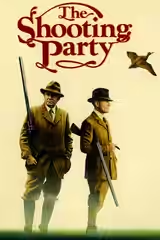
  4. The Shooting Party (1985) · not on Fi1m yetEnglish gentry in 1913, one last weekend, and James Mason knowing exactly what is coming.

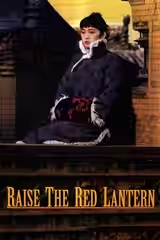
  5. Raise the Red Lantern (1991, Fi1m 91)A great house run on ritual, filmed by Zhang Yimou as a slow, exquisite trap.